 Qubit Zoo
Figure
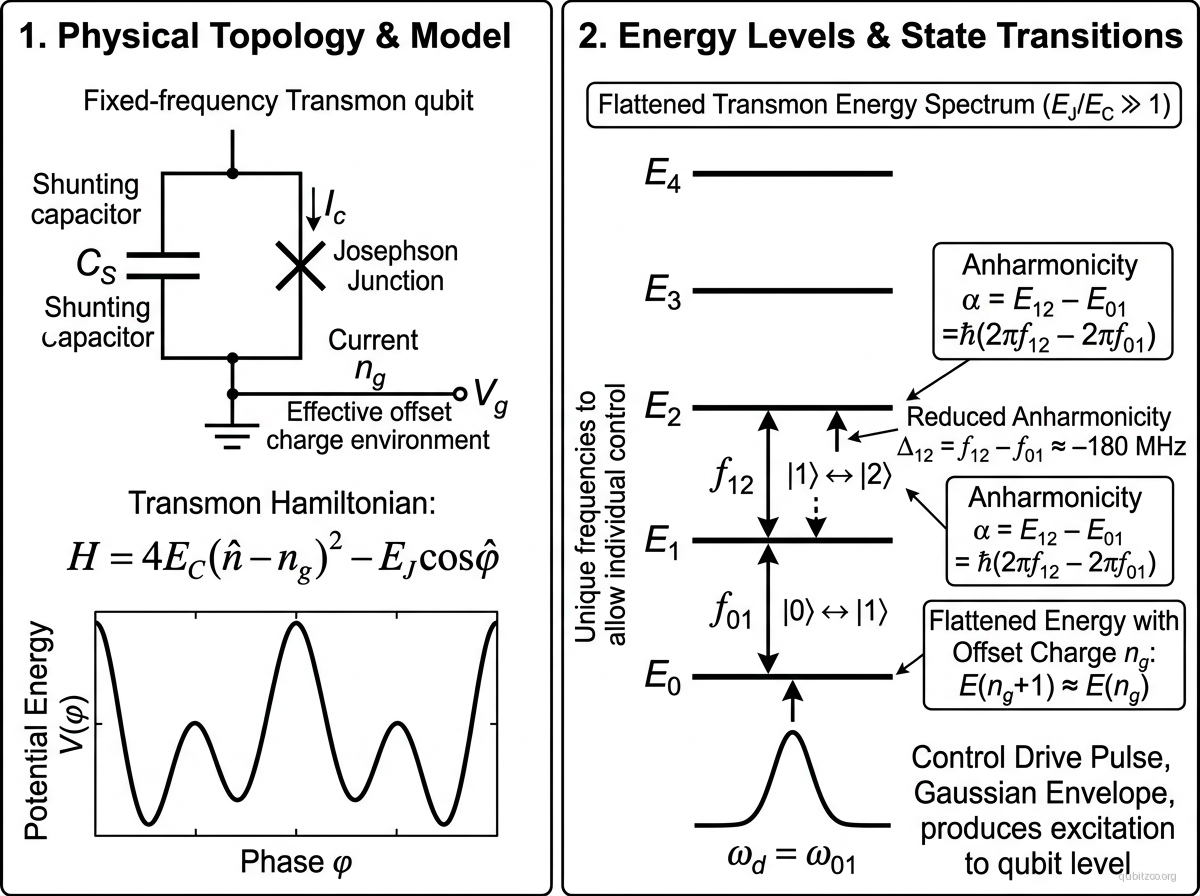
Description
The transmon (short for “transmission-line shunted plasma oscillation qubit”) is a superconducting charge qubit derived from the Cooper pair box by dramatically increasing the ratio . Koch et al. (2007) showed that operating at (vs. for the CPB) exponentially suppresses charge dispersion — the sensitivity of transition frequencies to offset charge — while reducing anharmonicity only as a weak power law. This tradeoff is the central design insight: charge noise immunity improves exponentially while the penalty in anharmonicity is manageable.
The large ratio is achieved by shunting the Josephson junction with a large external capacitance (typically an interdigitated or pad capacitor). The qubit transition frequency is set by lithographic design, and the anharmonicity is typically to — small compared to the transition frequency () but large enough for selective microwave control.
The transmon is almost always operated inside a circuit QED architecture: coupled to a coplanar waveguide or 3D cavity resonator for dispersive readout and Purcell-filtered spontaneous emission suppression. It is the dominant qubit modality in current superconducting quantum processors (IBM, Google, Rigetti, IQM, OQC).
Hamiltonian
The full transmon Hamiltonian is identical to the Cooper pair box:
where is the charging energy, is the Josephson energy, is the Cooper pair number operator, is the offset charge, and is the superconducting phase.
In the transmon regime (), the charge dispersion of the -th level scales as:
while the anharmonicity decreases only algebraically:
The energy levels approach those of a weakly anharmonic oscillator (Duffing oscillator):
Motivation
The Cooper pair box suffered from extreme sensitivity to charge noise, limiting to nanoseconds away from the charge degeneracy point. Active feedback to maintain was impractical at scale. The transmon eliminates this problem by operating in a regime where the transition frequency is essentially flat as a function of , enabling “set and forget” operation with coherence limited by other mechanisms (dielectric loss, quasiparticles, radiation).
Experimental Status
Original proposal and demonstration — Koch et al. (2007):
- Showed charge dispersion at (negligible vs. linewidths)
- Anharmonicity sufficient for selective microwave control
- Demonstrated dispersive readout via circuit QED
- Compatible with fixed-frequency (no flux noise) or tunable (split-junction SQUID) variants
Scaling milestones:
- Schreier et al. (2008): First experimental demonstration, in 2D CPW geometry
- Paik et al. (2011): 3D transmon in aluminum cavity,
- Barends et al. (2014): Google Xmon variant, gate fidelities >99.4% (1Q) and >99.0% (2Q)
- Arute et al. (2019): Google Sycamore, 53-qubit quantum computational advantage demonstration
- Place et al. (2021): Tantalum-based transmon, in planar geometry
- Google Willow (2024): 105-qubit processor, below-threshold surface code error correction, 2Q CZ fidelity 99.7–99.85%
- Tuokkola et al. (2025): Aalto University, first transmon to break the millisecond coherence barrier — (record), median , quality factor ; planar geometry fabricated in academic cleanrooms
- Bland et al. (2025): Princeton, tantalum-on-high-resistivity-silicon 2D transmon — up to , time-averaged up to ; 1Q gate fidelity 99.994%; mean across 45 qubits on 9 chips
- IQM (2025): Record 2Q CZ fidelity of 99.95% (max) / 99.93% (40-hour averaged), 1Q fidelity >99.98%, simultaneous readout fidelity 99.94%; achieved via the PALEA leakage reduction protocol
State-of-the-art (as of late 2025): up to (planar, tantalum on silicon), up to ; 1Q gate fidelity up to 99.9926% (Z. Li et al. 2023); 2Q CZ fidelity up to 99.95% (IQM 2025).
Key Metrics
| Metric | Value | Notes | Fidelity reference |
|---|---|---|---|
| 100 μs – 1.68 ms | Typical planar: ~100–500 μs; SOTA planar (Ta on Si): 1.68 ms | Bland et al. 2025 | |
| (echo) | 100 μs – 1.06 ms | Often with echo; SOTA 1.06 ms | Tuokkola et al. 2025 |
| Anharmonicity | −200 to −350 MHz | Koch et al. 2007 | |
| 20–100 | Typical operating regime | Koch et al. 2007 | |
| 1Q gate fidelity | 99.9–99.99% | RB; SOTA 99.9926% (error 7.42 × 10⁻⁵) | Z. Li et al. 2023 |
| 2Q gate fidelity (CZ/CR) | 99.0–99.95% | Tunable coupler or cross-resonance; IQM SOTA 99.95% (max), 99.93% (40-hr avg) | IQM 2025 |
| Readout fidelity | 97–99.9% | Dispersive, with Purcell filter + JPA | Arute et al. 2019 |
| Gate time (1Q) | 20–50 ns | DRAG pulse | — |
| Gate time (2Q) | 100–400 ns | Depends on gate scheme | — |
| Transition frequency | 4–6 GHz | Design-tunable | — |
| Operating temperature | 10–20 mK | Dilution refrigerator | — |
| Chip footprint per qubit | ~300 μm × 300 μm | Pad + junction + readout resonator | — |
Scaling Considerations
- Frequency crowding: as qubit count grows, avoiding spectral collisions between qubits, readout resonators, and two-level system (TLS) defects becomes exponentially harder. This is a primary challenge for large-scale fixed-frequency transmon arrays.
- Low anharmonicity: the anharmonicity, while sufficient for current gate speeds, causes persistent leakage to and higher levels at faster gate rates. Competitors like fluxonium offer higher anharmonicity.
- TLS defect losses: two-level system defects at material interfaces (metal–substrate, metal–air, substrate–air) are the dominant source of variability and the primary obstacle to uniform coherence across large arrays.
- Quasiparticle poisoning: nonequilibrium quasiparticles limit and cause parity switching events. Mitigation strategies (normal-metal traps, phonon engineering) are active areas of research.
- Residual ZZ coupling: always-on parasitic interaction between neighboring transmons is a significant source of correlated errors in multi-qubit systems, requiring careful frequency allocation or dynamical decoupling.
- Cryogenic I/O overhead: each qubit requires dedicated microwave control and readout lines routed to the 10–20 mK stage of a dilution refrigerator (\sim \500\text{K}+10^4+$ qubits demands multiplexing, cryo-CMOS control, or photonic interconnects.
References
Original proposal
- J. Koch et al., “Charge-insensitive qubit design derived from the Cooper pair box,” PRA 76, 042319 (2007) — arXiv:cond-mat/0703002
Key experimental milestones
- J. A. Schreier et al., “Suppressing charge noise decoherence in superconducting charge qubits,” PRB 77, 180502(R) (2008) — first experimental transmon
- H. Paik et al., “Observation of high coherence in Josephson junction qubits measured in a three-dimensional circuit QED architecture,” PRL 107, 240501 (2011) — 3D transmon
- R. Barends et al., “Superconducting quantum circuits at the surface code threshold for fault tolerance,” Nature 508, 500 (2014) — Xmon, surface code threshold
- F. Arute et al., “Quantum supremacy using a programmable superconducting processor,” Nature 574, 505 (2019) — Sycamore, 53 qubits
- A. P. M. Place et al., “New material platform for superconducting transmon qubits with coherence times exceeding 0.3 milliseconds,” Nature Commun. 12, 1779 (2021) — tantalum transmon
- Google Quantum AI, “Quantum error correction below the surface code threshold,” Nature 638, 920 (2024) — Willow, 105 qubits
- M. Tuokkola et al., “Methods to achieve near-millisecond energy relaxation and dephasing times for a superconducting transmon qubit,” Nature Commun. 16, 5421 (2025) — arXiv:2407.18778 — first ms-scale T₂ in transmon
- M. P. Bland et al., “Millisecond lifetimes and coherence times in 2D transmon qubits,” Nature 647, 343 (2025) — arXiv:2503.14798 — Ta-on-Si, T₁ up to 1.68 ms
Gate optimization
- F. Motzoi et al., “Simple pulses for elimination of leakage in weakly nonlinear qubits,” PRL 103, 110501 (2009) — DRAG pulse
- Z. Li et al., “Error per single-qubit gate below 10⁻⁴ in a superconducting qubit,” npj Quantum Info. 9, 111 (2023) — arXiv:2302.08690 — SOTA 1Q error rate 7.42 × 10⁻⁵ (fidelity 99.9926%)
Linked Papers
- koch-2007-transmon
- acharya-2025-error-correction-below
- arute-2019-supremacy-programmable-superconducting
- barends-2013-xmon
- barends-2014-superconducting-circuits-surface
- bland-2025-millisecond-lifetimes-coherence
- campbell-2020-composite-qubit
- casparis-2018-ge-gatemon
- chen-2014-gmon
- divincenzo-2000-physical-implementation
- fowler-2012-surface-code-roadmap
- larsen-2015-gatemon
- levine-2024-dual-rail-erasure
- li-2023-error-per-single
- madon-2021-mergemon
- motzoi-2009-simple-pulses-elimination
- nakamura-1999-cpb-coherent-oscillation
- paik-2011-observation-high-coherence
- place-2021-material-platform-superconducting
- purkayastha-2025-sn-inas-gatemon
- schreier-2008-suppressing-charge-noise
- sun-2026-junction-intrinsic-dissipation-in-hybrid
- sung-2021-parametric-coupler
- tuokkola-2025-methods-achieve-near
- walter-2017-rapid-readout
- yan-2018-tunable-coupler
- zhao-2020-mergemon
- wu-2026-demonstrating-advantages-of-dynamic
- lu-2026-dynamically-suppressing-cavity-dephasing
- qiao-2026-transducer-leakage-error-suppression
- wysocki-2026-detailed-interpretable-characterization-of
- li-2026-high-fidelity-control-of
- salmanogli-2026-a-unified-quantum-neural
- yang-2026-the-gain-engineered-transmon
- direkci-2026-dissipatively-stabilized-0-n-fock
- spring-2026-low-leakage-superconducting-qubit-measurement
- zhou-2026-superconducting-flux-memory-for
- fontaine-2026-programming-anharmonic-potentials-in
- luca-2026-implementation-of-quantum-gates
- lyngfelt-2026-analog-quantum-simulation-of
- guan-2026-mitigating-capacitive-loading-enables
- lisenfeld-2026-readout-failures-in-superconducting
- kubo-2026-instantaneous-frame-theory-of-strongly
- gohar-2026-the-halo-engine-mathcal-o-1-step
- liu-2026-two-qubit-gates-for-the
- kang-2026-quantum-simulation-of-two-dimensional
- geisert-2026-parametric-two-qubit-gates-via
- park-2026-an-all-van-der-waals-qubit
- heunisch-2026-analytic-leakage-suppression-with
- hajr-2026-dynamically-protected-erasure-qubit
- haug-2026-a-quasiparticle-protected-superconducting-qubit
Evergreen context
- charge-noise-in-superconducting-qubits — why the transmon exists at all
- charge-noise-sweet-spot — the design pattern behind large-
E_J/E_Coperation - josephson-junction-as-nonlinear-element — the circuit element that provides the weak anharmonicity
- coherence-time-hierarchy — how to interpret the
T_1,T_2, and echo numbers in the metrics table - jaynes-cummings-in-circuits — the transmon usually enters circuit QED through the same one-qubit, one-mode interaction that later gets reduced into dispersive readout and cavity-mediated coupling pictures
- dispersive-readout-mechanism — the cQED readout architecture that let the transmon replace destructive tunneling-style superconducting measurements
- purcell-protection-via-detuning — why transmons are usually parked far enough from their readout resonators, and then paired with Purcell filters, to keep fast measurement from quietly shortening
Related Entries
- cooper-pair-box-charge-qubit — ancestor (charge-sensitive limit)
- circuit-qed — readout and coupling architecture
- fluxonium — alternative SC qubit with higher anharmonicity
- xmon — planar transmon variant (Google)
- gmon — tunable-coupler transmon variant (Google)
- dual-rail-superconducting-qubit — encoded transmon-pair qubit