 Qubit Zoo
Figure
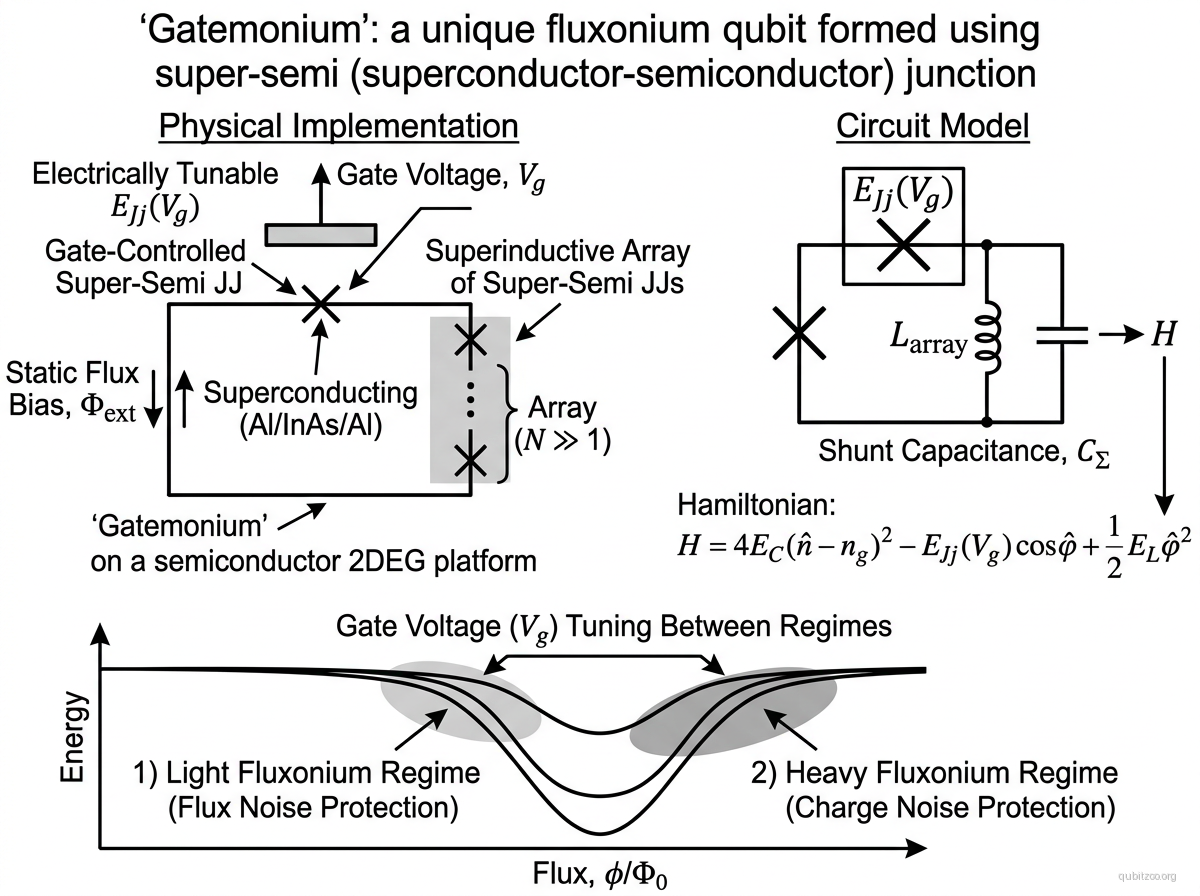
Description
Gatemonium is a hybrid superconductor-semiconductor fluxonium qubit in which both the small Josephson junction and the superinductive shunt array are realized as planar Al/InAs junctions on a two-dimensional-electron-gas (2DEG) platform. A top gate tunes the small junction; the array supplies the large linear inductance. The name reflects its parentage: a gatemon (gate-voltage-tunable transmon) crossed with the fluxonium architecture (small junction shunted by a superinductance).
The key innovation is that the Josephson energy of the small junction can be tuned continuously by a gate voltage , without using a SQUID flux to tune . The fluxonium loop still requires an external flux bias to select its operating point. Independent electrical control of lets one device move between different fluxonium regimes while remaining at a chosen flux sweet spot:
- Light fluxonium ( in the convention used by Strickland et al.): the Josephson corrugation is weak, the low spectrum approaches a single harmonic well, and transition frequencies become comparatively flat with external flux, suppressing flux-noise dephasing.
- Heavy fluxonium (): deep Josephson wells form near half flux and the charge-number matrix element can become small, suppressing dielectric-loss-induced bit flips. This is not simultaneous protection from every charge- and flux-noise channel.
The superinductance is achieved using approximately 600 planar Al-InAs Josephson junctions in series, each with large critical current so they behave as linear inductors. The 2DEG platform offers advantages over nanowire-based gatemons, including the ability to fabricate large junction arrays with controlled parameters.
Hamiltonian
with the sinusoidal weak-link approximation
where:
- is the charging energy
- is the gate-voltage-tunable Josephson energy of the single junction
- is the inductive energy from the superinductive shunt
- is the Cooper pair number operator conjugate to
- is the reduced external flux through the loop
This is the standard single-mode fluxonium Hamiltonian with a gate-dependent junction potential. A static offset charge does not appear as a physical control parameter in this ideal model: because the superinductor makes the phase coordinate noncompact, a term is unitarily gauge-equivalent to the expression above. At half-flux-quantum bias, ; equivalent phase-origin conventions can move this offset from the inductive term into the Josephson term, but it must appear exactly once.
For a short semiconductor junction with channel transparencies , the spectroscopic model instead uses an Andreev weak-link potential of the form
which captures the nonsinusoidal current-phase relation and reduces to the cosine model in the many-channel, low-transparency limit.
Motivation
- Enables electrical tuning of without a SQUID-control flux, reducing one source of magnetic crosstalk while retaining the ordinary fluxonium loop bias.
- Allows in-situ exploration of different fluxonium parameter regimes (light vs. heavy) on the same device by adjusting gate voltage.
- The 2DEG platform supports fabrication of large junction arrays with more uniform parameters than nanowire-based approaches.
- Potential path to enhanced coherence times through hybridization of fluxon and plasmon modes, and through high-plasma-frequency junction arrays.
- Demonstrates the viability of an all-superconductor-semiconductor platform for complex superconducting qubit circuits beyond the simple gatemon.
Experimental Status
First demonstration — Strickland et al. (2024 preprint; 2025 peer-reviewed publication):
- Fabricated Device A with 600 planar Al-InAs Josephson junctions in series for the superinductance; Device B used 400.
- Demonstrated electrostatic control of effective Josephson energy via gate voltage on the single junction.
- Performed one- and two-tone spectroscopy revealing the hybrid plasmon-fluxon spectrum.
- Extracted charging and inductive energies by fitting measured spectra with a model accounting for nonsinusoidal current-phase relation.
- Demonstrated Rabi oscillations of a heavy-regime plasmon mode and measured ns in Device B; the inferred indicates dominant inductive loss, plausibly associated with the thin aluminum film.
Related gate-tunable-fluxonium milestone — Isakov et al. (2026 preprint):
- Used a gate-tunable semiconductor junction in a nanowire fluxonium to realize a drive-induced flux-charge interaction.
- Demonstrated coherent control of the even-parity transition at half flux through gate modulation, where a purely capacitive drive is parity-forbidden.
- Identified a charge-insensitive-with-variable- (ChIVE) operating point: the transition is first-order insensitive to gate-voltage noise while the flux-charge coupling remains finite. This is a related architecture rather than the same all-planar Al/InAs-array device.
Key Metrics
| Metric | Value | Notes | Fidelity reference |
|---|---|---|---|
| Heavy-regime plasmon | ns | Device B near 6.35 GHz; inferred and inductive-loss limitation | Strickland et al. 2025 |
| Rabi-envelope decay | ns | Device B plasmon mode; this is not a Ramsey measurement | Strickland et al. 2025 |
| Fitted effective range | approximately 6–50 GHz | Device A, from gate-dependent spectroscopy with a nonsinusoidal weak-link model | Strickland et al. 2025 |
| Junction-array size | 600 (Device A); 400 (Device B) | Planar Al-InAs junctions in series | Strickland et al. 2025 |
| Inductive energy | 2.80 GHz (A); 4.97 GHz (B) | Spectroscopic fits | Strickland et al. 2025 |
| Base temperature | 12 mK | Cryogen-free dilution refrigerator | Strickland et al. 2025 |
References
Original demonstration
- W. M. Strickland, B. H. Elfeky, L. Baker, A. Maiani, J. Lee, I. Levy, J. Issokson, A. Vrajitoarea, and J. Shabani, “Gatemonium: A Voltage-Tunable Fluxonium,” PRX Quantum 6, 010326 (2025); arXiv:2406.09002
Related gate-tunable fluxonium control
- B. D. Isakov, S. Singh, A. Parra-Rodriguez, D. Feldstein-Bofill, Z. Sun, A. Kringhøj, S. Krøjer, A. Blais, M. Kjaergaard, and A. Gyenis, “Observation of coherent flux-charge interaction in a gate-tunable fluxonium,” arXiv:2607.07798 (2026)
Related fluxonium theory
- V. E. Manucharyan, J. Koch, L. I. Glazman, and M. H. Devoret, “Fluxonium: Single Cooper-Pair Circuit Free of Charge Offsets,” Science 326, 113 (2009)
- A. Somoroff, Q. Ficheux, R. A. Mencia, H. Xiong, R. V. Kuzmin, and V. E. Manucharyan, “Millisecond Coherence in a Superconducting Qubit,” Phys. Rev. Lett. 130, 267001 (2023)
Related gatemon work
- L. Casparis, M. R. Connolly, M. Kjaergaard, N. J. Pearson, A. Kringhøj, T. W. Larsen, F. Kuemmeth, T. Wang, C. Thomas, S. Gronin, G. C. Gardner, M. J. Manfra, C. M. Marcus, and K. D. Petersson, “Superconducting gatemon qubit based on a proximitized two-dimensional electron gas,” Nat. Nanotechnol. 13, 915 (2018)
Linked Papers
- strickland-2024-gatemonium
- isakov-2026-coherent-flux-charge-interaction
- manucharyan-2009-fluxonium
- somoroff-2023-millisecond-coherence-superconducting
- casparis-2018-ge-gatemon
Evergreen context
- josephson-junction-as-nonlinear-element — gatemonium swaps the fixed tunnel junction for a gate-tunable semiconductor weak link.
- cos2phi — the weak link’s nonsinusoidal current-phase relation makes gatemonium a useful bridge note for when higher-harmonic Josephson physics starts to matter inside an otherwise fluxonium-like circuit.
- charge-noise-in-superconducting-qubits — gate-voltage noise modulates the semiconductor weak link, while fluxonium matrix elements and sweet spots determine how strongly that noise reaches a chosen transition.
- charge-noise-sweet-spot — a gate-tunable fluxonium can reach transition-frequency extrema with respect to , including the ChIVE mechanism demonstrated in 2026.
- quantum-hardware — it is a useful bridge note for how a super-semi platform can inherit the superconducting control stack while opening a new materials-design axis.
Related Entries
- gatemon — parent device (gate-tunable transmon, no superinductance)
- fluxonium — inductive shunt ancestor with oxide junctions
- transmon — capacitive shunt cousin
- andreev-spin-qubit — shares the Al/InAs material platform
- all-semiconductor-superconducting-qubit — umbrella entry for circuits built entirely from semiconductor weak links
- mergemon — related multi-junction semiconductor-superconductor qubit architecture
- cos2phi-qubit — another protected superconducting qubit with superinductance
- flux-qubit — related persistent-current qubit