 Qubit Zoo
Figure
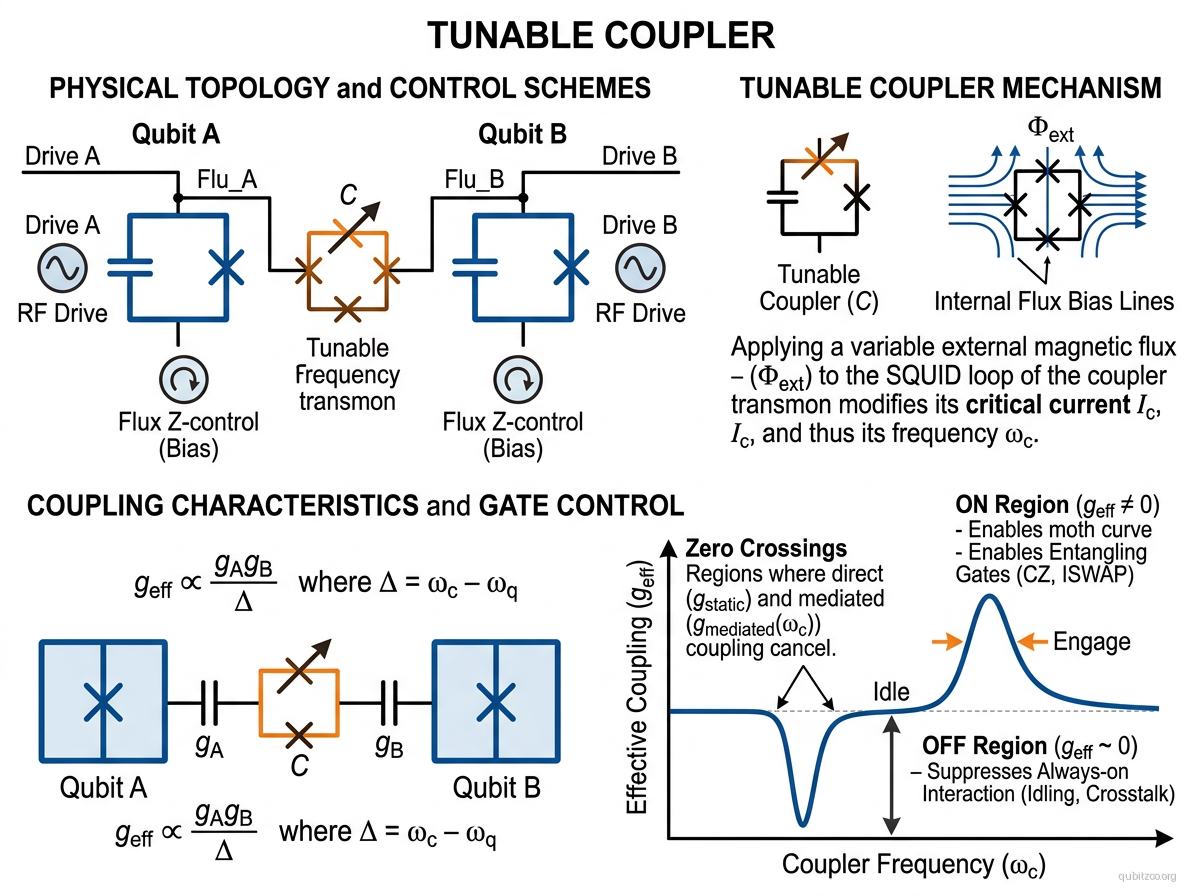
Description
A tunable coupler is a superconducting coupling element — typically a frequency-tunable transmon or a flux-tunable resonator — placed between two computational qubits to enable fast, high-fidelity ON/OFF switching of qubit-qubit interactions. By modulating the coupler’s frequency via an external flux bias, the effective coupling between the computational qubits can be tuned from a large value (ON, enabling fast entangling gates) to near zero (OFF, suppressing unwanted always-on crosstalk during idle periods).
The coupler mediates the interaction between qubits through virtual excitation exchange: when the coupler frequency is far detuned from both qubits, it mediates a second-order coupling. The direct capacitive coupling between qubits and the coupler-mediated coupling have opposite signs, and at a specific coupler frequency they cancel exactly, yielding . This zero-coupling condition is the key innovation — it enables idling with negligible crosstalk.
Two-qubit gates (CZ, iSWAP, or ) are implemented by briefly tuning the coupler to activate the interaction, performing a controlled phase accumulation or excitation swap, then returning to the OFF point. Gate times of 10–60 ns have been demonstrated with fidelities exceeding 99.5%.
Tunable couplers are the enabling technology behind Google’s Sycamore (2019) and Willow (2024) processors, and IBM’s Heron architecture.
Hamiltonian
The system of two qubits (, ) coupled via a tunable coupler () has the Hamiltonian:
where are the bare capacitive couplings. Adiabatic elimination of the coupler (valid when ) gives an effective qubit-qubit coupling:
The zero-coupling condition is satisfied when the coupler-mediated term exactly cancels the direct coupling . This occurs at a specific coupler frequency .
The residual interaction at the OFF point is:
which can be tuned below at the zero-coupling point.
Motivation
Fixed-frequency transmon qubits coupled by fixed capacitors suffer from always-on coupling () that accumulates correlated phase errors during idle time. Frequency-tunable qubits can reduce this but introduce flux-noise sensitivity. The tunable coupler resolves this tradeoff: the computational qubits can remain at fixed (or nearly fixed) frequencies, preserving their coherence, while the coupler provides the dynamic control needed for entangling gates and idle isolation. This enables simultaneous high coherence, fast gates, and low crosstalk — the three requirements for scalable superconducting quantum processors.
Experimental Status
First tunable-coupler demonstration — Yan et al. (2018):
- Demonstrated ON/OFF coupling ratio >1000 with CZ gate fidelity 99.1%.
- Showed that coupler-mediated and direct coupling can be made to cancel at a specific coupler frequency.
- Established the tunable-coupler paradigm for high-fidelity two-qubit gates.
High-fidelity CZ gates — Sung et al. (2021):
- Achieved CZ gate fidelity of 99.76% with 60 ns gate time using parametric modulation of the coupler.
- Demonstrated -free iSWAP gates on the same platform.
Google Sycamore — Arute et al. (2019):
- 53-qubit processor with tunable couplers for 86 qubit pairs.
- Median CZ fidelity 99.4% via randomized benchmarking.
Google Willow — Google Quantum AI (2025):
- Improved to 99.7–99.85% median CZ fidelity.
- Enabled below-threshold surface code operation.
IBM Heron (2024):
- IBM adopted tunable couplers after transitioning from fixed-coupling cross-resonance gates.
- Achieved 99.5% two-qubit gate fidelity.
Key Metrics
| Metric | Value | Notes | Fidelity reference |
|---|---|---|---|
| ON/OFF coupling ratio | >1000:1 | Yan et al. 2018 | |
| CZ gate fidelity | 99.5–99.85% | Randomized benchmarking; Willow SOTA | Google Quantum AI 2025 |
| iSWAP gate fidelity | 99.5–99.7% | Used in Sycamore-type circuits | Arute et al. 2019 |
| Gate time (2Q) | 10–60 ns | Coupler-activated CZ or iSWAP | Sung et al. 2021 |
| Residual at OFF | <10 kHz | At zero-coupling operating point | Yan et al. 2018 |
| Coupler frequency range | 4–8 GHz | Flux-tunable, typically above qubit frequencies | Yan et al. 2018 |
| Coupler | 5–20 μs | Shorter than qubits; not a computational element | — |
| Operating temperature | 10–20 mK | Dilution refrigerator | — |
References
Original proposal and demonstration
- F. Yan et al., “Tunable Coupling Scheme for Implementing High-Fidelity Two-Qubit Gates,” Phys. Rev. Applied 10, 054062 (2018)
High-fidelity implementations
- Y. Sung et al., “Realization of High-Fidelity CZ and ZZ-Free iSWAP Gates with a Tunable Coupler,” Phys. Rev. X 11, 021058 (2021)
- F. Arute et al., “Quantum supremacy using a programmable superconducting processor,” Nature 574, 505 (2019)
- Google Quantum AI, “Quantum error correction below the surface code threshold,” Nature 638, 920 (2025)
Linked Papers
- yan-2018-tunable-coupler
- sung-2021-parametric-coupler
- acharya-2025-error-correction-below
- arute-2019-supremacy-programmable-superconducting
- barends-2013-xmon
- guo-2026-entangling-superconducting-qubits-via
- jin-2026-a-double-resonator-coupler-for
- xu-2026-remote-adiabatic-controlled-z-gate
Evergreen context
- charge-noise-sweet-spot — tunable couplers are one answer to the fixed-frequency dilemma: leave the data qubits near their best operating points, and localize flux sensitivity in a sacrificial interaction element instead.
- josephson-junction-as-nonlinear-element — the coupler works because a Josephson element makes its effective inductance, and therefore the mediated interaction, flux-tunable and nonlinear.
- resonator-as-quantum-bus — the tunable coupler solves the same architectural problem as the old shared-bus picture, but upgrades it with an explicit idle OFF point instead of living with a permanently-on residual interaction budget.
- threshold-theorem — the zero-coupling idle point matters as much as the fast ON state, because correlated idle errors and residual are exactly the terms that can quietly erase a below-threshold margin.
Related Entries
- transmon — primary qubit type used with tunable couplers
- gmon — Google’s qubit-plus-coupler architecture
- circuit-qed — measurement and readout framework
- fluxonium — alternative qubit with tunable-coupler compatibility