 Qubit Zoo
Figure
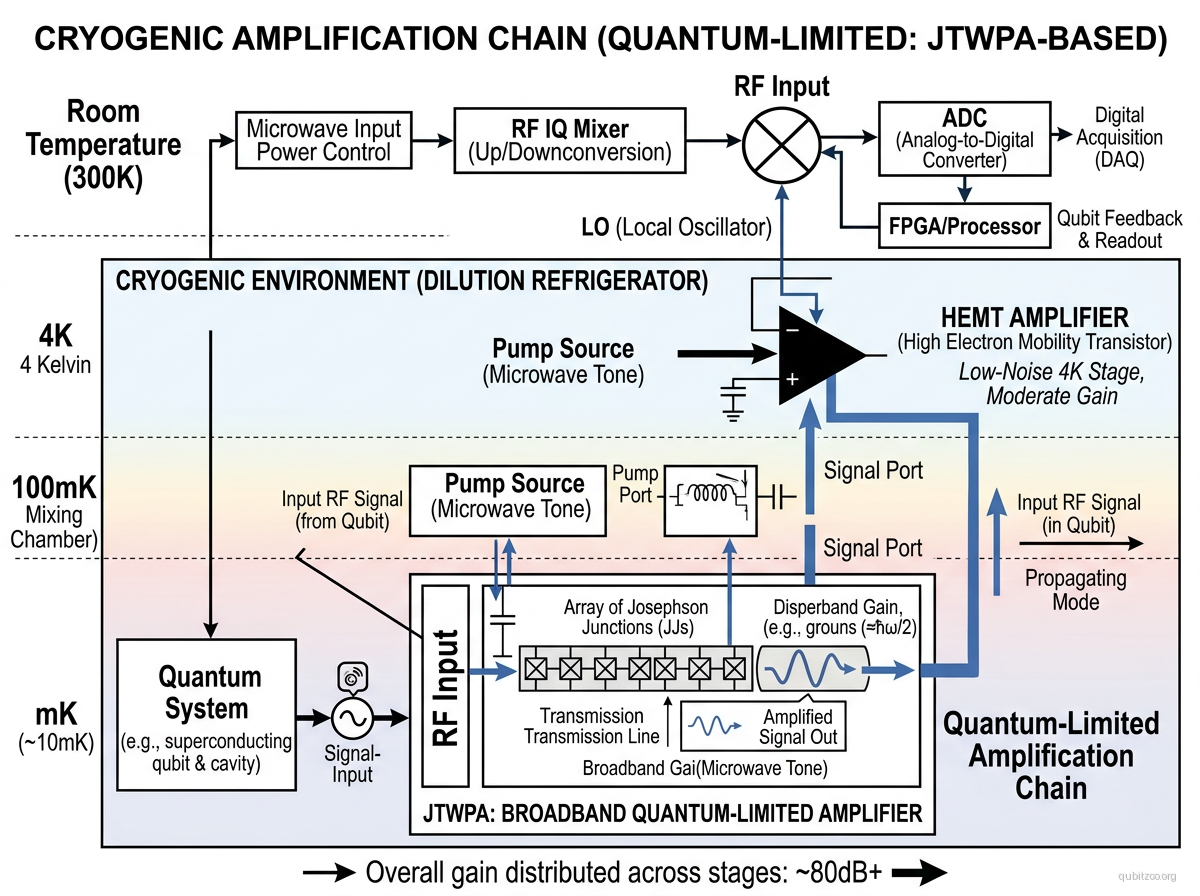
Description
Quantum-limited cryogenic amplifiers are the first active stage of the superconducting qubit readout chain. They amplify the ~10-photon-level readout signal to levels detectable by room-temperature electronics while adding the minimum noise allowed by quantum mechanics (). Without them, readout fidelity is limited to ~90%; with them, >99.9% single-shot fidelity is routinely achieved.
The main amplifier types are:
-
Josephson Parametric Amplifier (JPA): Single-mode resonant amplifier using a Josephson junction’s nonlinearity. Narrow bandwidth (~10 MHz) but truly quantum-limited. Workhorse for single-qubit readout.
-
Josephson Traveling-Wave Parametric Amplifier (JTWPA): Broadband (~4 GHz) amplifier using thousands of Josephson junctions in a transmission line. Enables frequency-multiplexed readout of many qubits simultaneously. Critical for scaling.
-
HEMT (High Electron Mobility Transistor): Semiconductor amplifier at 4K stage. Higher noise (~20× quantum limit) but robust, broadband, and commercially available. Used as second-stage amplification.
-
Kinetic Inductance Amplifiers (KIT): Uses the nonlinear kinetic inductance of superconducting thin films. Potentially simpler fabrication than JTWPA with comparable bandwidth.
The typical signal flow is: qubit → readout resonator → circulator → JPA/JTWPA (20 mK) → HEMT (4K) → room-temperature ADC. The quantum-limited first stage sets the ultimate readout fidelity.
Hamiltonian
Josephson parametric amplifier (degenerate mode):
where is the Kerr nonlinearity from the Josephson junction and is the pump strength. Near-quantum-limited amplification occurs when the pump drives parametric gain: .
Motivation
- Readout bottleneck: Without quantum-limited amplification, superconducting qubit readout fidelity is capped at ~90% — insufficient for quantum error correction.
- Scaling enabler: Broadband JTWPAs enable frequency-multiplexed readout of 8–12+ qubits per feedline, critical for scaling to thousands of qubits.
- Signal-to-noise: Quantum-limited noise floor () maximizes the information extracted per measurement, enabling single-shot readout in <500 ns.
- Mid-circuit measurement: Fast, high-fidelity readout is essential for real-time error correction and feed-forward operations.
Evergreen context
- dispersive-readout-mechanism explains why the first amplifier matters so much: the qubit state only produces a small cavity-frequency or phase shift, so the earliest added noise in the chain sets the usable measurement contrast.
- josephson-junction-as-nonlinear-element is the device-level reason JPAs and JTWPAs exist at all, because Josephson nonlinearity provides gain without the dissipative noise penalty of ordinary microwave amplifiers.
- divincenzo-criteria identifies qubit-specific measurement as a core hardware requirement, and quantum-limited cryogenic amplification is one of the enabling steps that made superconducting readout satisfy it at high fidelity.
- threshold-theorem is the downstream systems test, because repeated syndrome extraction only helps if measurement infidelity from the readout chain stays below the logical error budget.
Experimental Status
JTWPA demonstration — Macklin et al. (2015):
- First near-quantum-limited Josephson traveling-wave parametric amplifier
- ~20 dB gain over 4 GHz bandwidth (4–8 GHz)
- Added noise within factor of 2 of the quantum limit
- Enabled frequency-multiplexed readout of multiple qubits
Routine deployment (2020–present):
- JTWPAs now standard in multi-qubit superconducting processors (Google, IBM, Rigetti)
- Single-shot readout fidelities >99.9% routinely achieved with quantum-limited first stage
Key Metrics
| Metric | Value | Notes | Fidelity reference |
|---|---|---|---|
| JPA added noise | ~0.5 photons | At quantum limit | Macklin et al. 2015 |
| JTWPA bandwidth | ~4 GHz | 4–8 GHz typical | Macklin et al. 2015 |
| JTWPA gain | ~20 dB | Sufficient for HEMT cascade | Macklin et al. 2015 |
| Readout fidelity enabled | >99.9% | Single-shot, with JPA/JTWPA | Macklin et al. 2015 |
Scaling Considerations
- Multiplexed readout: JTWPAs enable 8–12+ qubits per readout feedline via frequency multiplexing.
- Power handling: Amplifier saturation power limits the number of simultaneous readout tones. Higher saturation power is an active research area.
- Cryogenic heat load: Each amplifier dissipates ~1–10 μW at the mixing chamber stage. At 1000+ qubits, cumulative heat load becomes a constraint.
- Commercial availability: JTWPAs becoming commercially available (e.g., from Silent Waves, Quantum Microwave) but still expensive.
References
Key experiments
- C. Macklin et al., “A near-quantum-limited Josephson traveling-wave parametric amplifier,” Science 350, 307 (2015) — arXiv:1507.06672
Reviews
- A. A. Clerk et al., “Introduction to quantum noise, measurement, and amplification,” Rev. Mod. Phys. 82, 1155 (2010) — arXiv:0810.4729
Linked Papers
Related Entries
- qubit-readout — The measurement process that cryogenic amplifiers enable
- circuit-qed — Microwave quantum optics framework for readout
- transmon — Primary qubit type requiring quantum-limited readout