 Qubit Zoo
Figure
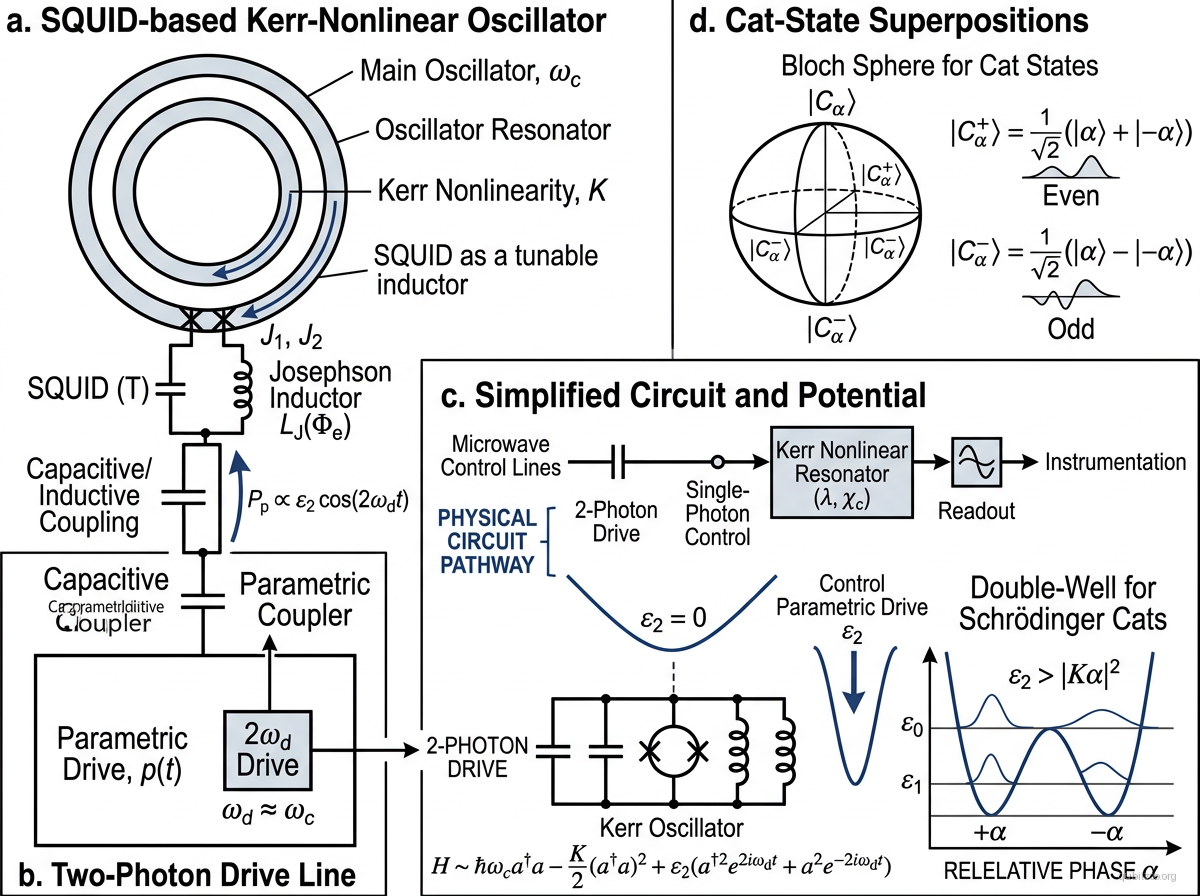
Description
The Kerr-cat qubit is a superconducting bosonic qubit that encodes quantum information in two coherent-state superpositions of a Kerr nonlinear oscillator stabilized by a resonant two-photon drive. The two computational states are the even and odd Schrödinger cat states , which are confined to a two-dimensional manifold within the oscillator’s infinite-dimensional Hilbert space by the interplay of the Kerr nonlinearity and the parametric drive.
The key feature of the Kerr-cat qubit is exponential noise bias: bit-flip errors (transitions between and ) require tunneling through a phase-space barrier that grows with , and are therefore exponentially suppressed with increasing cat size. Phase-flip errors (relative phase between and ) grow only linearly with . This extreme noise asymmetry can be exploited by tailored quantum error correction codes (e.g., repetition codes for phase flips only), dramatically reducing the overhead for fault-tolerant quantum computing.
Demonstrated by Grimm et al. (2020) at Yale using a SNAIL-based parametric oscillator, and further developed by the Amazon AWS Center for Quantum Computing in collaboration with Yale.
Hamiltonian
The Kerr-cat Hamiltonian in the rotating frame of the oscillator is:
where is the Kerr nonlinearity (self-Kerr), are the ladder operators, and is the two-photon drive amplitude.
The two classical stable states are coherent states with amplitude . The quantum ground states are the even/odd cat states:
The energy gap protecting against bit-flips scales as:
and the bit-flip rate is suppressed as .
Motivation
Standard bosonic codes (GKP, binomial) require complex syndrome extraction. The Kerr-cat qubit achieves autonomous error bias through its Hamiltonian structure alone: the two-photon drive continuously stabilizes the cat-state manifold without active feedback. By concentrating errors into a single channel (phase flips), the Kerr-cat enables a path to fault-tolerant quantum computing using simpler, lower-overhead error correction — potentially a repetition code rather than a full surface code. This could reduce the number of physical qubits needed for a logical qubit by an order of magnitude.
Experimental Status
First demonstration — Grimm et al. (2020):
- Generated and stabilized Schrödinger cat states using a SNAIL-based Kerr nonlinear resonator with single-mode squeezing.
- Demonstrated quantum non-demolition readout of the cat qubit state via dispersive coupling to an ancilla transmon.
- Showed >10× improvement in transverse relaxation time over Fock-state encoding.
Exponential bit-flip suppression — Lescanne et al. (2020):
- Bit-flip times exceeding demonstrated with noise bias ratios .
Bias-preserving gates — Puri et al. (2020):
- Demonstrated bias-preserving CNOT and Toffoli gates that maintain the noise asymmetry during gate operations.
Repetition code combination — Guillaud and Mirrahimi (2019):
- Showed theoretically that combining cat qubits with a repetition code achieves exponential suppression of both error types simultaneously.
Autoparametric stabilization — Réglade et al. (2024):
- Eliminated the need for an external two-photon pump via autoparametric design.
Key Metrics
| Metric | Value | Notes | Fidelity reference |
|---|---|---|---|
| Bit-flip time | >1 ms | Exponentially suppressed with | Lescanne et al. 2020 |
| Phase-flip time | 1–10 μs | Grows linearly with ; dominant error | Grimm et al. 2020 |
| Noise bias ratio | – | Lescanne et al. 2020 | |
| Cat size | 2–8 photons | Larger increases bias but also phase-flip rate | Grimm et al. 2020 |
| Kerr nonlinearity | 1–10 MHz | Set by SNAIL or transmon nonlinearity | Grimm et al. 2020 |
| 1Q gate fidelity (Z-rotation) | 99%+ | Bias-preserving via detuning of drive | Puri et al. 2020 |
| 2Q gate fidelity (ZZ-CNOT) | 98–99% | Bias-preserving CNOT | Puri et al. 2020 |
| Operating temperature | 10–20 mK | Dilution refrigerator | — |
References
Original demonstration
- A. Grimm et al., “Stabilization and operation of a Kerr-cat qubit,” Nature 584, 205 (2020) — arXiv:1907.12131
Bit-flip suppression
- R. Lescanne et al., “Exponential suppression of bit-flips in a qubit encoded in an oscillator,” Nat. Phys. 16, 509 (2020) — arXiv:1907.11729
Bias-preserving gates
- S. Puri et al., “Bias-preserving gates with stabilized cat qubits,” Sci. Adv. 6, eaay5901 (2020)
Related theory
- J. Guillaud and M. Mirrahimi, “Repetition Cat Qubits for Fault-Tolerant Quantum Computation,” Phys. Rev. X 9, 041053 (2019)
Linked Papers
- grimm-2020-kerr-cat
- puri-2020-bias-preserving-gates
- lescanne-2020-bit-flip-suppression
- guillaud-2019-repetition-cat-qubits
- mirrahimi-2014-cat-codes
Evergreen context
- bosonic-code-hierarchy — where the Kerr-cat sits among cat, GKP, and binomial bosonic encodings
- josephson-junction-as-nonlinear-element — the SNAIL / junction nonlinearity is the hardware ingredient that turns the abstract cat manifold into a concrete superconducting oscillator
- noise-bias-and-asymmetric-error-channels — why exponentially suppressed bit flips change the error-correction story
- erasure-error-vs-pauli-error — useful contrast with architectures that reduce overhead by flagged loss rather than Pauli bias
Related Entries
- cat-codes — general cat code framework underlying the Kerr-cat encoding
- transmon — provides the Kerr nonlinearity in some implementations
- gkp-codes — alternative bosonic code with different error correction strategy
- erasure-qubit — complementary approach to reducing QEC overhead via error conversion