 Qubit Zoo
Figure
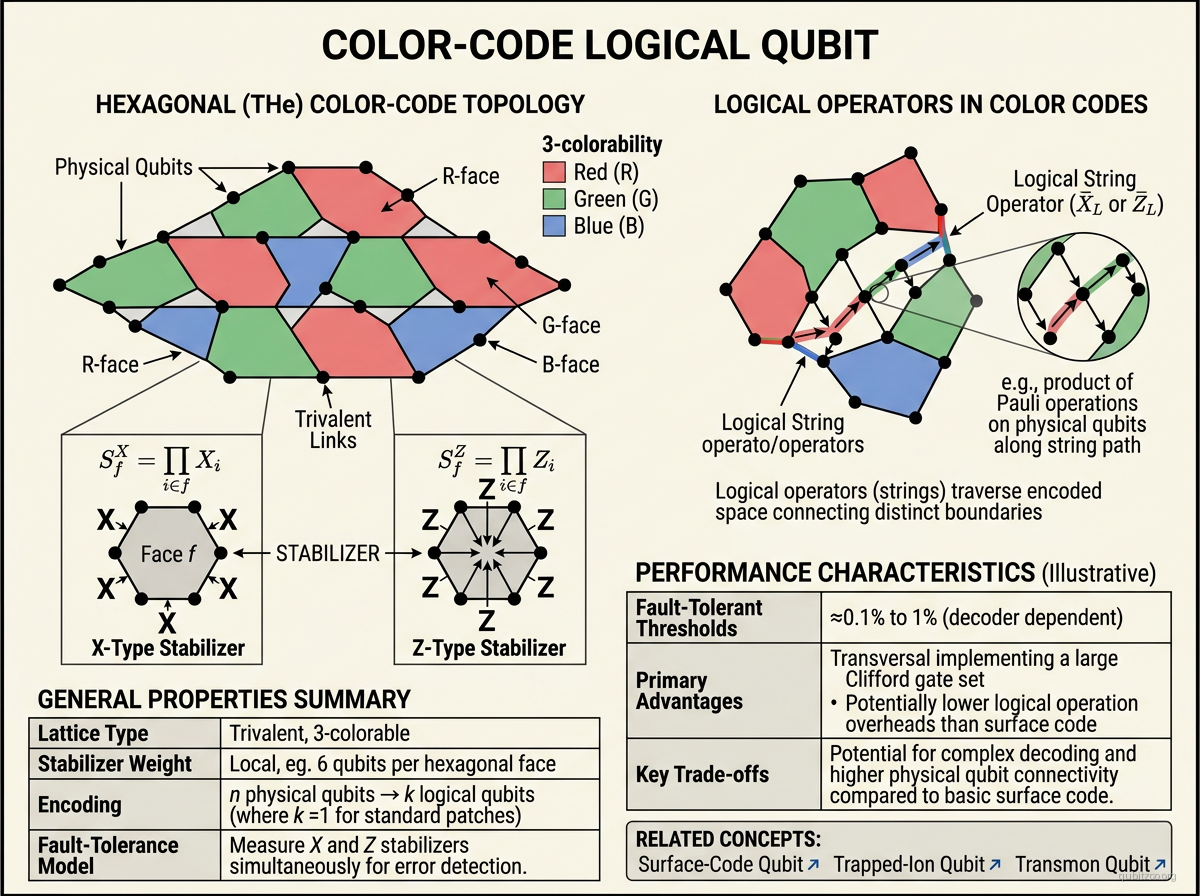
Description
Color-code logical qubits are encoded in 2D or 3D topological stabilizer codes defined on trivalent, three-colorable lattices. Relative to surface codes, color codes can offer transversal implementation of a larger Clifford gate set (including the Hadamard and phase gates), reducing some lattice-surgery overheads for Clifford-heavy workloads.
The code is defined on a lattice where each face is assigned one of three colors (red, green, blue) such that no two adjacent faces share the same color. Physical qubits reside on the vertices. Both X-type and Z-type stabilizers are defined on the same faces, a key structural difference from the surface code.
Hamiltonian
For each face in a colorable lattice:
Code space is the +1 eigenspace of all face stabilizers. Logical operators correspond to colored string operators connecting boundaries of matching color.
Motivation
Color codes are a leading alternative to the surface code when gate-transversality and decoding tradeoffs favor reduced compilation overhead. The native transversal Clifford gate set eliminates the need for magic state distillation for H and S gates, which is especially advantageous for Clifford-heavy workloads common in many quantum algorithms.
Experimental Status
First fault-tolerant QEC with color code — Ryan-Anderson et al. (2021):
- Realized real-time fault-tolerant quantum error correction on a Quantinuum trapped-ion processor
- Demonstrated fault-tolerant parity readout and logical qubit persistence through repeated QEC rounds
- Color code on a distance-3 lattice with flag qubits
Transversal Clifford gates — Ryan-Anderson et al. (2024):
- Demonstrated native transversal Hadamard and phase gates on encoded color-code qubits
- Confirmed the architectural advantage of color codes for Clifford-heavy circuits
- arXiv:2404.02280
Key Metrics
| Metric | Value | Notes | Fidelity reference |
|---|---|---|---|
| Logical lifetime | ~10 QEC rounds (d=3) | Demonstrated logical qubit persistence through repeated error correction | Ryan-Anderson et al. 2021 |
| 1Q gate fidelity (transversal H/S) | 99%+ (d=3) | Native Clifford advantage — transversal gates without magic state distillation | Ryan-Anderson et al. 2024 |
| 2Q gate fidelity (logical CNOT) | ~97–99% (d=3, small scale) | Via code deformation; limited by physical gate fidelities | Postler et al. 2022 |
| Threshold | ~0.1–1% | Decoder/noise model dependent | — |
| Transversal Clifford support | Yes | Major architectural advantage | — |
| Qubit overhead | Comparable order to surface code | Constants depend on layout | — |
Note: For QEC code entries, gate fidelities are logical-level operations on encoded information.
References
Original proposal
- H. Bombin and M. A. Martin-Delgado, “Topological Quantum Distillation,” Phys. Rev. Lett. 97, 180501 (2006) — arXiv:quant-ph/0605138
Experimental demonstrations
- C. Ryan-Anderson et al., “Realization of Real-Time Fault-Tolerant Quantum Error Correction,” Phys. Rev. X 11, 041058 (2021) — arXiv:2107.07505
- C. Ryan-Anderson et al., “High-fidelity and fault-tolerant teleportation of a logical qubit using transversal gates and lattice surgery on a trapped-ion quantum computer,” arXiv:2404.02280 (2024)
Linked Papers
Evergreen context
- threshold-theorem — color codes are an alternative route to the same below-threshold scaling goal, but with a different overhead mix than the surface code.
- quantum-hardware — helpful umbrella when comparing whether a platform would rather pay for simpler decoding and layout regularity or for the transversal Clifford structure color codes offer.
- erasure-error-vs-pauli-error — useful when asking how much color-code performance depends on the assumed noise model instead of the abstract code family alone.
- noise-bias-and-asymmetric-error-channels — separates flagged-location information from the directional structure of the remaining Pauli channel, which can change which color-code decoder or lattice variant is actually competitive.
Related Entries
- surface-code-logical-qubit — primary alternative topological QEC code
- transmon — physical qubit platform for superconducting color code implementations
- trapped-ion-qubit — physical qubit platform for Quantinuum demonstrations