 Qubit Zoo
Figure
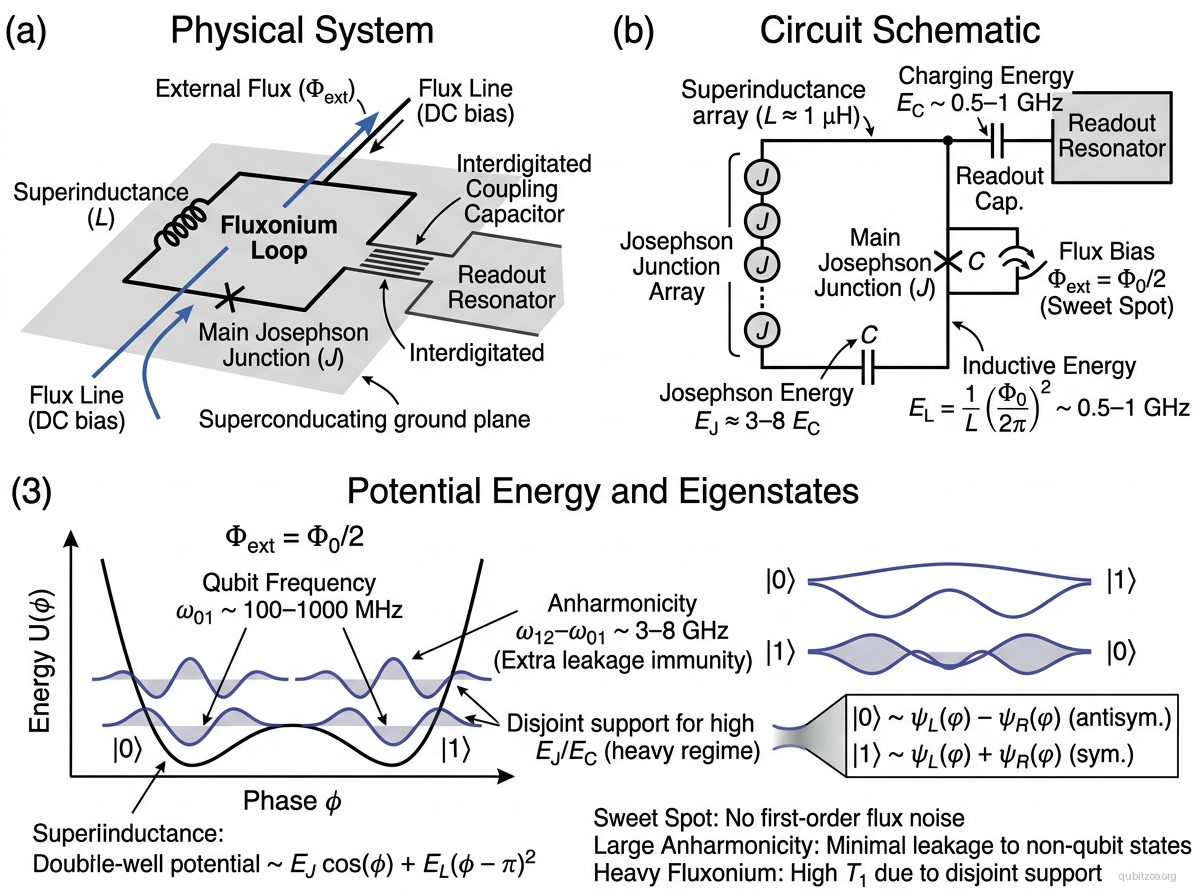
Description
The fluxonium qubit, introduced by Manucharyan et al. (2009), consists of a small Josephson junction shunted by a superinductance — a very large inductance (, corresponding to ) realized as an array of larger Josephson junctions. This superinductance provides a DC path for phase slips, grounding the superconducting phase and enabling operation at the half-flux-quantum sweet spot , where the qubit transition is first-order insensitive to flux noise.
Unlike the transmon (which operates in the weakly anharmonic oscillator regime), the fluxonium can have enormous anharmonicity — the transition can be as low as while higher transitions are at . This spectral isolation makes leakage errors fundamentally smaller. The tradeoff is that the low transition frequency makes direct dispersive readout more challenging, typically requiring auxiliary readout schemes or coupling to a transmon for measurement.
In the “heavy fluxonium” regime (, ), the wavefunctions of and have disjoint support in phase space: is localized in one well of the cosine potential and in the other. This disjoint support makes the qubit insensitive to virtually all local noise operators, enabling times exceeding .
Hamiltonian
where is the charging energy, is the Josephson energy of the small junction, is the inductive energy of the superinductance, and are conjugate charge and phase operators, and is the external flux threading the loop.
At the half-flux-quantum sweet spot (), the potential has a double-well structure with the two minima related by parity symmetry . The qubit states are the symmetric and antisymmetric superpositions of the states localized in each well, split by the tunneling rate through the cosine barrier.
Motivation
The transmon’s achilles heel is its weak anharmonicity (), which limits gate speeds and makes it vulnerable to leakage to . The fluxonium addresses this with GHz-scale anharmonicity while simultaneously achieving superior coherence through flux-sweet-spot operation and disjoint-support noise protection. The main challenge is implementing fast, high-fidelity gates at low qubit frequencies and achieving high-fidelity readout without a direct dispersive shift.
Experimental Status
First demonstration — Manucharyan et al. (2009):
- Realized the fluxonium circuit using a Josephson junction array as a superinductance.
- Demonstrated charge-offset insensitivity while preserving single-Cooper-pair anharmonicity.
- Confirmed spectroscopic signatures consistent with the fluxonium Hamiltonian.
Superinductance characterization:
- Josephson junction arrays provide with self-resonance above qubit operating frequencies.
- Flux-sweet-spot operation at eliminates first-order flux noise sensitivity.
High-coherence fluxonium — Nguyen et al. (2019):
- First demonstration of high-coherence fluxonium at the half-flux sweet spot.
- Achieved and — an order-of-magnitude improvement over earlier fluxonium devices.
- Established the flux sweet spot as the preferred operating point for coherence-optimized fluxonium.
Millisecond coherence — Somoroff et al. (2023):
- Heavy fluxonium regime achieved through disjoint-support protection.
High-fidelity gates — Ding et al. (2023):
- Two-qubit fluxonium gates demonstrated with a transmon coupler.
- Single-qubit gate fidelities and two-qubit gate fidelities .
Key Metrics
| Metric | Value | Notes | Fidelity reference |
|---|---|---|---|
| 100 μs – 1.5 ms | Heavy fluxonium at half-flux sweet spot | Somoroff et al. 2023 | |
| (echo) | 100–500 μs | Echo at sweet spot | Somoroff et al. 2023 |
| Anharmonicity | 3–8 GHz | ; much larger than transmon | Manucharyan et al. 2009 |
| Qubit frequency | 100 MHz – 1 GHz | Much lower than transmon | — |
| 3–8 | Heavy fluxonium regime | — | |
| 1Q gate fidelity | 99.97–99.998% | Microwave or charge-parity-protected gates | Ding et al. 2023 |
| 2Q gate fidelity | 99.2–99.92% | Capacitive or inductive coupling; CZ gate | Ding et al. 2023 |
| Gate time (1Q) | 20–100 ns | Frequency-dependent | — |
| Operating temperature | 10–20 mK | Dilution refrigerator | — |
References
Original proposal
- V. E. Manucharyan et al., “Fluxonium: Single Cooper-Pair Circuit Free of Charge Offsets,” Science 326, 113 (2009) · arXiv:0906.0831
Experimental demonstrations
- L. B. Nguyen et al., “High-Coherence Fluxonium Qubit,” Phys. Rev. X 9, 041041 (2019) · arXiv:1810.11006
- A. Somoroff et al., “Millisecond Coherence in a Superconducting Qubit,” Phys. Rev. Lett. 130, 267001 (2023) · arXiv:2103.08578
- L. Ding et al., “High-Fidelity, Frequency-Flexible Two-Qubit Fluxonium Gates with a Transmon Coupler,” Phys. Rev. X 13, 031035 (2023) · arXiv:2304.06087
Linked Papers
- manucharyan-2009-fluxonium
- nguyen-2019-high-coherence-fluxonium
- somoroff-2023-millisecond-coherence-superconducting
- ding-2023-high-fidelity-frequency
- brooks-2013-0-pi-qubit
- kalashnikov-2019-cos2phi
- lin-2018-heavy-fluxonium
- pechenezhskiy-2020-blochnium
- strickland-2024-gatemonium
- n-2026-inductively-protected-andreev-ipa-spin
- reparaz-2026-time-optimal-quantum-gates-with
- geffroy-2026-an-ultracompact-dilution-refrigerator
- schirk-2026-high-fidelity-entangled-states-in
Evergreen context
- josephson-junction-as-nonlinear-element — the small junction supplying the nonlinearity
- charge-noise-in-superconducting-qubits — fluxonium is the classic reminder that the CPB offset-charge problem can be pushed far down without abandoning Josephson-circuit physics.
- charge-noise-sweet-spot — charge insensitivity is built into the architecture, but the best coherence still comes from the separate half-flux sweet-spot story.
- coherence-time-hierarchy — how to read the sweet-spot versus off-sweet-spot coherence claims
Related Entries
- transmon — operates in the opposite regime with weak anharmonicity
- flux-qubit — predecessor using persistent currents without superinductance
- cooper-pair-box-charge-qubit — original charge qubit that fluxonium generalizes
- circuit-qed — readout and coupling architecture used with fluxonium
- blochnium — quasicharge regime of the fluxonium circuit
- heavy-fluxonium-qubit — heavy regime variant with disjoint-support coherence protection
- cos2phi-qubit — protected qubit derived from fluxonium-family circuits
- 0-pi-qubit — protected qubit in the same superconducting circuit family
- ferbo-qubit — light fluxonium with Andreev weak link; fermion-boson hybridization provides dual noise protection