 Qubit Zoo
Figure
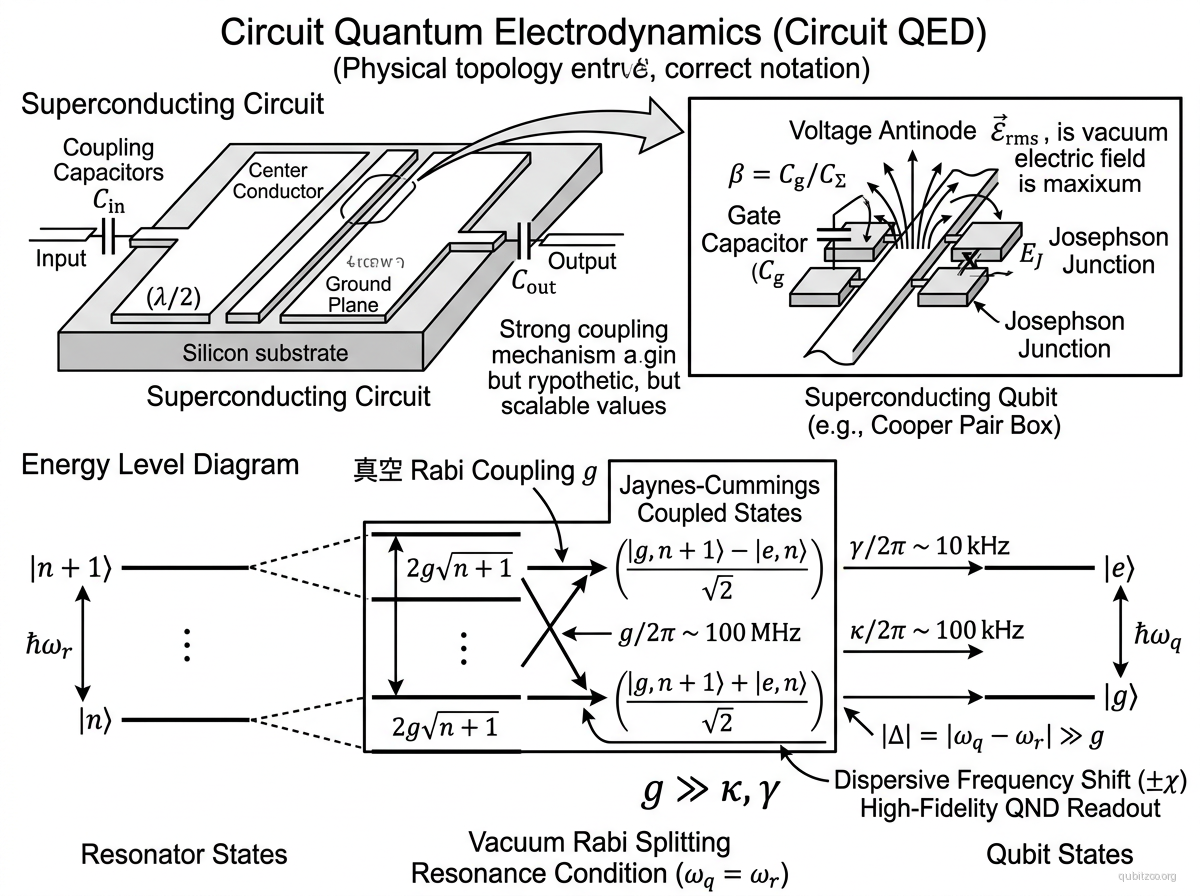
Description
Circuit quantum electrodynamics (circuit QED) is the on-chip analogue of cavity QED: a superconducting artificial atom couples coherently to a quantized mode of a microwave resonator. In the original Blais et al. proposal, a quasi-one-dimensional coplanar-waveguide (CPW) resonator confined its zero-point energy to an effective volume of about cubic wavelengths, producing . Together with the Cooper-pair-box dipole moment (), this led to the proposal-scale estimate —not .
The defining regime is strong coupling, , where coherent qubit–photon exchange outpaces cavity loss and qubit decoherence . Wallraff et al. first demonstrated it in 2004 with , , and , observing a vacuum-Rabi splitting of .
Most processor applications operate instead in the dispersive regime, . The qubit shifts the resonator frequency by a state-dependent amount, enabling QND readout, while virtual photons mediate interactions between separated qubits. Detuning suppresses cavity-mediated relaxation to the Purcell rate ; engineered Purcell filters can suppress that channel further. Circuit QED now underlies superconducting-qubit readout, resonator buses, bosonic encodings, microwave quantum optics, and hybrid quantum interfaces.
Hamiltonian
The two-level quantum-Rabi model is
Near resonance and for , the rotating-wave approximation gives the Jaynes–Cummings Hamiltonian
Here is the resonator frequency, is the qubit transition frequency, is the single-photon coupling rate, and are photon annihilation (creation) operators. At exact resonance, the excitation manifold contains
split by . This ordering is the central vacuum-Rabi signature.
For the original Cooper-pair-box geometry at its charge sweet spot,
where , is capacitance per unit length, and is resonator length.
With and , a two-level dispersive approximation is
For a weakly anharmonic transmon, higher levels modify the shift to approximately , where . The measured resonator separation is in the ideal two-state readout picture.
Motivation
Compared with earlier lumped-element proposals, lithographic transmission-line resonators offered reproducible modes, large zero-point voltages, spatially separated antinodes, and controlled input/output coupling. Those ingredients made strong coupling, dispersive measurement, and cavity-mediated state transfer practical. Modern implementations add dedicated Purcell filters because a readout resonator is both a measurement channel and, without filtering, a radiative decay channel.
Experimental Status
First strong coupling — Wallraff et al. (2004):
- Coupled a Cooper pair box to a 6.04-GHz CPW resonator with .
- Observed a vacuum-Rabi splitting of about 11.6 MHz, larger than both and .
Cavity quantum bus — Majer et al. (2007):
- Demonstrated coherent state transfer between two spatially separated superconducting qubits through virtual photons in a shared transmission-line cavity.
Long-lived cavity modes and bosonic encodings — Teoh et al. (2023):
- Used two superconducting cavities with photon lifetimes above 1 ms as the modes of a dual-rail qubit, with transmon-assisted control and erasure detection.
Fast multiplexed dispersive readout — Spring et al. (2025):
- Combined readout and filter resonators with intrinsic notch filtering, obtaining 99.77% average assignment fidelity across four qubits in a 56-ns integration window; the best channel exceeded 99.9%.
Millimeter-wave circuit QED — Dixit et al. (2026):
- Coupled a 3.1-GHz transmon to a 34.7-GHz cavity at and achieved greater than 99% readout fidelity without a quantum-limited first-stage amplifier, demonstrating a highly detuned extension of the architecture.
Key Metrics
| Metric | Value | Notes | Fidelity reference |
|---|---|---|---|
| First strong-coupling demonstration | MHz; MHz | 6.04-GHz CPW resonator; MHz, MHz | Wallraff et al. 2004 |
| Long-lived cavity photon | ms | Two 3D stub cavities used for dual-rail encoding | Teoh et al. 2023 |
| Multiplexed assignment fidelity | 99.77% average; best | Four qubits, 56-ns integration, resonator linewidths up to 42 MHz | Spring et al. 2025 |
| Millimeter-wave readout | fidelity | 34.7-GHz cavity, 3.1-GHz transmon, GHz | Dixit et al. 2026 |
References
Original proposal
- A. Blais et al., “Cavity quantum electrodynamics for superconducting electrical circuits: An architecture for quantum computation,” Phys. Rev. A 69, 062320 (2004) — arXiv:cond-mat/0402216
First experimental demonstration
- A. Wallraff et al., “Strong coupling of a single photon to a superconducting qubit using circuit quantum electrodynamics,” Nature 431, 162–167 (2004) — arXiv:cond-mat/0407325
Review and milestones
- A. Blais et al., “Circuit quantum electrodynamics,” Rev. Mod. Phys. 93, 025005 (2021) — arXiv:2005.12667
- J. Majer et al., “Coupling superconducting qubits via a cavity bus,” Nature 449, 443–447 (2007) — arXiv:0709.2135
- J. D. Teoh et al., “Dual-rail encoding with superconducting cavities,” PNAS 120, e2221736120 (2023) — arXiv:2212.12077
- P. A. Spring et al., “Fast Multiplexed Superconducting-Qubit Readout with Intrinsic Purcell Filtering Using a Multiconductor Transmission Line,” PRX Quantum 6, 020345 (2025) — arXiv:2409.04967
- A. V. Dixit et al., “Millimeter wave readout of a superconducting qubit,” Phys. Rev. Lett., accepted 3 September 2026 — arXiv:2603.13837
Linked Papers
- blais-2004-circuit-qed
- blais-2021-circuit-electrodynamics
- dixit-2026-millimeter-wave-readout
- majer-2007-cavity-bus
- spring-2025-fast-multiplexed-readout
- strickland-2024-gatemon-losses
- teoh-2023-dual-rail-cavity
- wallraff-2004-strong-coupling-single
- walter-2017-rapid-readout
- rathnakaran-2026-squeezing-fueled-quantum-otto-engine
Evergreen context
- jaynes-cummings-in-circuits — the atom-cavity Hamiltonian in its superconducting form
- dispersive-readout-mechanism — why off-resonant coupling yields QND measurement
- resonator-as-quantum-bus — how the cavity mediates long-range qubit-qubit coupling
- vacuum-rms-field-scaling — why CPW resonators achieve unusually large zero-point fields
- purcell-protection-via-detuning — how detuning and filters suppress spontaneous emission
Related Entries
- transmon — most common qubit used in circuit QED architectures
- cooper-pair-box-charge-qubit — original qubit in the Blais et al. proposal
- fluxonium — also operates within circuit QED, requires auxiliary readout
- qubit-readout — dispersive readout is the primary application of circuit QED
- bosonic-qubit — long-lived cavity modes host oscillator encodings
- dual-rail-superconducting-qubit — two circuit-QED cavity modes encode an erasure-biased qubit