 Qubit Zoo
Figure
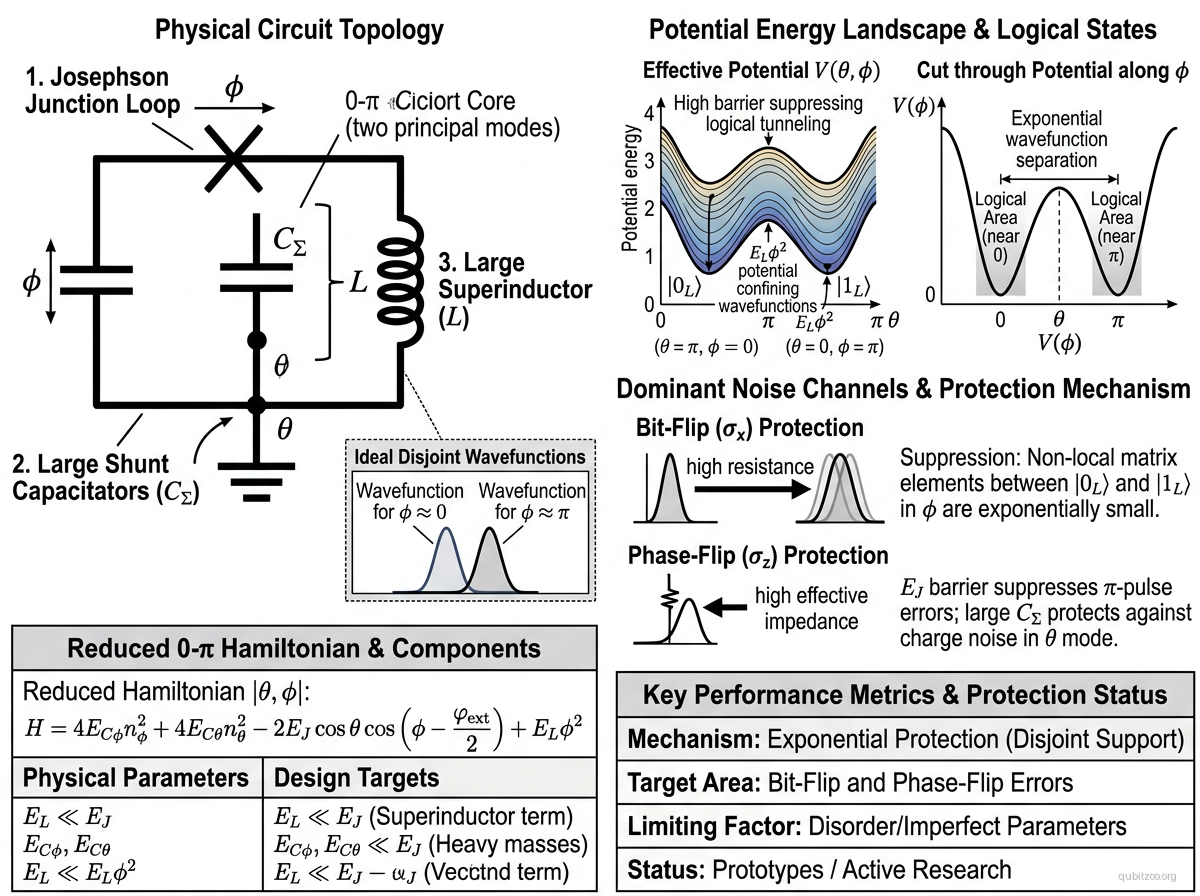
Description
The 0-π qubit is a superconducting protected-qubit design (Brooks, Kitaev, and Preskill, 2013) that aims to suppress both bit-flip and phase-flip errors at the hardware level using a circuit with two nearly degenerate minima (near phase 0 and π) and strongly biased noise channels.
The circuit combines large inductive and capacitive elements with Josephson junctions to produce a potential landscape where logical states have exponentially small overlap. In the ideal parameter regime, local noise operators have exponentially weak matrix elements between logical states.
Hamiltonian
A reduced 0-π model can be written in collective coordinates as:
with design target and anisotropic capacitances producing disjoint-support wavefunctions in .
Motivation
0-π is one of the clearest “hardware-protected” superconducting qubit proposals: it targets passive suppression of dominant error channels before full QEC overhead. If the ideal parameter regime can be reached in practice, the qubit would provide exponential suppression of both bit-flip and phase-flip errors simultaneously, dramatically reducing the overhead needed for fault-tolerant quantum computing.
Experimental Status
First experimental realization — Gyenis et al. (2021):
- Demonstrated a protected superconducting circuit derived from the 0-π qubit design
- Used an array of gate-tunable Josephson interferometers
- Observed signatures of the protected regime, though full exponential protection not yet achieved
- Dominant challenge remains disorder and parameter spread, which break the ideal protection symmetry
Key Metrics
| Metric | Value | Notes | Fidelity reference |
|---|---|---|---|
| Protection mechanism | Exponential wavefunction separation | In ideal parameter regime | Brooks et al. 2013 |
| Dominant challenge | Disorder / parameter spread | Breaks ideal protection symmetry | — |
| Experimental status | Early prototypes / partial regimes | Not yet transmon-level maturity | Gyenis et al. 2021 |
| Operating temperature | 10–20 mK | Dilution refrigerator | — |
References
Original proposal
- P. Brooks, A. Kitaev, and J. Preskill, “Protected gates for superconducting qubits,” Phys. Rev. A 87, 052306 (2013) — arXiv:1302.4122
Experimental demonstrations
- A. Gyenis et al., “Experimental Realization of a Protected Superconducting Circuit Derived from the 0–π Qubit,” PRX Quantum 2, 010339 (2021) — arXiv:1910.07542
Linked Papers
- brooks-2013-0-pi-qubit
- gyenis-2021-experimental-realization-protected
- kalashnikov-2019-cos2phi
- lin-2018-heavy-fluxonium
Evergreen context
- cos2phi — the doubled-periodicity circuit intuition behind related protected superconducting designs
- charge-noise-sweet-spot — frames the 0-π qubit as a multi-axis sweet-spot strategy against both charge and flux noise
- noise-bias-and-asymmetric-error-channels — the protection target is not just lower error, but strongly biased residual error channels
Related Entries
- fluxonium — parent circuit family
- heavy-fluxonium-qubit — related protected regime in the fluxonium family
- transmon — conventional superconducting qubit for comparison