 Qubit Zoo
Figure
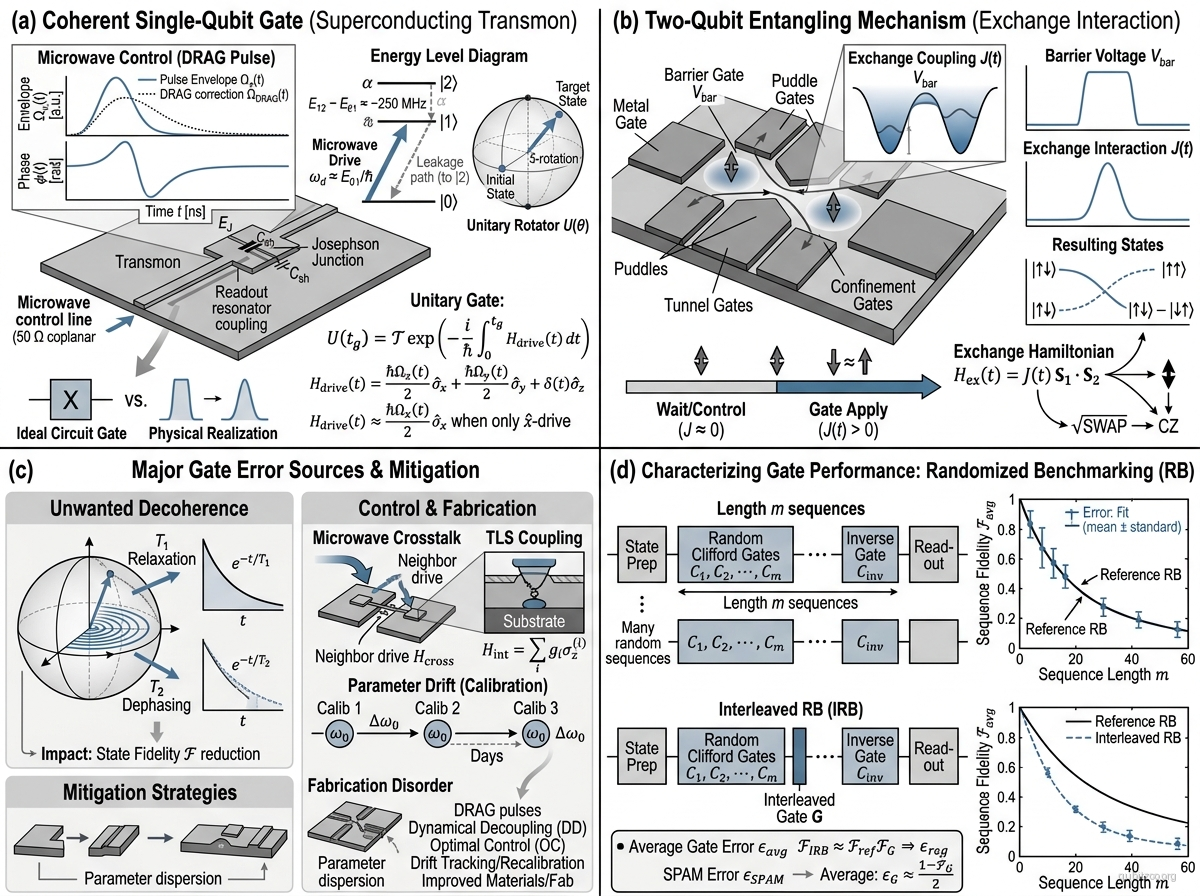
Description
A quantum gate is a physical operation that implements a unitary transformation on one or more qubits by applying precisely calibrated control signals — microwave pulses, laser beams, voltage waveforms, or magnetic field gradients — for a specific duration. In the abstract circuit model, gates are idealized unitary matrices; in hardware, every gate is a time-dependent Hamiltonian interaction whose propagator must approximate the target unitary to within a specified error budget.
Single-qubit gates rotate the Bloch vector about arbitrary axes and are typically the highest-fidelity operations on any platform. Physically, they correspond to resonant or near-resonant driving of the qubit transition (e.g., for a Rabi drive with envelope ).
Two-qubit entangling gates (CNOT, CZ, , etc.) create entanglement by exploiting a controllable interaction between qubits — capacitive coupling, shared motional modes, exchange interaction, or dipolar Rydberg blockade. These are typically the fidelity-limiting operations and the primary bottleneck for fault-tolerant quantum computing.
Physical Implementations by Platform
Superconducting Qubits
Single-qubit gates are driven by shaped microwave pulses at the qubit transition frequency (). DRAG (Derivative Removal by Adiabatic Gate) pulses suppress leakage to the state caused by the transmon’s weak anharmonicity, achieving gate times of . Rotations about are implemented virtually (frame updates in the control software) at zero time cost.
Two-qubit gates use several schemes:
- Cross-resonance (CR): driving one transmon at a neighbor’s frequency to produce a interaction (IBM’s native gate)
- Tunable coupler + CZ: flux-pulsing a tunable element to mediate a controlled-phase gate ()
- Parametric gates: modulating the coupler at the difference frequency to activate -like interactions
Trapped Ions
Single-qubit gates use laser-driven Raman transitions between hyperfine ground states (gate time ), or direct microwave driving of the hyperfine splitting ( for ). All-electronic microwave control avoids laser-induced photon scattering entirely.
Two-qubit gates exploit shared motional (phonon) modes of the ion chain:
- Mølmer–Sørensen (MS) gate: bichromatic laser fields create a spin-dependent force, generating an interaction via transient phonon excitation ()
- Cirac–Zoller gate: sequential sideband pulses transfer information through a single phonon; historically first but slower and less robust than MS
Semiconductor Spin Qubits
Single-qubit gates rotate individual electron or hole spins via:
- ESR (Electron Spin Resonance): oscillating magnetic fields at the Larmor frequency
- EDSR (Electric Dipole Spin Resonance): oscillating electric fields coupled to spin via spin–orbit interaction or micromagnet field gradients; faster and more locally addressable than ESR
Gate times are depending on driving mechanism and Rabi frequency.
Two-qubit gates exploit the exchange interaction controlled by the barrier gate voltage between neighboring quantum dots. Pulsing implements or CZ-like operations in .
Neutral Atoms (Rydberg)
Single-qubit gates use global or site-selective Raman transitions between hyperfine ground states of alkali atoms (, ) held in optical tweezer arrays. Gate times are .
Two-qubit gates exploit the Rydberg blockade: when one atom is excited to a Rydberg state (), the strong dipole–dipole interaction ( at separations) shifts the doubly-excited state out of resonance, implementing a conditional phase (CZ) gate. Gate times are .
Photonic Qubits
Single-qubit gates are implemented with passive linear-optical elements: beam splitters (Hadamard), phase shifters (rotations about ), and wave plates (arbitrary SU(2)). These are deterministic and high-fidelity.
Two-qubit gates are fundamentally challenging because photons do not naturally interact. The KLM scheme (Knill, Laflamme, Milburn 2001) achieves probabilistic entangling gates using ancilla photons, beam splitters, and post-selection on photon detection. Success probability is for a bare CZ, improved to near-deterministic rates with teleportation-based boosting. Measurement-based (fusion) approaches sidestep this by consuming entangled resource states.
Evergreen context
- divincenzo-criteria turn gates from a circuit-model abstraction into a hardware requirement: a platform is not computationally useful until it can realize a native single-qubit-plus-entangling gate set.
- threshold-theorem makes gate quality quantitative, because the real question is not whether a gate exists but whether its error rate sits far enough below threshold to support deep fault-tolerant circuits.
- resonator-as-quantum-bus shows one archetypal route to entangling gates in circuit QED, where virtual photons mediate interactions between qubits that are not directly adjacent.
- sqrt-swap-as-universal-gate captures the complementary spin-qubit route, where an exchange pulse plus local rotations already furnishes a universal entangling primitive.
Key Metrics
| Metric | Platform | SOTA Value | Gate Time | Reference |
|---|---|---|---|---|
| 1Q fidelity | Trapped ion | 99.999985% | 4–35 μs | Oxford 2025, microwave |
| 1Q fidelity | Superconducting | 99.998% | ~25 ns | Ding et al. 2025, fluxonium, MIT |
| 1Q fidelity | Superconducting (transmon) | 99.9926% | ~25 ns | Z. Li et al. 2023 |
| 1Q fidelity | Spin qubit | >99.9% | ~1 μs | Mądzik et al. 2022, UNSW Si donor |
| 1Q fidelity | Neutral atom | >99.9% | ~1 μs | Raman/microwave on |
| 2Q fidelity | Trapped ion | 99.99% | ~100 μs | IonQ 2025, EQC, R&D lab |
| 2Q fidelity | Trapped ion (production) | 99.914% | ~200 μs | Quantinuum H1-1, all pairs |
| 2Q fidelity | Superconducting (CZ) | 99.95% | ~60 ns | IQM 2025, PALEA protocol |
| 2Q fidelity | Neutral atom (CZ) | 99.6% | ~0.5 μs | Atom Computing 2024 |
| 2Q fidelity | Spin qubit | >99% | ~10–100 ns | CMOS-compatible Si, multiple groups (2024) |
Fidelities are measured via randomized benchmarking (RB) or interleaved RB, which isolate gate errors from state-preparation and measurement (SPAM) errors.
Gate Error Sources
Gate infidelity arises from several distinct physical mechanisms:
-
Decoherence during the gate: (energy relaxation) and (dephasing) processes degrade the qubit state during the finite gate duration . The coherence-limited error scales roughly as , making fast gates essential.
-
Leakage to non-computational states: in weakly anharmonic systems (transmons, ), population can leak to or higher levels during fast pulses. DRAG pulses and leakage reduction protocols (e.g., IQM’s PALEA) specifically target this error.
-
Calibration drift: qubit frequencies, coupling strengths, and pulse amplitudes drift on timescales of minutes to hours due to TLS fluctuations, flux noise, or thermal effects. Requires periodic recalibration and drift-tracking protocols.
-
Crosstalk: in multi-qubit processors, driving one qubit inadvertently perturbs neighbors through residual coupling (always-on ), microwave leakage, or shared control lines. This produces correlated errors that are harder to correct.
-
Control imperfections: finite pulse bandwidth, DAC quantization, IQ mixer imbalance, and timing jitter all contribute systematic coherent errors.
-
SPAM errors (state preparation and measurement) are distinct from gate errors but often conflated in raw process metrics. Randomized benchmarking specifically separates gate error from SPAM.
Historical Milestones
| Year | Milestone | Reference |
|---|---|---|
| 1995 | First experimental CNOT gate (trapped ion, ) | Monroe et al., PRL 75, 4714 |
| 1998 | First NMR quantum gates demonstrated | Chuang et al., Nature 393, 143 |
| 2003 | First solid-state two-qubit gate (superconducting charge qubits) | Yamamoto et al., Nature 425, 941 |
| 2007 | Transmon qubit introduced, enabling high-fidelity SC gates | Koch et al., PRA 76, 042319 |
| 2009 | DRAG pulse invented for leakage suppression | Motzoi et al., PRL 103, 110501 |
| 2014 | Surface code threshold crossed in superconducting qubits | Barends et al., Nature 508, 500 |
| 2016 | First two-qubit MS gate (trapped ions) | Ballance et al., PRL 117, 060504 |
| 2023 | two-qubit CZ on 60 neutral atoms simultaneously | Evered et al., Nature 622, 268 |
| 2024 | Google Willow: below-threshold surface code error correction | Google QAI, Nature 638, 920 |
| 2025 | Oxford: 1Q error rate (trapped ion, microwave) | Sheridan et al., PRL (2025) |
| 2025 | IonQ: 99.99% 2Q fidelity (trapped ion, EQC) | Moses et al., arXiv:2510.17286 |
| 2025 | IQM: 99.95% 2Q CZ fidelity (superconducting, PALEA) | Landra et al., arXiv:2508.16437 |
Linked Papers
Related Entries
- transmon — dominant superconducting qubit platform
- fluxonium — alternative SC qubit with higher anharmonicity, record 1Q fidelity
- trapped-ion-qubit — leading platform for 2Q gate fidelity
- spin-qubit — semiconductor spin qubits with ultrafast exchange gates
- silicon-spin-qubit — CMOS-compatible spin qubit implementations
- neutral-atom-qubit — Rydberg-mediated entangling gates
- rydberg-neutral-atom-qubit — Rydberg blockade mechanism for 2Q gates
- qubit-readout — measurement (distinct from gate operations)
- circuit-qed — architecture enabling SC qubit control and readout
- tunable-coupler — mediates high-fidelity 2Q gates in SC processors
- cirac-zoller-gate — original trapped-ion 2Q gate proposal
- molmer-sorenson-gate — workhorse trapped-ion entangling gate
- motional-mode-coupling-in-ion-traps — the shared phonon bus underlying MS, Cirac-Zoller, and LS gates
- rydberg-blockade-mechanism — the physical mechanism behind Rydberg-mediated entangling gates
- dual-rail-photonic-qubit — photonic encoding for linear-optical gates
- linear-optical-photonic-qubit — KLM-scheme photonic gates
- exchange-only-qubit — all-exchange spin qubit gates
- surface-code-logical-qubit — error correction enabled by high gate fidelities