 Qubit Zoo
Figure
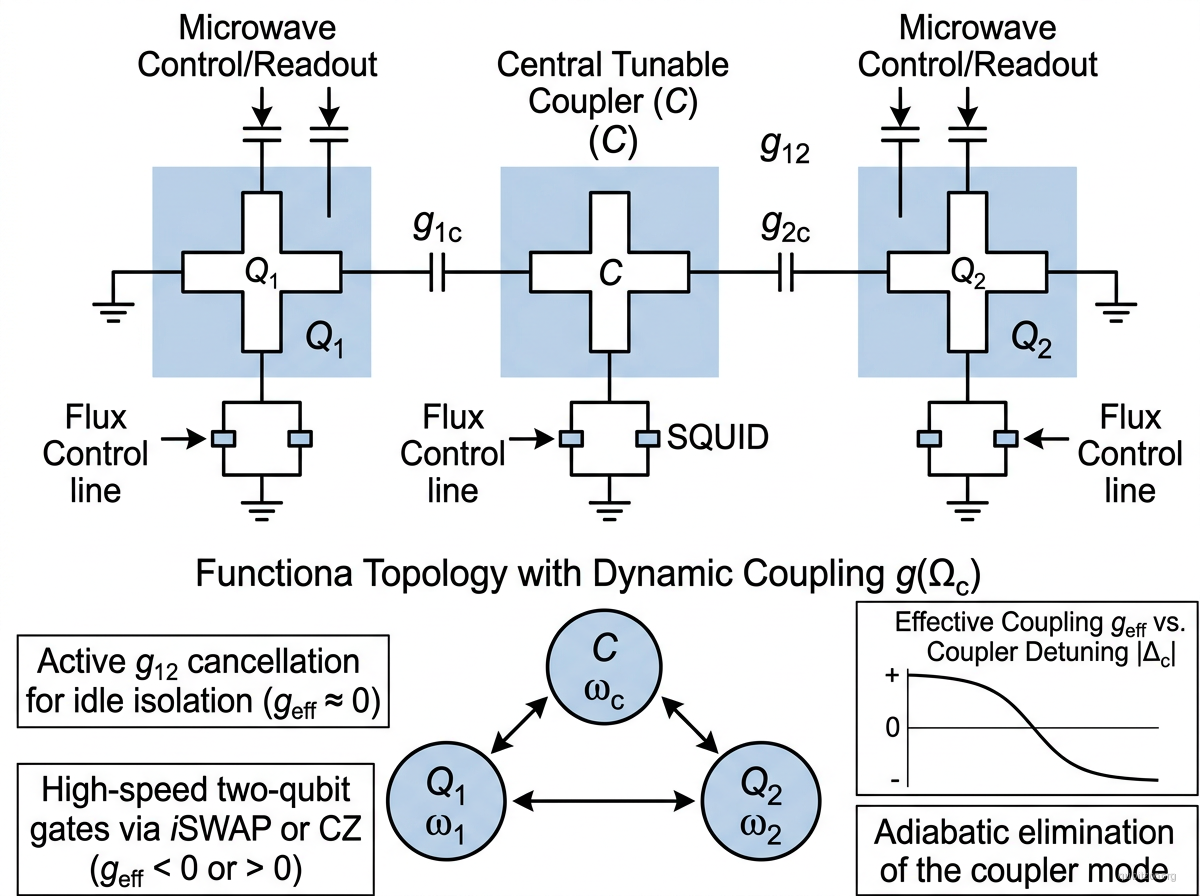
Description
The Gmon is a superconducting qubit architecture developed at Google that adds a tunable coupler between neighboring Xmon-style qubits. Introduced by Y. Chen et al. (2014), the “g” in Gmon refers to the tunable coupling strength between qubits.
The tunable coupler is itself a frequency-tunable transmon-like element placed between two computational qubits. By adjusting its frequency via a flux line, the effective qubit-qubit coupling can be tuned from a finite positive value through zero to a finite negative value. This enables:
- Fast two-qubit gates: bringing qubits into resonance with strong coupling for SWAP-like gates in ~10–20 ns.
- Idle isolation: parking the coupler to cancel residual coupling, suppressing always-on errors.
- CZ gates: diabatic flux pulses that accumulate a conditional phase.
The Gmon/tunable-coupler architecture was used in Google’s Sycamore (2019) and Willow (2024) processors and has become the dominant paradigm for frequency-tunable superconducting qubit arrays.
Hamiltonian
The three-body system (qubit 1 — coupler — qubit 2):
The effective qubit-qubit coupling after adiabatically eliminating the coupler:
where is the coupler detuning. Setting achieves zero effective coupling (idle point).
Motivation
Fixed-coupling architectures suffer from always-on interaction, causing idle errors and frequency-crowding constraints. The tunable coupler solves both: it allows fast gates when coupling is “on” and near-perfect isolation when “off,” dramatically improving circuit fidelity for multi-qubit algorithms.
Experimental Status
First demonstration — Y. Chen et al. (2014):
- Demonstrated tunable coupling between two Xmon-style qubits via a flux-tunable coupler element.
- Achieved two-qubit gate fidelities suitable for quantum error correction exploration.
- Showed ON/OFF switching of effective coupling by tuning the coupler frequency.
Sycamore processor — Arute et al. (2019):
- 53-qubit processor using Gmon-style tunable couplers for 86 qubit pairs.
- Median CZ fidelity 99.4% via randomized benchmarking.
- Demonstrated quantum computational advantage.
Willow processor — Google Quantum AI (2025):
- Improved to 99.7–99.85% median CZ fidelity.
- Enabled below-threshold surface code operation with 105 qubits.
Key Metrics
| Metric | Value | Notes | Fidelity reference |
|---|---|---|---|
| 2Q gate fidelity | 99.5–99.9% | CZ or SWAP | Y. Chen et al. 2014 |
| 2Q gate time | 10–30 ns | Fast parametric gates | — |
| Residual (off) | <10 kHz | At idle point | — |
| 1Q gate fidelity | 99.9%+ | Same as Xmon | Y. Chen et al. 2014 |
| Operating temperature | 10–20 mK | Dilution refrigerator | — |
References
Original proposal and demonstration
- Y. Chen et al., “Qubit Architecture with High Coherence and Fast Tunable Coupling,” Phys. Rev. Lett. 113, 220502 (2014)
Key experimental milestones
- F. Arute et al., “Quantum supremacy using a programmable superconducting processor,” Nature 574, 505 (2019)
- Google Quantum AI, “Quantum error correction below the surface code threshold,” Nature 638, 920 (2025)
Linked Papers
- chen-2014-gmon
- acharya-2025-error-correction-below
- arute-2019-supremacy-programmable-superconducting
- yan-2018-tunable-coupler
Evergreen context
- charge-noise-sweet-spot — the architectural trick is to keep the computational qubits transmon-like and coherence-friendly while moving most of the aggressive tunability into a separate coupling element.
- josephson-junction-as-nonlinear-element — both the qubits and the coupler rely on Josephson nonlinearity, but the Gmon repurposes it from single-qubit anharmonicity into programmable interaction engineering.
- resonator-as-quantum-bus — Gmon is the switchable descendant of the earlier shared-resonator bus idea: keep the long-range interaction intuition, but move the aggressive tunability into a dedicated coupler with a real OFF point.
- threshold-theorem — Gmon is important because suppressing idle while preserving fast two-qubit gates is exactly the kind of error-budget shaping needed before large surface-code patches become viable.
Related Entries
- xmon — predecessor qubit architecture without tunable coupling
- transmon — parent qubit family
- tunable-coupler — the coupling element technology in detail
- circuit-qed — measurement and readout framework