 Qubit Zoo
Figure
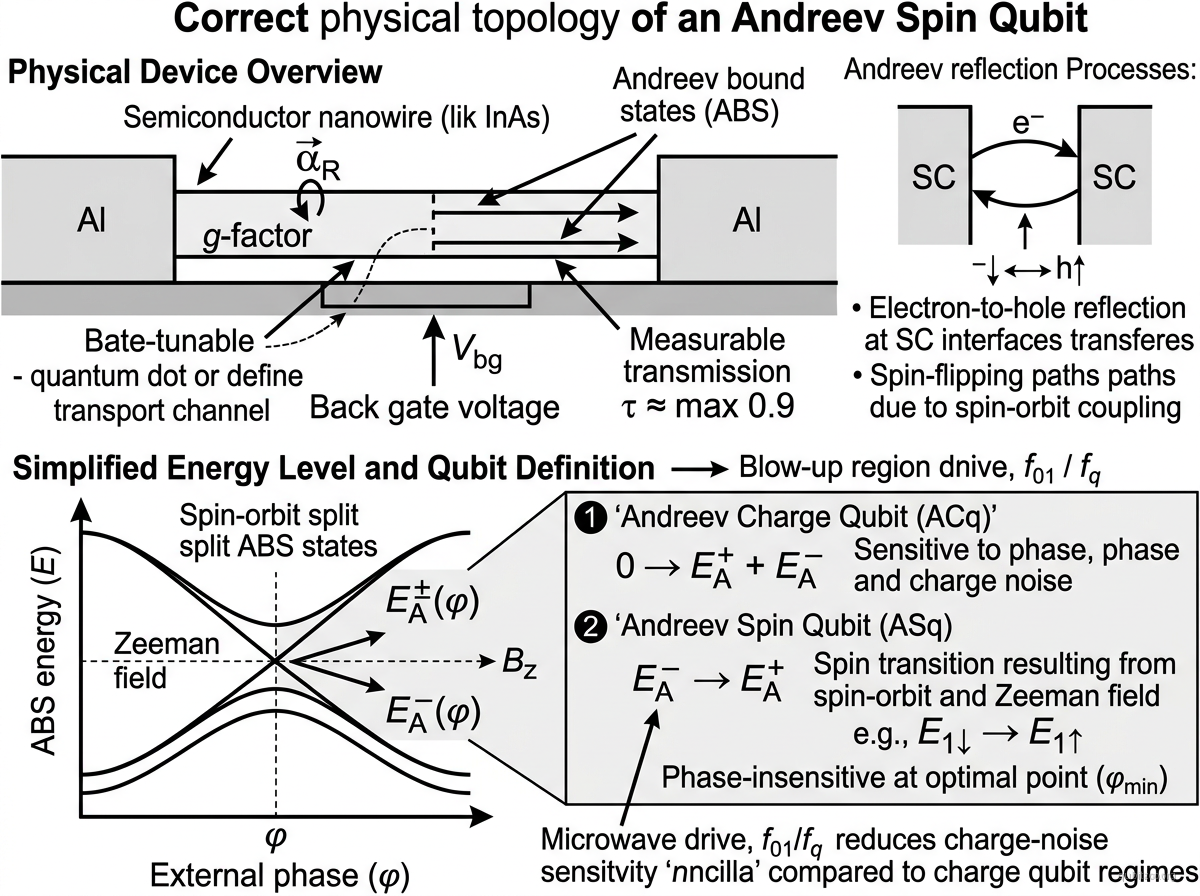
Description
The Andreev spin qubit encodes quantum information in the spin degree of freedom of an electronic quasiparticle trapped in the supercurrent-carrying Andreev bound states of a semiconductor-superconductor nanowire Josephson junction. It combines the compact footprint and circuit-QED compatibility of superconducting qubits with the long-lived spin degree of freedom of semiconductor quantum dots.
In a Josephson junction made from a semiconductor nanowire (typically InAs) with superconducting contacts (Al), Andreev reflection at each superconductor-semiconductor interface creates bound states below the superconducting gap. With spin-orbit coupling in the semiconductor (Rashba-type in InAs), these Andreev bound states become spin-split: the two spin states and carry different supercurrents. This spin-dependent supercurrent enables dispersive readout via a coupled microwave resonator, directly bridging spin and superconducting qubit paradigms.
The qubit operates within a fixed fermion parity sector (odd parity — one quasiparticle occupying the Andreev level). At an optimal phase bias point, the spin transition frequency becomes first-order insensitive to phase fluctuations, providing a sweet spot for coherent operation. Quasiparticle poisoning (uncontrolled parity switches) is a primary decoherence mechanism.
Hamiltonian
A minimal Andreev-spin-qubit model uses spin-split Andreev bound states in a phase-biased Josephson weak link:
with Andreev level dispersion (short-junction limit):
where is the channel transparency, the superconducting phase difference, and spin-orbit coupling enables electrically driven spin control and spin-dependent supercurrent readout. The spin splitting at the optimal phase point depends on the spin-orbit energy and the Zeeman field.
Motivation
- Combines the scalability of superconducting circuits (microwave control, resonator readout) with the compact footprint of quantum dots (~1 μm junction).
- The spin degree of freedom is potentially longer-lived than the charge/phase degrees of freedom used in standard superconducting qubits.
- Spin-dependent supercurrent provides a natural readout mechanism without requiring separate spin-to-charge conversion.
- Shares the InAs/Al material platform with topological qubit proposals, enabling technology cross-pollination.
Experimental Status
Coherent manipulation of Andreev states — Janvier et al. (2015):
- Demonstrated coherent manipulation of Andreev charge states (parity-changing transitions) in superconducting atomic contacts.
- Established the circuit-QED framework for Andreev level spectroscopy.
First Andreev spin qubit — Hays et al. (2021):
- Demonstrated coherent manipulation of the spin degree of freedom in Andreev bound states of an InAs/Al nanowire junction.
- Achieved –s (limited by quasiparticle poisoning), –s.
- Single-qubit gate fidelity ~95% via microwave-driven spin transitions.
- Dispersive readout fidelity ~90% through spin-dependent supercurrent.
Key Metrics
| Metric | Value | Notes | Fidelity reference |
|---|---|---|---|
| 1–10 μs | Limited by quasiparticle poisoning | Hays et al. 2021 | |
| 0.1–1 μs | Early devices (2021) | Hays et al. 2021 | |
| 1Q gate fidelity | ~95% | Microwave-driven spin transitions | Hays et al. 2021 |
| Readout fidelity | ~90% | Dispersive via resonator | Hays et al. 2021 |
| Qubit footprint | ~1 μm junction | Nanowire device | — |
| Operating temperature | 10–30 mK | Dilution refrigerator | — |
References
First Andreev spin qubit
- M. Hays et al., “Coherent manipulation of an Andreev spin qubit,” Science 373, 430 (2021)
Andreev state coherent manipulation
- C. Janvier et al., “Coherent manipulation of Andreev states in superconducting atomic contacts,” Science 349, 1199 (2015)
Linked Papers
- hays-2021-andreev-spin-qubit
- aghaee-2021-majorana-spectroscopy
- janvier-2015-coherent-manipulation-andreev
- larsen-2015-gatemon
- buka-2026-search-for-majorana-bound
- ilicin-2026-quasiparticle-resolved-variational-theory-of
Evergreen context
- spin-orbit-coupling-for-qubit-control — Rashba SOC in the weak link is exactly what turns Andreev states into electrically addressable spin qubits.
- josephson-junction-as-nonlinear-element — this is still a Josephson weak link, but one whose nonlinear element carries spinful Andreev structure instead of a simple tunnel-junction cosine.
- dispersive-readout-mechanism — the readout layer is still the familiar cQED move of inferring qubit state from a resonator response, even though the state dependence now comes from spinful Andreev supercurrent rather than a transmon dipole.
- quantum-hardware — a good cross-family bridge case: one device behaving simultaneously like a spin qubit, a Josephson circuit, and a circuit-QED component.
- divincenzo-criteria — parity stability and single-shot readout are the real scaling bottlenecks here, not just raw coherence numbers.
Related Entries
- gatemon — same InAs/Al material platform, charge degree of freedom
- gatemonium — semiconductor-superconductor hybrid qubit
- majorana-topological-qubit — related InAs/Al platform, topological protection
- transmon — shares dispersive readout mechanism
- spin-qubit — broader spin qubit family
- ferbo-qubit — uses even-parity Andreev sector in a fluxonium-like circuit for dual noise protection