 Qubit Zoo
Note: This is a category entry covering the bosonic-qubit paradigm. Individual encodings have their own detailed entries, including cat-codes, binomial-codes, gkp-codes, and dual-rail-superconducting-qubit.
Figure
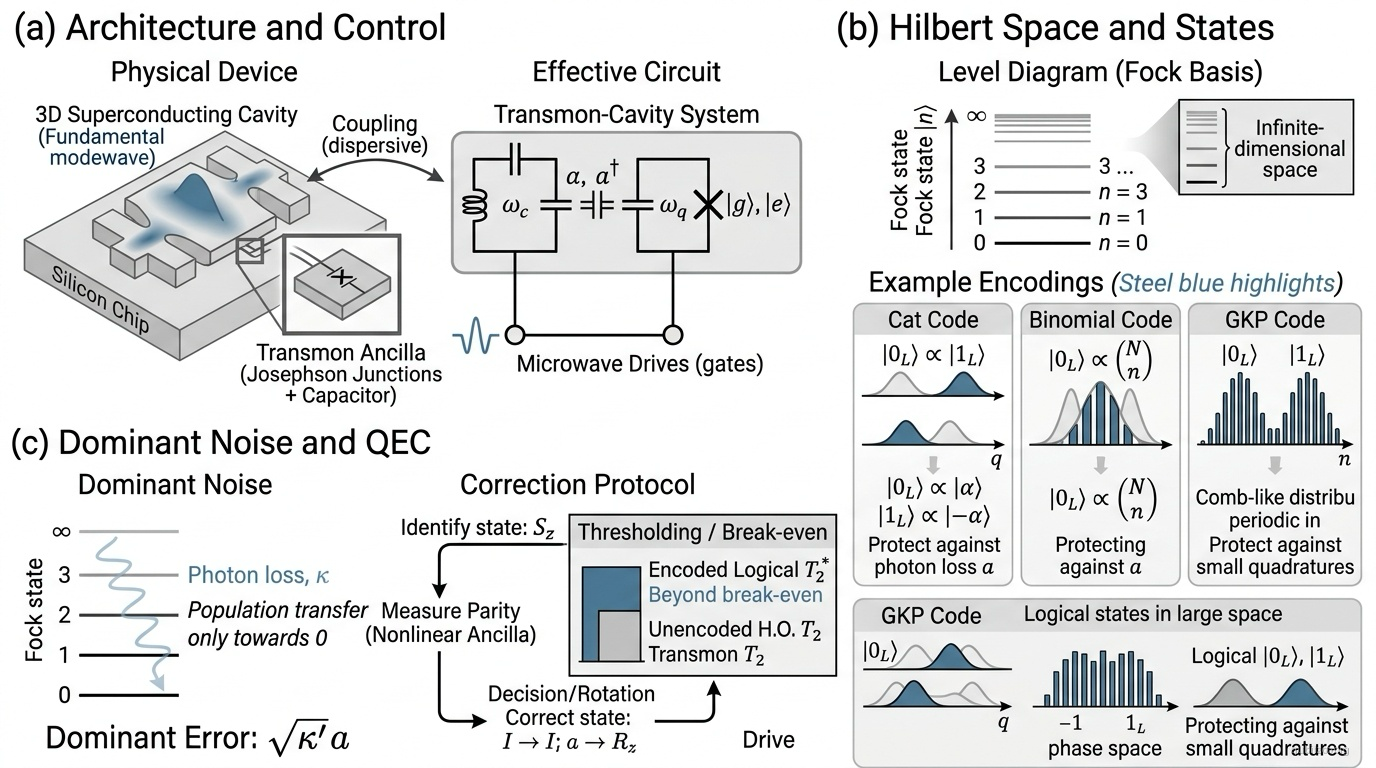
Description
A bosonic qubit encodes quantum information in the Hilbert space of one or more harmonic-oscillator modes, typically superconducting microwave cavities or optical modes. Rather than identifying the qubit with two energy levels of one nonlinear element, bosonic encodings choose a two-dimensional logical subspace inside a much larger oscillator space. That redundancy can make dominant errors—especially photon loss—correctable, detectable as erasures, or strongly biased toward one logical Pauli channel.
In circuit QED, a long-lived cavity is commonly coupled to a nonlinear ancilla such as a transmon or fluxonium. The ancilla supplies number-selective control, syndrome extraction, and readout, but it can also import dephasing, loss, and unwanted Kerr nonlinearities into the storage mode. Bosonic-QEC design therefore concerns both the logical code words and the control architecture that manipulates them without destroying their error structure.
Important encoding families include:
- Cat codes (cat-codes): coherent-state superpositions whose engineered stabilization produces a strongly biased logical noise channel. Depending on the code convention, photon loss either changes a tracked parity sector or acts primarily as a logical phase error. The Kerr-cat variant (kerr-cat-qubit) uses driven nonlinearity for stabilization.
- Binomial codes (binomial-codes): finite superpositions of Fock states chosen so that specified orders of loss, gain, and dephasing satisfy the quantum error-correction conditions.
- GKP codes (gkp-codes): grid states in oscillator phase space that convert small displacement errors in both quadratures into correctable shifts.
- Dual-rail cavity codes (dual-rail-superconducting-qubit): a single excitation shared by two modes, with photon loss leaving the code space and therefore becoming a detectable erasure.
Bosonic qubits have achieved beyond-break-even quantum error correction, meaning that an encoded memory outlives the best relevant unencoded component under the same comparison. The frontier has since moved from protected idling toward scalable concatenation, error-transparent control, and bias-preserving entangling gates.
Hamiltonian
The bare storage mode is a quantum harmonic oscillator (with its constant zero-point energy omitted):
where and are annihilation and creation operators. For a cavity whose dominant error is single-photon loss, the open-system dynamics contains the collapse operator . A more complete umbrella model also includes dephasing, , plus ancilla-induced channels.
In the two-level approximation for a dispersively coupled ancilla, a representative Hamiltonian is
where the sign of follows the displayed convention. The number-dependent ancilla transition enables parity or modular-quadrature measurements and conditional control. There is no single universal “bosonic-code Hamiltonian”: cat stabilization adds driven nonlinear or dissipative terms, GKP protocols use conditional displacements and feedback, and dual-rail gates use beam-splitter and dispersive interactions between modes.
Motivation
- Hardware efficiency: A single high-quality cavity mode replaces many physical qubits for error correction.
- Engineered error structure: Photon loss, small displacements, or biased phase errors can be targeted by the encoding; which channel dominates is device- and code-dependent.
- Beyond break-even QEC: Multiple bosonic codes have demonstrated logical qubit lifetimes exceeding the best uncorrected encodings.
- Compatibility with circuit QED: The mature superconducting circuit platform provides universal control of cavity modes via ancilla transmons.
- Modularity: Bosonic qubits can serve as logical building blocks for concatenated architectures (bosonic code + surface code).
Experimental Status
Cat codes — Ofek et al. (2016):
- First bosonic break-even demonstration, using repeated photon-parity tracking in a 3D superconducting cavity.
Binomial codes — Hu et al. (2019):
- Repetitive correction of single-photon loss together with a universal single-logical-qubit gate set; the reported average process fidelity was 97%.
GKP codes — Campagne-Ibarcq et al. (2020) and Sivak et al. (2023):
- Established repeated stabilization of a cavity GKP qubit and then real-time QEC beyond break-even, with coherence gain over the best constituent.
Dual-rail erasure qubits — Chou et al. (2024):
- Demonstrated logical SPAM error at the 0.01% level and detected more than 99% of cavity-decay events as erasures.
Concatenated cat-code memory — Putterman et al. (2025):
- Combined five stabilized bosonic cat qubits with a distance-5 repetition code. The phase-flip correction operated below threshold, with a minimum measured logical error of per cycle at distance 5.
Error-structured logical operations — 2026:
- Roy et al. demonstrated an error-semitransparent gate set and a fivefold reduction of infidelity conditioned on photon loss.
- D-Wave Quantum Inc. demonstrated a roughly 500 ns dual-rail cavity CZ with about 0.5% erasure probability, residual Pauli errors below 0.1%, and bit flips at the level.
- Copetudo et al. reported a direct Raman-assisted controlled-phase interaction between microwave photons without populating the nonlinear coupler (preprint).
Key Metrics
| Metric | Value | Notes | Fidelity reference |
|---|---|---|---|
| Cavity single-photon lifetime | ms | Coaxial 3D memory cavity coupled to a transmon | Reagor et al. 2016 |
| GKP QEC coherence gain | Relative to the best constituent in the same device | Sivak et al. 2023 | |
| Binomial logical-gate process fidelity | 97% average | Universal single-logical-qubit gate set under the reported protocol | Hu et al. 2019 |
| Dual-rail logical SPAM error | 0.01% level | With integrated erasure detection | Chou et al. 2024 |
| Detected cavity-decay events | Dual-rail decay flagged as erasure | Chou et al. 2024 | |
| Distance-5 logical error per cycle | Concatenated cat + repetition-code memory | Putterman et al. 2025 | |
| Dual-rail CZ | ns; erasure; residual Pauli error | Bias-preserving cavity-qubit entangling gate | D-Wave Quantum Inc. 2026 |
| Photon-loss-conditioned gate infidelity | 5× reduction | Error-semitransparent logical control | Roy et al. 2026 |
References
Reviews
- A. Joshi, K. Noh, and Y. Y. Gao, “Quantum information processing with bosonic qubits in circuit QED,” Quantum Sci. Technol. 6, 033001 (2021)
Key experimental milestones
- N. Ofek et al., “Extending the lifetime of a quantum bit with error correction in superconducting circuits,” Nature 536, 441 (2016)
- P. Campagne-Ibarcq et al., “Quantum error correction of a qubit encoded in grid states of an oscillator,” Nature 584, 368 (2020)
- L. Hu et al., “Quantum error correction and universal gate set operation on a binomial bosonic logical qubit,” Nature Physics 15, 503 (2019)
- V. V. Sivak et al., “Real-time quantum error correction beyond break-even,” Nature 616, 50 (2023)
- K. S. Chou et al., “A superconducting dual-rail cavity qubit with erasure-detected logical measurements,” Nature Physics 20, 1454 (2024)
- H. Putterman et al., “Hardware-efficient quantum error correction via concatenated bosonic qubits,” Nature 638, 927 (2025)
- S. Roy, O. C. Wetherbee, and V. Fatemi, “Error semitransparent universal control of a bosonic logical qubit,” Nature Communications (2026)
- D-Wave Quantum Inc., “An entangling gate for dual-rail erasure qubits,” Nature 656, 47 (2026)
Linked Papers
- copetudo-2026-a-direct-controlled-phase-gate
- campagneibarcq-2020-error-correction-qubit
- chou-2024-superconducting-dual-rail
- d-wave-quantum-2026-entangling-dual-rail-gate
- hu-2019-binomial-bosonic-logical-qubit
- joshi-2021-information-processing-bosonic
- ofek-2016-extending-lifetime-bit
- putterman-2025-hardware-efficient-bosonic-qec
- reagor-2016-quantum-memory-millisecond
- roy-2026-error-semitransparent-bosonic-control
- sivak-2023-real-time-error
Evergreen context
- bosonic-code-hierarchy — the most direct evergreen map of the main bosonic code families
- dispersive-readout-mechanism — the operational primitive behind cavity-transmon parity checks, photon-number-resolved ancilla measurements, and real-time bosonic syndrome extraction
- noise-bias-and-asymmetric-error-channels — important for cat-style bosonic protection
- erasure-error-vs-pauli-error — important when comparing bosonic loss channels to standard qubit noise models
Related Entries
- cat-codes — coherent state superposition encoding
- binomial-codes — Fock state superposition encoding with binomial coefficients
- gkp-codes — grid state encoding in phase space
- kerr-cat-qubit — driven-dissipative cat code variant
- circuit-qed — hardware platform
- transmon — ancilla qubit used for bosonic state preparation, control, and readout
- dual-rail-superconducting-qubit — two-mode bosonic encoding that converts photon loss into a detected erasure
- erasure-qubit — system-level context for exploiting detected leakage or loss