 Qubit Zoo
Figure
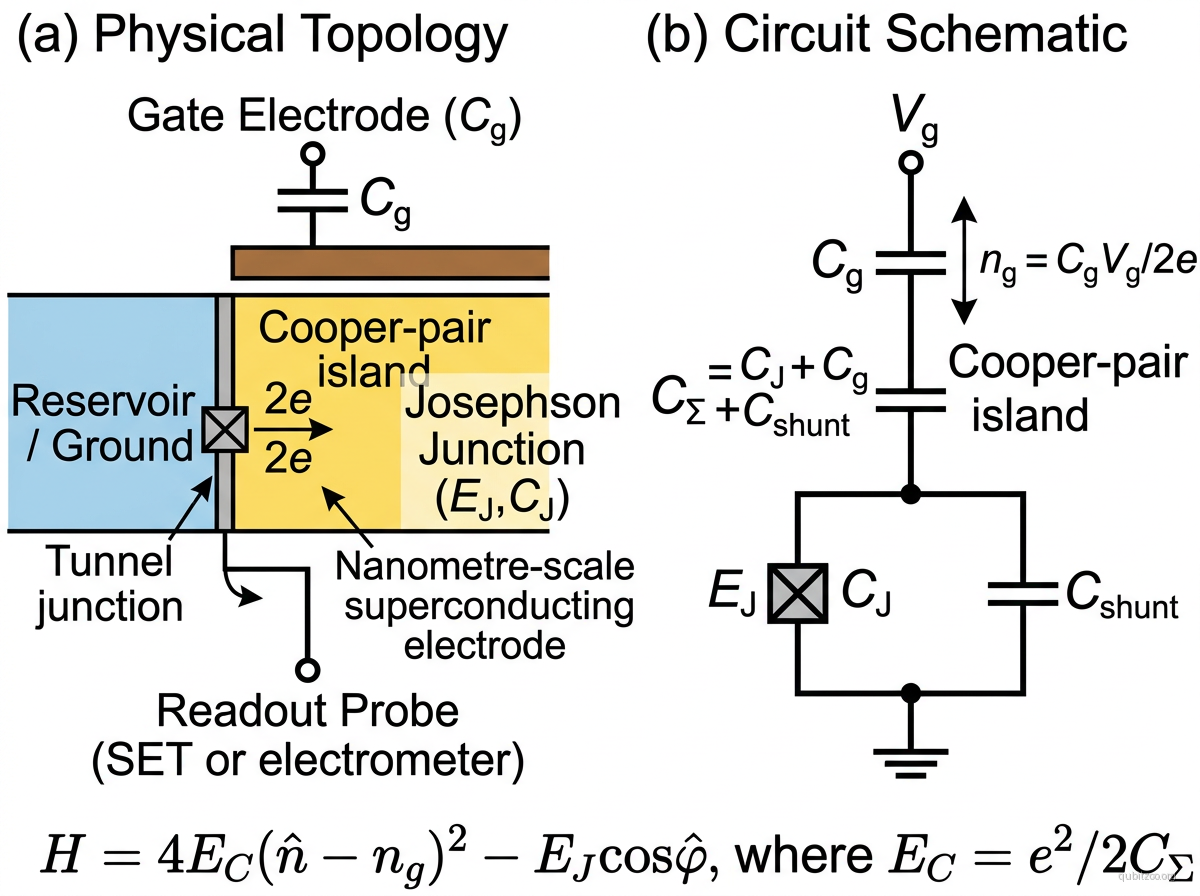
Description
A nanometre-scale superconducting electrode (the “island”) connected to a reservoir via a Josephson junction constitutes an artificial two-level electronic system: a single-Cooper-pair box. The two levels consist of charge states differing by one Cooper pair () that are coupled by tunneling through the junction. Although the two-level system is macroscopic, containing a large number of electrons, the two charge states can be coherently superposed.
The Cooper-pair box operates in the charge regime where — the electrostatic energy cost of adding a Cooper pair to the island exceeds the Josephson coupling energy. At the charge degeneracy point , the two lowest charge states and are degenerate and split by the Josephson energy , forming a protected sweet spot with first-order insensitivity to charge noise. Away from this point, the qubit frequency is strongly sensitive to gate charge fluctuations, which historically limited coherence times.
The Cooper-pair box was the first superconducting qubit to demonstrate coherent quantum oscillations (Nakamura, Pashkin, and Tsai, 1999), establishing superconducting circuits as a viable platform for quantum computing. Its extreme charge noise sensitivity motivated the development of the transmon (), which trades anharmonicity for exponential suppression of charge dispersion.
Hamiltonian
where is the charging energy, is the total island capacitance, is the gate-induced charge in units of Cooper pairs, is the Josephson energy, and , are conjugate charge number and phase operators.
In the charge regime (), the two lowest-energy states near the degeneracy point are approximately:
The qubit frequency is minimized at degeneracy () and is first-order insensitive to charge noise at that point.
Motivation
The Cooper-pair box was the original “artificial atom” formed in a superconducting circuit, demonstrating that macroscopic electrical circuits could exhibit quantum coherent behavior. Its sensitivity to charge noise () at generic operating points motivated the development of charge-insensitive variants: the transmon (large shunt capacitance, ) and the fluxonium (superinductive shunt). The CPB remains foundational as the circuit from which the entire family of superconducting qubits descends.
Experimental Status
First coherent oscillations — Nakamura, Pashkin, and Tsai (1999):
- Demonstrated time-domain coherent quantum oscillations in a single-Cooper-pair box.
- Gate-voltage pulses drove Rabi-like oscillations between charge states.
- Coherence limited by charge noise to .
Quantronium — Vion et al. (2002):
- Operated at the charge degeneracy sweet spot, achieving .
- Introduced Ramsey interferometry and spin-echo techniques for superconducting qubits.
- Demonstrated single-qubit gate fidelity ~99%.
Two-qubit coupling — Yamamoto et al. (2003):
- Capacitive coupling between two CPBs demonstrated with ~95% gate fidelity.
Key Metrics
| Metric | Value | Notes | Fidelity reference |
|---|---|---|---|
| ~1–10 μs | Limited by charge noise | Nakamura et al. 1999 | |
| ~0.5–5 μs | At sweet spot () | Vion et al. 2002 | |
| 1Q gate fidelity | ~99% | Voltage-pulse driven | Vion et al. 2002 |
| 2Q gate fidelity | ~95% | Capacitive coupling | Yamamoto et al. 2003 |
| Gate time (1Q) | ~1–10 ns | Fast voltage pulses | — |
| Gate time (2Q) | ~10–50 ns | Capacitive coupling | — |
| Readout fidelity | ~90–95% | Probe junction or SET | Vion et al. 2002 |
| Qubit footprint | ~1 × 1 μm² | Very compact | — |
| Operating temperature | 20–50 mK | Dilution refrigerator | — |
| Connectivity | Fixed capacitive | Nearest-neighbor | — |
References
Original demonstration
- Y. Nakamura, Yu. A. Pashkin, and J. S. Tsai, “Coherent control of macroscopic quantum states in a single-Cooper-pair box,” Nature 398, 786 (1999)
Key experiments
- D. Vion et al., “Manipulating the Quantum State of an Electrical Circuit,” Science 296, 886 (2002)
- T. Yamamoto et al., “Demonstration of conditional gate operation using superconducting charge qubits,” Nature 425, 941 (2003)
Related theory
- V. Bouchiat et al., “Quantum Coherence with a Single Cooper Pair,” Phys. Scr. T76, 165 (1998)
Linked Papers
- nakamura-1999-cpb-coherent-oscillation
- bouchiat-1998-coherence-single-cooper
- koch-2007-transmon
- pashkin-2003-oscillations-coupled-charge
- vion-2002-manipulating-state-electrical
Evergreen context
- charge-noise-in-superconducting-qubits — the original failure mode that limited the CPB
- charge-noise-sweet-spot — why the charge degeneracy point mattered, and why it was not enough
- josephson-junction-as-nonlinear-element — the nonlinear element underlying the CPB Hamiltonian
- coherence-time-hierarchy — how to read the jump from nanosecond-scale charge-noise-limited operation to the later sweet-spot and transmon generations
- jaynes-cummings-in-circuits — the CPB was the original artificial atom in the first circuit-QED mapping, before the transmon became the dominant superconducting implementation
Related Entries
- transmon — descendant operating in for charge noise immunity
- fluxonium — inductive shunt alternative to capacitive shunting
- blochnium — quasicharge regime of the fluxonium circuit
- phase-qubit — operates in the complementary phase regime
- flux-qubit — encodes in persistent-current states rather than charge
- circuit-qed — CPB was the original qubit in the Blais et al. proposal