 Qubit Zoo
Figure
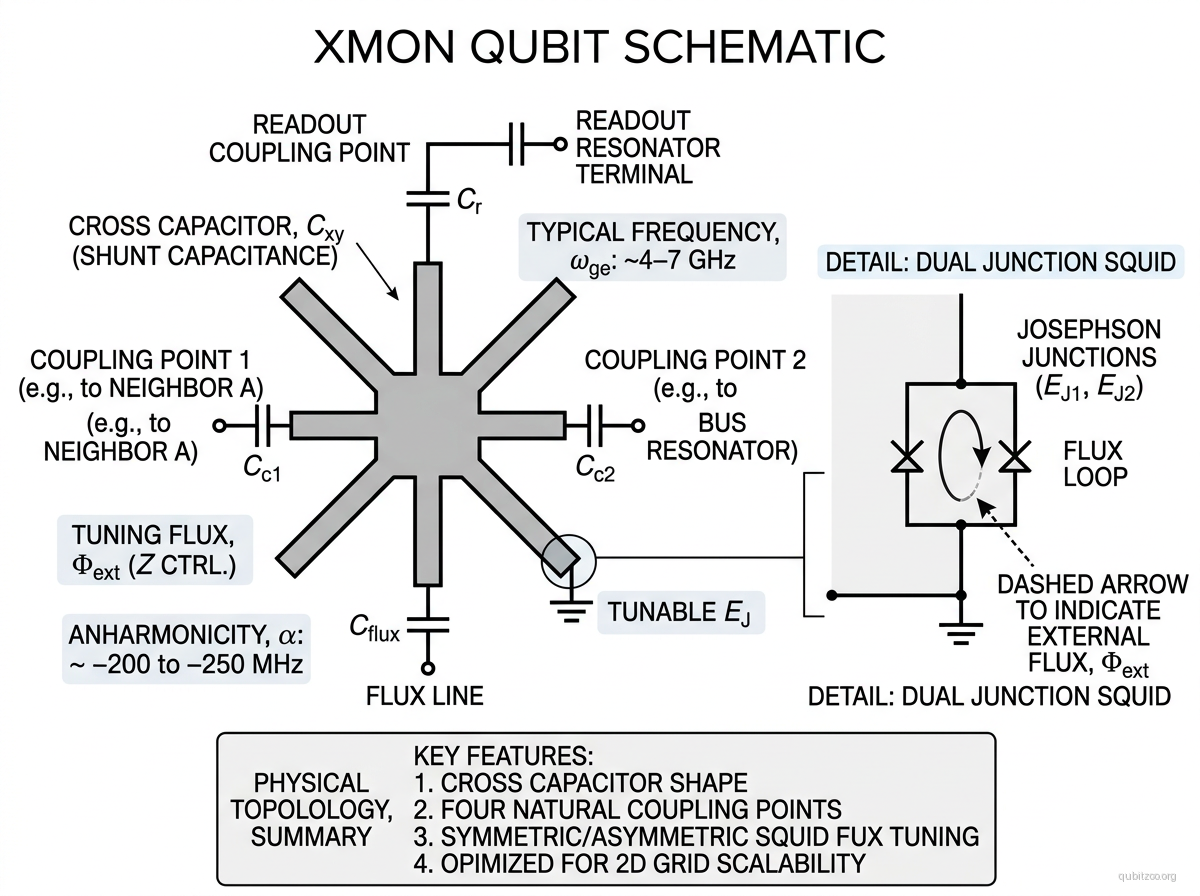
Description
The Xmon is a planar transmon variant developed by the Martinis group (later Google Quantum AI) featuring a cross-shaped capacitor geometry. Introduced by Barends et al. (2013), the ”+” shape provides four natural coupling points — one for readout and up to three for nearest-neighbor qubit-qubit coupling — enabling a scalable 2D grid layout.
The Xmon shares the same physics as the transmon (, charge-insensitive regime) but its geometry is optimized for multi-qubit integration. Each arm of the cross can capacitively couple to a bus resonator or neighboring Xmon, and the design minimizes spurious cross-talk. The qubit frequency is typically tunable via a SQUID loop (split junction), enabling parametric two-qubit gates (e.g., SWAP or CZ via flux pulses).
The Xmon was the qubit used in Google’s Sycamore processor (2019 quantum supremacy demonstration) and subsequent Willow processor.
Hamiltonian
Identical to the transmon:
For the tunable variant (asymmetric SQUID):
where and is the junction asymmetry.
Motivation
Earlier transmon designs used coaxial or lumped-element capacitors that did not naturally tile into 2D arrays. The cross geometry solves the layout problem: it provides controllable coupling to 4 neighbors in a square lattice while maintaining low crosstalk and individual readout. This geometry was the key enabler for scaling to the 53-qubit Sycamore and 72-qubit Willow processors.
Experimental Status
First demonstration — Barends et al. (2013):
- Introduced the cross-shaped capacitor geometry for planar transmon qubits
- Demonstrated of 20–40 μs in the initial devices
- Showed compatibility with scalable 2D grid layouts
Surface code threshold — Barends et al. (2014):
- Demonstrated single-qubit gate fidelity of 99.92% and two-qubit gate fidelity of 99.4% via randomized benchmarking
- First superconducting qubit system to reach the surface code fault-tolerance threshold
- Five-qubit device with simultaneous high-fidelity single- and two-qubit gates
Quantum supremacy — Arute et al. (2019):
- 53-qubit Sycamore processor using Xmon qubits
- Average single-qubit gate fidelity 99.84%, average CZ fidelity 99.4%
- Completed a random circuit sampling task in 200 seconds that would take classical supercomputers ~10,000 years
Key Metrics
| Metric | Value | Notes | Fidelity reference |
|---|---|---|---|
| 20–100 μs | Planar geometry | Barends et al. 2013 | |
| 1Q gate fidelity | 99.84–99.9%+ | Sycamore RB: 99.84% avg; Willow improved | Barends et al. 2014, Arute et al. 2019 |
| 2Q gate fidelity | 99.4–99.9% | CZ or SWAP via flux pulse; Sycamore 99.4% CZ avg | Barends et al. 2014, Arute et al. 2019 |
| Anharmonicity | −200 to −250 MHz | Same as transmon | — |
| Transition frequency | 4–7 GHz | Tunable via flux | — |
| Coupling to neighbors | 4 (cross arms) | Square lattice layout | — |
| Operating temperature | 10–20 mK | Dilution refrigerator | — |
References
Original proposal / first demonstration
- R. Barends et al., “Coherent Josephson Qubit Suitable for Scalable Quantum Integrated Circuits,” Phys. Rev. Lett. 111, 080502 (2013) — arXiv:1304.2322
Experimental demonstrations
- R. Barends et al., “Superconducting quantum circuits at the surface code threshold for fault tolerance,” Nature 508, 500 (2014) — arXiv:1402.4848
- F. Arute et al., “Quantum supremacy using a programmable superconducting processor,” Nature 574, 505 (2019) — arXiv:1910.11333
Linked Papers
- barends-2013-xmon
- arute-2019-supremacy-programmable-superconducting
- barends-2014-superconducting-circuits-surface
- chen-2014-gmon
- koch-2007-transmon
- sung-2021-parametric-coupler
Evergreen context
- charge-noise-sweet-spot — the Xmon inherits the transmon strategy of buying coherence by flattening charge sensitivity, then spends the saved robustness on a scalable planar layout.
- josephson-junction-as-nonlinear-element — the cross capacitor changes packaging, not the underlying source of anharmonicity: the Josephson cosine still does the qubit-making work.
- dispersive-readout-mechanism — one arm of the Xmon is effectively reserved for a readout resonator, so the planar geometry bakes the standard circuit-QED measurement layer directly into the qubit footprint.
- threshold-theorem — Xmon mattered historically because it was one of the first planar superconducting stacks to pair coherence and gate fidelities in the range needed for surface-code scaling.
- resonator-as-quantum-bus — the cross geometry was not just packaging: it gave the planar transmon a clean way to hook into bus-resonator-mediated coupling while still tiling into a 2D grid.
Related Entries
- transmon — parent qubit type
- gmon — related Google qubit variant with tunable coupling
- circuit-qed — underlying hardware platform