 Qubit Zoo
Figure
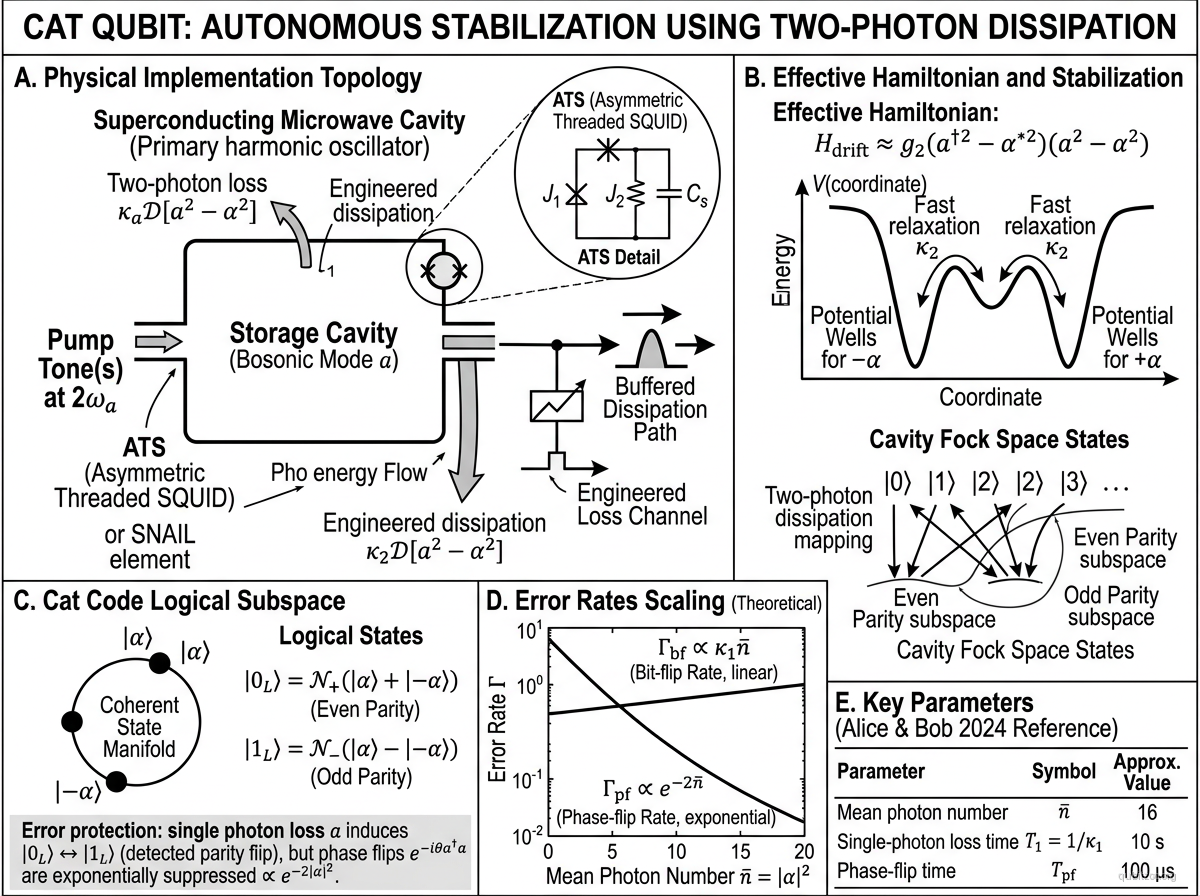
Description
Cat qubits encode quantum information in superpositions of coherent states of a harmonic oscillator (typically a superconducting microwave cavity). The logical states are:
where is a coherent state with mean photon number , and are normalization constants.
The key insight is that these states have exponentially different parity: lives in the even-photon Fock subspace and in the odd-photon subspace. Single-photon loss (the dominant error) maps — a detectable bit flip. But phase-flip errors (rotations in the coherent-state basis) are exponentially suppressed with increasing , because the overlap vanishes exponentially.
Modern implementations use two-photon driven-dissipative stabilization: a nonlinear element (Josephson junction or SNAIL) drives two-photon exchange between the cavity and a lossy buffer, confining the cavity state to the manifold spanned by and . This makes the cat qubit autonomous — it continuously corrects itself against single-photon loss while maintaining exponential bit-flip protection.
Alice & Bob (Paris) is developing cat qubits as their primary architecture, demonstrating bit-flip times exceeding 10 seconds with .
Hamiltonian
The driven-dissipative cat qubit is stabilized by the effective two-photon process:
with engineered two-photon dissipation:
where is the two-photon loss rate. The steady states of this dissipator are exactly .
The cat qubit error rates scale as:
- Bit-flip rate: (linear in photon loss rate)
- Phase-flip rate: (exponentially suppressed)
Motivation
Standard bosonic codes (like GKP) require complex active error correction. The cat qubit achieves exponential suppression of one error type (phase flips) autonomously through hardware design, reducing the problem to correcting only bit flips. Combined with a repetition code for the remaining bit-flip errors, this creates an asymmetric error correction scheme with favorable resource scaling.
Experimental Status
First demonstration of exponential bit-flip suppression — Lescanne et al. (2020):
- Demonstrated exponential suppression of phase-flip errors with increasing
- Used two-photon driven-dissipative stabilization in a superconducting cavity
- Achieved bit-flip times scaling with ratio
Bias-preserving CNOT gate — Guillaud and Mirrahimi (2019):
- Proposed and analyzed CNOT gate between cat qubits that maintains the exponential error bias
- Gate fidelity ~99% while preserving the noise asymmetry
- Compatible with repetition code for full fault tolerance
Alice & Bob scaling results (2024):
- Bit-flip times exceeding 10 s achieved with
- Demonstrated the practical viability of the cat qubit architecture for error-biased quantum computing
Key Metrics
| Metric | Value | Notes | Fidelity reference |
|---|---|---|---|
| Bit-flip time | 0.1–10+ s | Scales with and | Lescanne et al. 2020 |
| Phase-flip time | 1–100 μs | Scales as | Lescanne et al. 2020 |
| Mean photon number | 4–16 | Typical operating regime | Lescanne et al. 2020 |
| 10–100 | Two-photon vs single-photon loss ratio | Lescanne et al. 2020 | |
| CNOT gate fidelity | ~99% | Bias-preserving gate | Guillaud and Mirrahimi 2019 |
| Operating temperature | 10–20 mK | Dilution refrigerator | — |
References
Original proposal
- M. Mirrahimi et al., “Dynamically protected cat-qubits: a new paradigm for universal quantum computation,” New J. Phys. 16, 045014 (2014) — arXiv:1312.2017
Experimental demonstrations
- R. Lescanne et al., “Exponential suppression of bit-flips in a qubit encoded in an oscillator,” Nat. Phys. 16, 509 (2020) — arXiv:1907.11729
Related theory
- J. Guillaud and M. Mirrahimi, “Repetition Cat Qubits for Fault-Tolerant Quantum Computation,” Phys. Rev. X 9, 041053 (2019) — arXiv:1904.09474
Linked Papers
- mirrahimi-2014-cat-codes
- gottesman-2001-gkp
- grimm-2020-kerr-cat
- guillaud-2019-repetition-cat-qubits
- lescanne-2020-bit-flip-suppression
- michael-2016-binomial-codes
- puri-2020-bias-preserving-gates
- ye-2026-bias-preserving-cat-cat-cnot-gate
- masuda-2026-engineered-two-photon-dissipative-confinement
Evergreen context
- bosonic-code-hierarchy — where cat codes sit relative to GKP and binomial encodings
- josephson-junction-as-nonlinear-element — the physical source of the Kerr and parametric nonlinearities that superconducting cat implementations engineer into a stabilized manifold
- noise-bias-and-asymmetric-error-channels — the central idea behind exponentially biased cat noise
- erasure-error-vs-pauli-error — useful contrast when comparing bosonic and heralded architectures
Related Entries
- gkp-codes — alternative bosonic code with grid-state encoding
- kerr-cat-qubit — related cat qubit variant using Kerr nonlinearity
- circuit-qed — underlying hardware platform
- transmon — ancilla qubit used in cat qubit control
- binomial-codes — another bosonic code family