 Qubit Zoo
Figure
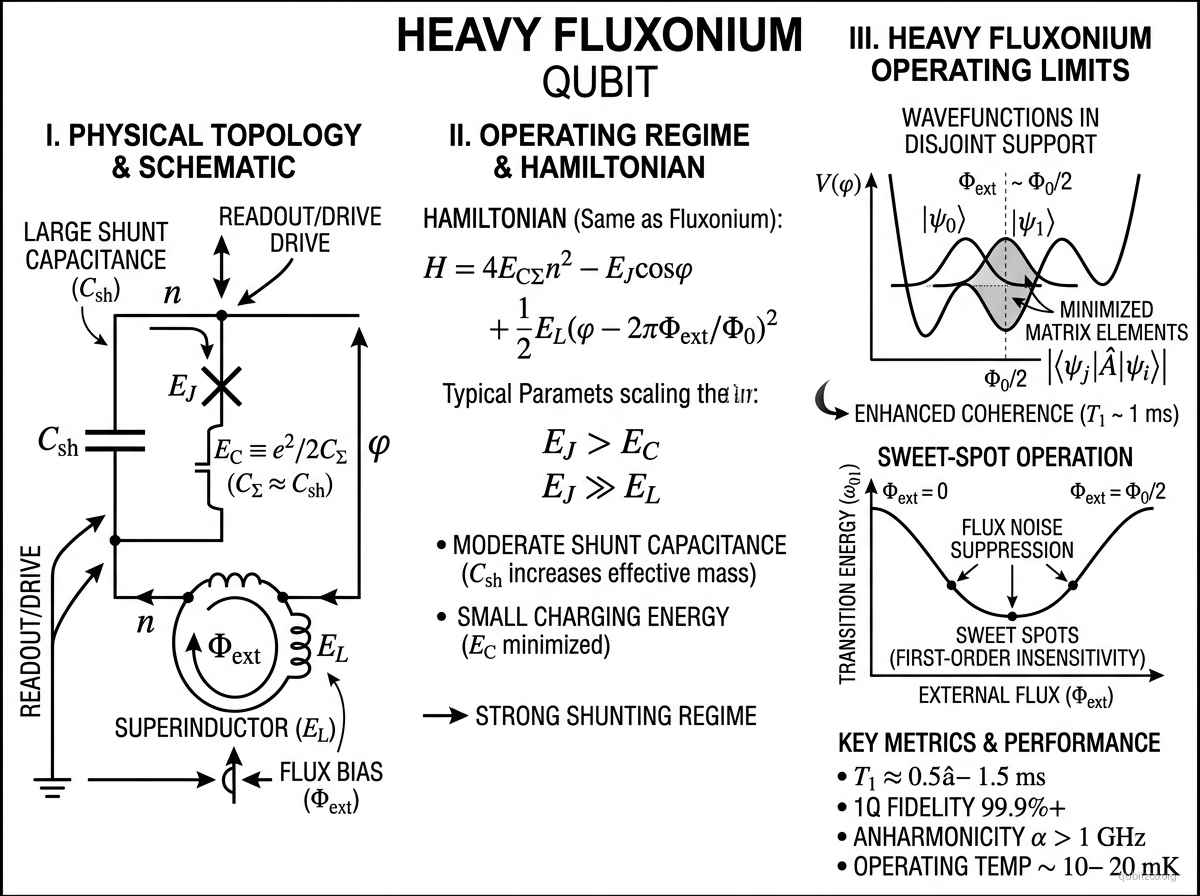
Description
Heavy fluxonium is a fluxonium regime engineered for maximal coherence by increasing effective mass in phase space (large capacitance, moderate ), producing wavefunctions with disjoint support and suppressed relaxation matrix elements.
Compared with conventional fluxonium, heavy fluxonium prioritizes coherence and error bias over speed, and has demonstrated millisecond-scale in sweet-spot operation.
Hamiltonian
Same base fluxonium Hamiltonian:
Heavy-fluxonium regime typically uses lower and operating points where wavefunctions are localized in different wells, suppressing dipole matrix elements.
Motivation
Heavy fluxonium targets a “hardware-protected” operating regime where coherence is improved by circuit design rather than solely by control optimization. By engineering large effective mass in phase space and operating at sweet spots, matrix elements for dominant noise channels are strongly suppressed. This architecture is a practical bridge between conventional superconducting qubits and more strongly protected designs such as 0-π.
Experimental Status
High-coherence fluxonium — Nguyen et al. (2019):
- Demonstrated in the 0.5–1.5 ms range at the half-flux-quantum sweet spot
- Large anharmonicity (GHz-scale) enables selective control with low leakage
- First-order flux-noise insensitivity at the sweet spot
Millisecond coherence — Somoroff et al. (2023):
- Achieved millisecond-scale and coherence times
- Single-qubit gate fidelity exceeding 99.9%
- Confirmed heavy fluxonium as a strong candidate for low-error bosonic/encoded hybrid stacks
Key Metrics
| Metric | Value | Notes | Fidelity reference |
|---|---|---|---|
| 0.5–1.5 ms | Sweet-spot operation | Nguyen et al. 2019 | |
| 1Q gate fidelity | 99.9%+ | Microwave control | Somoroff et al. 2023 |
| 2Q gate fidelity (CZ) | 99.2% | Conventional fluxonium regime; heavy-regime 2Q gates are active research frontier | Ficheux et al. 2021 |
| Anharmonicity | GHz-scale | Much larger than transmon | — |
| Operating temperature | 10–20 mK | Dilution refrigerator | — |
References
Original proposal / first demonstration
- L. B. Nguyen et al., “High-Coherence Fluxonium Qubit,” Phys. Rev. X 9, 041041 (2019) — arXiv:1907.12333
Experimental demonstrations
- A. Somoroff et al., “Millisecond Coherence in a Superconducting Qubit,” Phys. Rev. Lett. 130, 267001 (2023) — arXiv:2301.09549
Linked Papers
- lin-2018-heavy-fluxonium
- nguyen-2019-high-coherence-fluxonium
- somoroff-2023-millisecond-coherence-superconducting
Evergreen context
- charge-noise-in-superconducting-qubits — heavy fluxonium inherits fluxonium’s basic win of suppressing CPB-style charge dispersion before it layers on stronger matrix-element protection.
- charge-noise-sweet-spot — heavy fluxonium gets its best coherence only at carefully chosen flux-protected operating points on top of that baseline charge insensitivity.
- coherence-time-hierarchy — the millisecond-scale and claims are only meaningful in the sweet-spot versus off-sweet-spot context
- noise-bias-and-asymmetric-error-channels — disjoint-support wavefunctions suppress relaxation more strongly than the remaining dephasing channels
Related Entries
- fluxonium — parent qubit type
- 0-pi-qubit — related protected superconducting design
- transmon — conventional superconducting qubit for comparison