 Qubit Zoo
Figure
Description
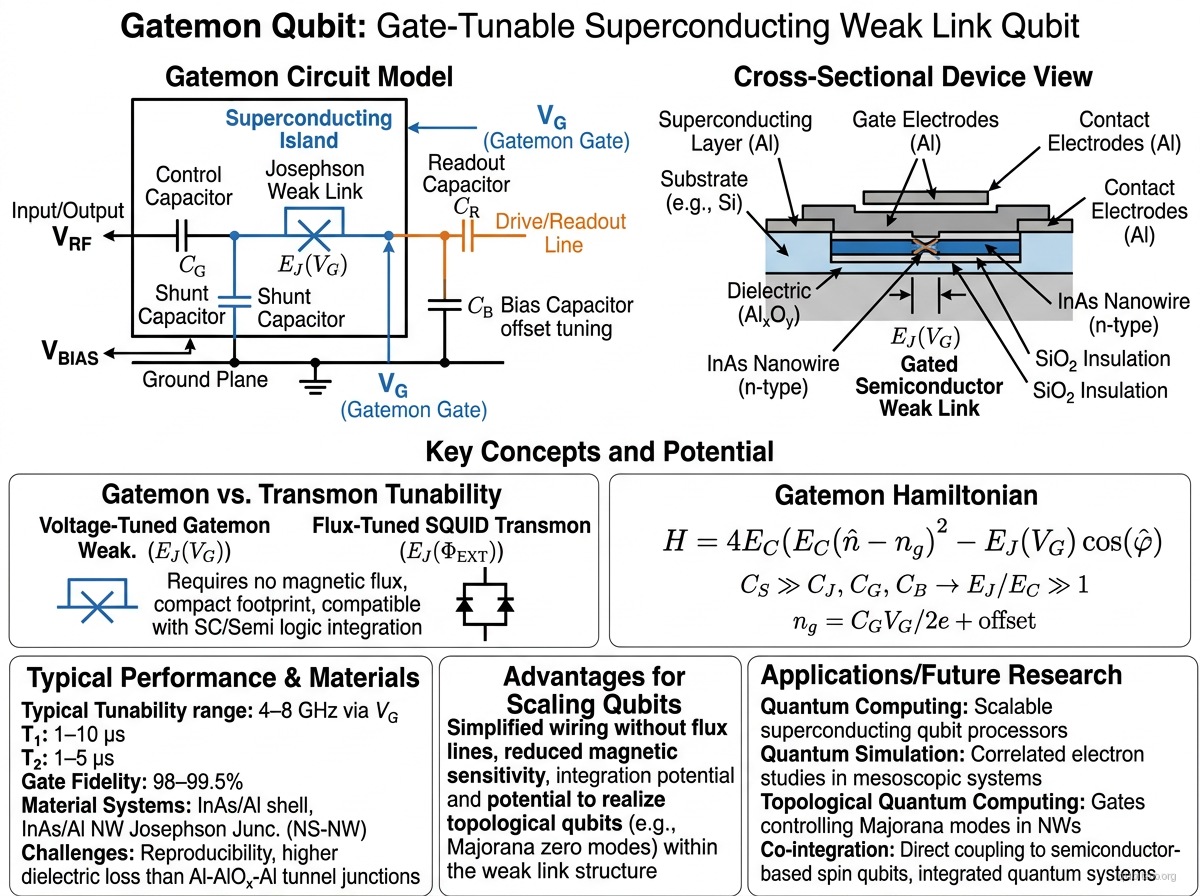
The gatemon is a transmon-like superconducting qubit in which the conventional superconductor-insulator-superconductor tunnel junction is replaced by a gate-tunable superconductor-semiconductor-superconductor weak link. Implementations include proximitized InAs nanowires, planar InAs two-dimensional electron gases (2DEGs), and other gate-defined quantum conductors. The gate changes the weak link’s transmission eigenvalues and therefore its Josephson potential, making the qubit frequency voltage-tunable without a SQUID flux-bias loop.
Introduced independently by Larsen et al. and de Lange et al. in 2015, the gatemon operates in the transmon regime (), which suppresses ordinary offset-charge dispersion. Voltage control avoids the first-order flux-noise channel of a SQUID-tunable transmon and can use high-impedance, low-static-power wiring. It does not make the device automatically lower-noise: charge traps, gate hysteresis, dielectric loss, and junction-specific dissipation remain important.
Because a semiconductor weak link can contain a few highly transmitting channels, its current-phase relation can be strongly non-sinusoidal. The resulting higher harmonics change the anharmonicity and spectrum relative to the tunnel-junction transmon. The same hybrid junction also provides a circuit-QED probe of Andreev physics and a materials route toward magnetic-field-compatible superconducting circuits; Majorana integration remains a proposed research direction rather than a demonstrated gatemon-computing capability.
The central tradeoff is coherence and stability. A 2025 reliability study achieved repeatable 1 MHz frequency placement across several gigahertz, but a controlled 2026 comparison still found gatemon values in the few-microsecond range while matched tunnel-junction transmons reached tens of microseconds. A 2025 -Sn/InAs device reported , showing that the limit is materials- and junction-dependent rather than a fixed architectural constant.
Hamiltonian
The charging term is the same as for a transmon, but the Josephson potential is set by the transmission eigenvalues of the semiconductor weak link:
This short-junction expression assumes the even-parity ground branch at temperatures small compared with the induced gap . In the tunnel or low-transparency limit it reduces, up to an additive constant, to the familiar approximation
At higher channel transparency the full must be retained; equivalently, the current-phase relation contains higher harmonics. The gate primarily tunes and , while denotes offset charge and is not the same control variable.
Motivation
- Replace local SQUID flux bias with high-impedance electrostatic control of the weak-link transmission and qubit frequency.
- Enable voltage-controlled rotations and potentially dense integration with semiconductor processing, while accepting gate-noise and hysteresis engineering challenges.
- Use circuit QED to study few-channel Josephson physics and hybrid materials in a coherent quantum circuit.
- Develop superconducting circuits that may tolerate magnetic fields better than conventional all-aluminum SQUID-tunable devices.
Experimental Status
First demonstrations — Larsen et al. and de Lange et al. (2015):
- Larsen et al. demonstrated coherent control of an epitaxial Al/InAs nanowire gatemon, with first-generation and .
- de Lange et al. independently demonstrated capacitively shunted InAs/NbTiN nanowire Josephson elements. Their two-element loop exhibited a non-sinusoidal current-phase relation and flux-qubit-like behavior near half flux; it was not a two-gatemon entangling-gate demonstration.
Benchmarking and planar scaling — Casparis et al. (2016, 2018):
- A two-nanowire-gatemon device demonstrated randomized-benchmarking single-qubit errors below 0.7% (fidelity above 99.3%) and an estimated 91% controlled-phase-gate fidelity in 2016.
- The 2018 device used a proximitized InAs/Al 2DEG, not Ge/SiGe, and demonstrated voltage-controlled single-qubit rotations, coherent swap operations, and coherence up to about .
Materials, stability, and present limits (2024–2026):
- Strickland et al. (2024) measured across a 1.5 GHz tunable band in one InAs-2DEG process, illustrating that wafer-scale hybrid materials can dominate loss.
- Feldstein-Bofill et al. (2025) achieved reliable 1 MHz frequency placement over several gigahertz and found grounded shunt capacitors more stable than floating designs.
- Purkayastha et al. (2025, preprint) reported a -Sn/InAs nanowire gatemon with and echo .
- Sun et al. (2026, preprint) co-fabricated nominally matched gatemons and tunnel-junction transmons. Representative devices gave versus , and the measured gatemon loss exceeded their Purcell, control-line, and dielectric-loss budget, pointing to additional junction-intrinsic dissipation.
Key Metrics
| Metric | Value | Notes | Fidelity reference |
|---|---|---|---|
| 27 μs | High-coherence -Sn/InAs nanowire gatemon; preprint result | Purkayastha et al. 2025 | |
| Echo | 1.8 μs | Same -Sn/InAs device; maximum occurred at a different bias from maximum | Purkayastha et al. 2025 |
| Matched-device | 4.5 μs | Representative Al/InAs gatemon; matched tunnel-junction transmon: 25.8 μs | Sun et al. 2026 |
| Frequency placement | 1 MHz precision over several GHz | Grounded gatemon design | Feldstein-Bofill et al. 2025 |
| 1Q gate fidelity | >99.3% | Randomized benchmarking; error below 0.7% | Casparis et al. 2016 |
| 2Q controlled-phase fidelity | 91% (estimated) | Two-nanowire-gatemon device | Casparis et al. 2016 |
References
Original demonstrations
- T. W. Larsen et al., “Semiconductor-Nanowire-Based Superconducting Qubit,” Phys. Rev. Lett. 115, 127001 (2015); arXiv:1503.08339.
- G. de Lange et al., “Realization of Microwave Quantum Circuits Using Hybrid Superconducting-Semiconducting Nanowire Josephson Elements,” Phys. Rev. Lett. 115, 127002 (2015); arXiv:1503.08483.
Gate benchmarking
- L. Casparis et al., “Gatemon Benchmarking and Two-Qubit Operations,” Phys. Rev. Lett. 116, 150505 (2016); arXiv:1512.09195.
2DEG gatemon
- L. Casparis et al., “Superconducting gatemon qubit based on a proximitized two-dimensional electron gas,” Nature Nanotech. 13, 915–919 (2018); arXiv:1711.07665.
2024–2026 updates
- W. M. Strickland et al., “Characterizing losses in InAs two-dimensional electron gas-based gatemon qubits,” Phys. Rev. Research 6, 023094 (2024); arXiv:2309.17273.
- D. Feldstein-Bofill et al., “Gatemon qubit revisited for improved reliability and stability,” Phys. Rev. Applied 24, 044099 (2025); arXiv:2412.11611.
- A. Purkayastha et al., “Transmon qubit using Sn as a junction superconductor,” arXiv:2508.04007 (2025 preprint).
- Z. Sun et al., “Junction-Intrinsic Dissipation in Hybrid Superconductor-Semiconductor Gatemon Qubits,” arXiv:2603.29498 (2026 preprint).
Linked Papers
- larsen-2015-gatemon
- de-lange-2015-hybrid-nanowire-josephson-elements
- casparis-2016-gatemon-benchmarking
- casparis-2018-ge-gatemon
- strickland-2024-gatemon-losses
- feldstein-bofill-2025-gatemon-reliability
- purkayastha-2025-sn-inas-gatemon
- sun-2026-junction-intrinsic-dissipation-in-hybrid
- hays-2021-andreev-spin-qubit
- shim-2014-bottom-up-sc
- shim-2016-semiconductor-inspired
- strickland-2024-gatemonium
Evergreen context
- josephson-junction-as-nonlinear-element — the gatemon keeps transmon physics but replaces the oxide tunnel barrier with a semiconductor weak link whose is tuned electrostatically.
- dispersive-readout-mechanism — in practice the measurement story is still the standard circuit-QED one: gate tuning changes the qubit, but the state is read out from a small resonator shift rather than from a new measurement primitive.
- charge-noise-in-superconducting-qubits — even with a semiconductor weak link, the underlying CPB/transmon Hamiltonian still inherits the same offset-charge noise channel that large is meant to suppress.
- charge-noise-sweet-spot — its protection story is still the transmon one: keep charge dispersion flat enough that the added gate knob does not drag the device back toward charge-qubit fragility.
- quantum-hardware — this is the cleanest bridge between mainstream superconducting control stacks and semiconductor-process ambitions.
- purcell-protection-via-detuning — the Sun et al. (2026) matched-device comparison shows gatemon fell well below the Purcell limit, pinning the residual loss on junction-intrinsic dissipation rather than circuit-QED design.
Related Entries
- transmon — parent qubit architecture; gatemon replaces the tunnel junction
- gatemonium — related semiconductor-superconductor hybrid qubit
- andreev-spin-qubit — same material platform, spin degree of freedom
- quantum-transduction — hybrid superconducting-semiconductor circuits are also studied as interfaces and field-compatible circuit elements