 Qubit Zoo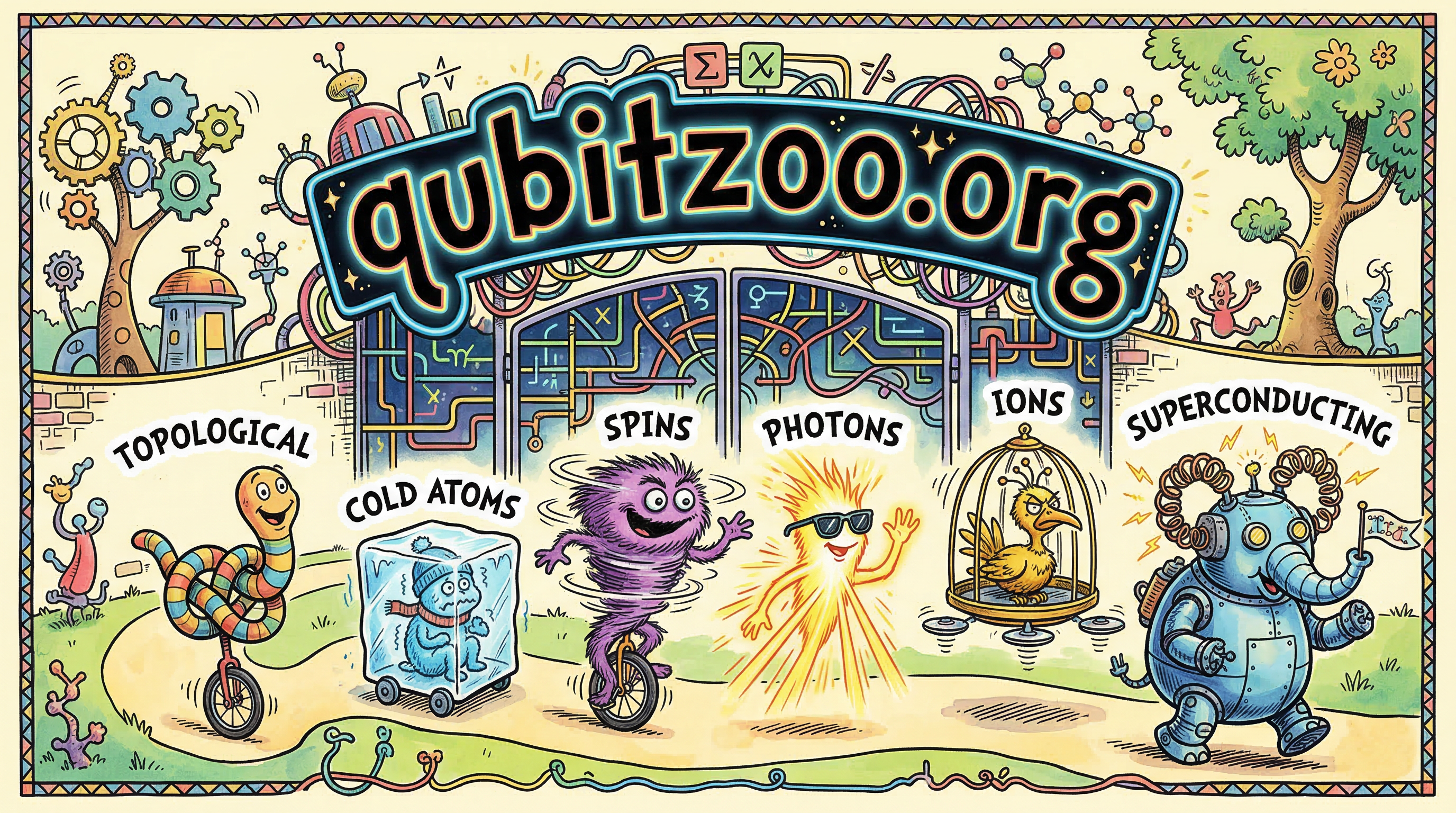
The Qubit Zoo is home to the qubits you qnow and love — and some you don’t yet. It is a curated atlas of physical qubit platforms, encodings, and the hardware primitives needed to operate and scale them, organized as a living Zettelkasten with Hamiltonians, performance metrics, and links to primary papers.
The qubit zoo is for hardcore qubit geeks and (hopefully) motivates further development of new and better qubits and associated quantum gates, some of which may be inspired by old ideas.
In case you didn’t qnow* (the q is silent), qubits are needed for quantum computers.
Explore the Current Facets
These maps are non-exclusive: one entry may belong to several facets, and the membership counts therefore add to more than the number of unique Zoo entries. The facets mix physical platforms with encodings, interfaces, and systems roles; a clearer multi-axis taxonomy is in development. Counts are not rankings of importance or maturity.
| Family | Entries | Description |
|---|---|---|
| 🔵 Superconducting | 22 | Josephson-junction qubits, circuits, couplers, and readout |
| 🟢 Semiconducting | 12 | Quantum-dot, donor, and semiconductor spin qubits |
| 🟡 Trapped Ion | 5 | Trapped ions, shuttling architectures |
| 🟠 Neutral Atom | 4 | Rydberg, clock, and nuclear-spin atom encodings |
| 🔴 Photonic | 9 | Discrete-variable and continuous-variable photonics |
| 🟣 Majorana ∕ Topological Superconductor | 3 | Majorana and topological-superconductor encodings |
| ⚡ Super-Semi | 6 | Superconductor-semiconductor hybrid devices |
| 💎 Color Center | 4 | Diamond, silicon, and silicon-carbide defects |
| 🔗 Spin-Photon | 5 | Network-emitter and optical-interface qubits |
| 🧪 Molecular | 3 | Molecular spin and polar-molecule qubits |
| 🌊 Floating Electron | 1 | Electrons hosted above cryogenic surfaces |
| 🧩 Codes | 6 | Bosonic and logical error-correcting encodings |
| 🧭 Cross-Platform | 10 | Architectures, gates, and platform-independent primitives |
| 🛠️ Classical Hardware | 2 | Cryogenic control and amplification infrastructure |
Featured Quanimals
- transmon — The workhorse of superconducting quantum computing
- fluxonium — Ultra-high coherence with large inductance
- spin-qubit — Silicon-based quantum dots for scalable processors
- trapped-ion-qubit — Record gate fidelities with atomic ions
Interactive Tools
- 🧬 Qubit Genealogy — Interactive family tree of qubit evolution.
- 🏁 The Qubit Race — Comparison methodology under development; no leaderboard is published yet.
Why a Qubit Zoo?
Qubits improve based on knowledge gained from previous qubit proposals and realizations. As we better understand what limits performance — decoherence mechanisms, material parameters, control overhead — we can sometimes use that knowledge to radically advance the state of the art. Many ideas from the early days of quantum computing, since forgotten, may be applicable again now that we have working qubits.
Developments can also be applied across technologies. It pays to understand qubits in all their forms when designing new ones. Hybrid qubits are possible too.
How This Works
This site is generated from a curated Obsidian vault. A daily pipeline discovers papers from arXiv and performs structured extraction and model cross-checks. Review depth varies by entry; those automated checks are not independent expert verification, and primary sources remain authoritative.
- Editorial Policy — What belongs in the Zoo
- Use the graph view (right sidebar) to explore connections between entries
- Use search (top left) to find specific qubits, concepts, or papers
- Backlinks show you what references each entry
Why isn’t qubit X in the Zoo? Because you haven’t submitted it yet.
The Qubit Zoo is maintained by Scibok — an AI-assisted scientific knowledge engine, built by a hardcore qubit geek.