 Qubit Zoo
Figure
Description
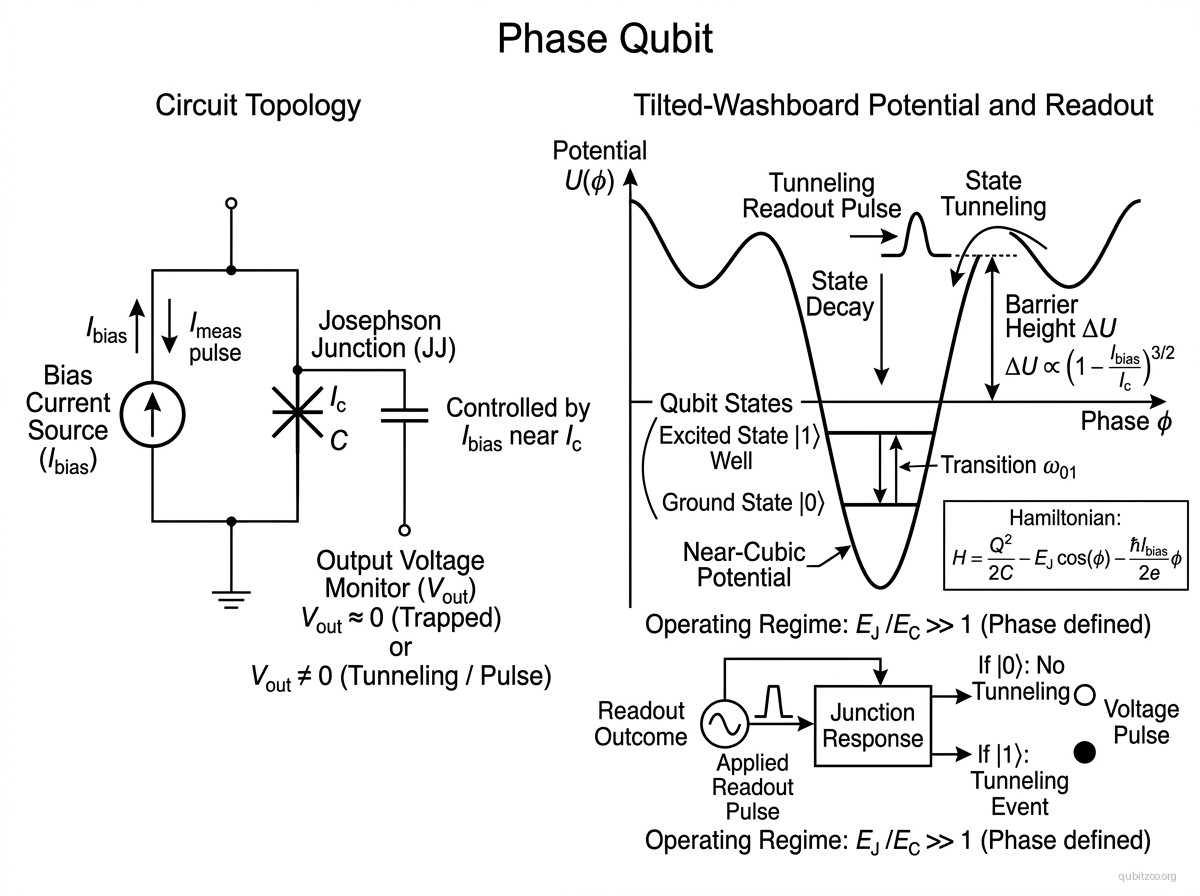
The phase qubit is a superconducting qubit based on a current-biased Josephson junction operating in the phase regime (). The qubit states are the two lowest energy levels in one metastable well of the tilted-washboard potential, which becomes approximately cubic when the bias approaches the junction critical current.
When biased near the critical current (), the washboard potential has shallow metastable wells containing only a few quantized levels. The two lowest levels serve as and , with transition frequency tunable by adjusting . The cubic asymmetry makes higher levels more closely spaced and gives excited states exponentially larger escape rates.
Readout exploits this escape-rate contrast. A fast bias pulse lowers the barrier so that the excited-state population escapes with much greater probability than ; the switched state is then amplified into a classical circulating-current or voltage signal. The original 2002 device first drove to enhance escape, whereas later capacitively shunted devices used direct state-selective tunneling.
The phase qubit was historically important—the Martinis group used it extensively from 2002 through the early 2010s—but it was superseded in quantum processors by transmon-family circuits with much longer coherence and nondestructive dispersive readout. Current-biased Josephson junctions remain active as macroscopic quantum systems and threshold detectors, not as a competitive processor-qubit architecture.
Hamiltonian
For a current-biased junction, with , , and , let denote the total capacitance seen by the junction phase mode, including the junction and intentional shunt capacitances,
Writing , the local minimum is at . For , expansion about that minimum gives
with plasma frequency
The exact barrier from the local minimum to the adjacent maximum is
where the approximation holds for . In the cubic-well limit the ground-state escape rate has the leading WKB dependence ; excited levels escape much faster.
Motivation
The phase qubit provided early demonstrations of quantum coherence and entanglement in superconducting circuits. Its straightforward readout mechanism (tunneling → voltage) was simpler than dispersive readout, making it an important stepping stone. However, its sensitivity to current-bias noise and the destructive nature of the tunneling measurement motivated the transition to transmon-based architectures.
Experimental Status
First coherent phase qubit — Martinis et al. (2002):
- Rabi oscillations observed in a large-area current-biased Josephson junction at GHz
- Spectroscopic quality factor and an inferred coherence time of about 10 ns in the reported device
- State-selective tunneling readout with 85% excited-state fidelity and greater than 99% ground-state preparation/readout fidelity
Capacitively shunted redesign — Steffen et al. (2006):
- Separated the shunt capacitor from the tunnel junction, reducing strongly coupled two-level defects by roughly an order of magnitude
- Demonstrated single-shot state tomography with about 90% measurement fidelity
Two-qubit entanglement — Steffen et al. (2006):
- Demonstrated entanglement between two capacitively coupled phase qubits
- Reconstructed a Bell state with 87% fidelity after correcting measurement error
- Reported ns and ns for the coupled devices
Three-qubit entanglement — Neeley et al. (2010):
- Generated both three-qubit W and GHZ states
- State tomography gave and , both above their respective genuine-three-party-entanglement witness thresholds
Materials endpoint — Patel et al. (2013):
- A phase qubit with a single-crystal silicon shunt capacitor reached at 5.093 GHz
- The same device had ns because the architecture has no flux sweet spot
Recent status — 2024–2026:
- No phase-qubit processor result or coherence/gate record superseding the early-2010s endpoint was found
- Ouyang et al. (2024) experimentally revisited the bias-controlled crossover of a current-biased junction from a nearly harmonic oscillator to a nonlinear two-level artificial atom
- Badarne et al. (2025) theoretically proposed a memory-integrated phase qubit based on a superconducting-ferroelectric Josephson junction whose history-dependent barrier modulates the critical current; it is a device concept, not an experimental phase-qubit revival or processor benchmark
- Chai et al. (2025, 2026) developed current-biased Josephson-junction threshold-detector protocols from few-photon sensitivity toward simulated single-photon sensitivity using fast nonadiabatic bias sweeps; these are detector results, not a revival of the phase-qubit processor architecture
Key Metrics
| Metric | Value | Notes | Fidelity reference |
|---|---|---|---|
| 1.6 μs | Single-crystal-Si shunt; best value in the cited device | Patel et al. 2013 | |
| 110 ns | No flux sweet spot; low-frequency flux noise dominated | Patel et al. 2013 | |
| Anharmonicity | Representative shallow well with | Martinis et al. 2002 | |
| Transition frequency | 5.093 GHz | Operating point of the 2013 crystalline-Si device | Patel et al. 2013 |
| Readout fidelity | 85% (2002); about 90% (2006) | Destructive, tunneling-based single-shot readout | Martinis et al. 2002; Steffen et al. 2006 |
| Two-qubit Bell-state fidelity | 87% | Tomographic fidelity after measurement-error correction | Steffen et al. 2006 |
| Three-qubit state fidelity | ; | Both exceeded the relevant entanglement-witness threshold | Neeley et al. 2010 |
| Operating temperature | 25 mK (2002); 35 mK (2013) | Dilution refrigerator | Martinis et al. 2002; Patel et al. 2013 |
References
Original proposal / demonstration
- J. M. Martinis et al., “Rabi Oscillations in a Large Josephson-Junction Qubit,” Phys. Rev. Lett. 89, 117901 (2002)
Experimental demonstrations
- M. Steffen et al., “State Tomography of Capacitively Shunted Phase Qubits with High Fidelity,” Phys. Rev. Lett. 97, 050502 (2006), arXiv:cond-mat/0602432
- M. Steffen et al., “Measurement of the Entanglement of Two Superconducting Qubits via State Tomography,” Science 313, 1423 (2006)
- M. Neeley et al., “Generation of Three-Qubit Entangled States using Superconducting Phase Qubits,” Nature 467, 570 (2010), arXiv:1004.4246
- U. Patel et al., “Coherent Josephson phase qubit with a single crystal silicon capacitor,” Appl. Phys. Lett. 102, 012602 (2013), arXiv:1210.1545
Recent current-biased-junction context
- P. H. Ouyang et al., “Experimental evidence for a current-biased Josephson junction acting as either a macroscopic boson or fermion,” Phys. Rev. Research 6, 013236 (2024)
- M. A. Badarne, E. G. Dalla Torre, and Y. Ivry, “Hybrid superconducting-ferroelectric quantum memristor,” Phys. Rev. Research 7, 043234 (2025)
- Y. Q. Chai et al., “Measuring weak microwave signals via current-biased Josephson junctions: Approaching the quantum limit of energy detection,” Phys. Rev. B 111, 024501 (2025)
- Y. Q. Chai et al., “Measuring weak microwave signals via a current-biased Josephson junction: Suppressing its thermal noise via fast bias current sweeps,” Phys. Rev. B 113, 224503 (2026), arXiv:2510.20570
Reviews
- J. Clarke and F. K. Wilhelm, “Superconducting quantum bits,” Nature 453, 1031 (2008)
- J. M. Martinis, “Superconducting phase qubits,” Quantum Inf. Process. 8, 81 (2009)
Linked Papers
- martinis-2002-phase-qubit
- steffen-2006-state-tomography-phase-qubits
- martinis-2009-superconducting-phase-qubits
- clarke-2008-superconducting-bits
- neeley-2010-generation-three-qubit
- steffen-2006-measurement-entanglement-superconducting
- patel-2013-coherent-phase-qubit-silicon-capacitor
- ouyang-2024-current-biased-josephson-boson-fermion
- badarne-2025-hybrid-superconducting-ferroelectric-memristor
- chai-2025-cbjj-quantum-limit-microwave-detection
- chai-2026-cbjj-single-photon-detection
Evergreen context
- josephson-junction-as-nonlinear-element — the tilted cosine potential and plasma-mode anharmonicity that the current-biased junction turns into a qubit
- coherence-time-hierarchy — how to interpret the short and numbers that ultimately made the phase qubit a transitional architecture
- dispersive-readout-mechanism — the non-destructive resonator readout paradigm that replaced tunneling-based measurement in mainstream superconducting processors
Related Entries
- transmon — successor architecture with superior coherence
- flux-qubit — alternative superconducting qubit in the phase regime
- cooper-pair-box-charge-qubit — charge-regime predecessor