 Qubit Zoo
Figure
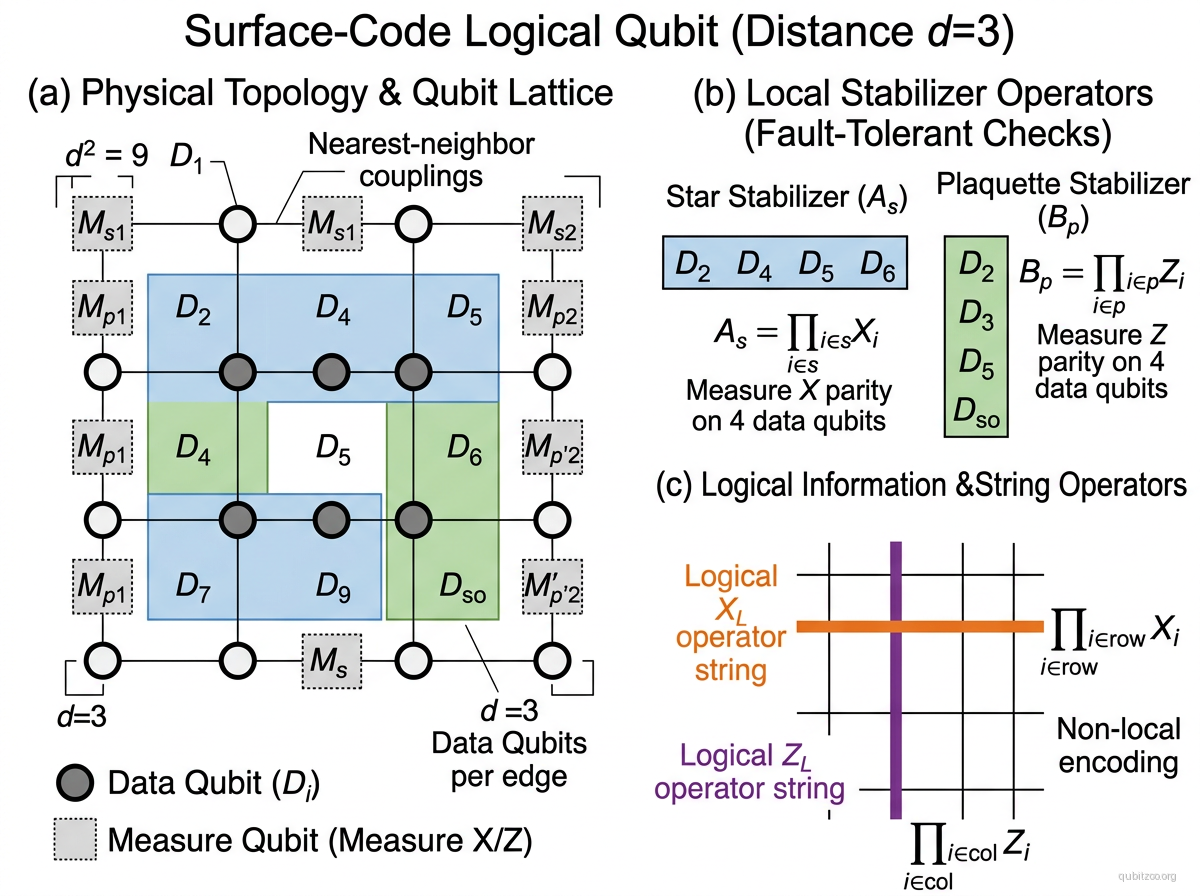
Description
A surface-code logical qubit is not a new physical modality, but a fault-tolerant logical qubit encoded across a 2D lattice of physical qubits using repeated stabilizer measurements. The surface code, introduced by Kitaev (1997) and developed for practical implementation by Fowler et al. (2012), is the leading quantum error correction architecture due to its high threshold (~1% circuit-level error rate) and requirement of only nearest-neighbor interactions on a 2D grid.
Logical information is stored nonlocally across data qubits (for code distance ) and ancilla qubits used for syndrome extraction. Errors are detected via local parity checks — X-type (star) stabilizers detect Z errors, and Z-type (plaquette) stabilizers detect X errors — and corrected by decoding syndrome histories. Logical operators are non-contractible strings of Pauli operators spanning the patch, providing topological protection against local errors.
Hamiltonian
The code space is defined by star and plaquette stabilizers:
with code Hamiltonian form:
The code space is the simultaneous eigenspace of all stabilizers. Logical operators correspond to non-contractible strings across the patch: connects the two smooth boundaries and connects the two rough boundaries. The code distance is the minimum weight of any logical operator.
Motivation
The surface code is currently the dominant QEC architecture for superconducting and trapped-ion roadmaps. Its key advantages are: a high circuit-level threshold of ~1%, compatibility with nearest-neighbor 2D qubit layouts (no long-range connectivity needed), well-understood decoder algorithms (MWPM, Union-Find), and experimental accessibility with current hardware. The primary cost is overhead: physical qubits per logical qubit, with determined by the physical-to-threshold error ratio.
Experimental Status
Below-threshold operation — Google Quantum AI (2024):
- Demonstrated logical error suppression when scaling from distance-3 to distance-5 to distance-7 on the Willow processor.
- Achieved a error suppression factor per code distance step.
- Distance-7 code with 101 qubits achieved error per cycle.
- Logical memory exceeded best physical qubit lifetime by factor (beyond break-even).
Lattice surgery — Erhard et al. (2021):
- Demonstrated entangling operations between logical qubits using lattice surgery protocols on trapped ions.
Key Metrics
| Metric | Value | Notes | Fidelity reference |
|---|---|---|---|
| Logical lifetime | ~2× improvement per code distance step | Exponential suppression of logical errors demonstrated d=3→5→7 | Google Quantum AI 2024 |
| 1Q gate fidelity (logical Pauli) | 99.6–99.8% | d=5, Google Willow processor | Google Quantum AI 2024 |
| 2Q gate fidelity (logical CNOT) | ~99% (estimated) | Lattice surgery protocol; full demonstration pending | Erhard et al. 2021 |
| Threshold | ~1% | Circuit-level threshold | — |
| Physical qubits per logical | Code distance | — | |
| Stabilizer cycle time | 0.5–5 μs | Platform dependent | — |
| Current status | Logical error suppression demonstrated | Below-threshold operation at d=7 | Google Quantum AI 2024 |
Note: For QEC code entries, “T₁” refers to logical qubit lifetime (error-suppressed), and gate fidelities are logical-level operations on encoded information.
References
Original proposal
- A. Yu. Kitaev, “Fault-tolerant quantum computation by anyons,” Ann. Phys. 303, 2 (2003) — arXiv:quant-ph/9707021
Practical implementation roadmap
- A. G. Fowler et al., “Surface codes: Towards practical large-scale quantum computation,” Phys. Rev. A 86, 032324 (2012) — arXiv:1208.0928
Experimental demonstrations
- Google Quantum AI and Collaborators, “Quantum error correction below the surface code threshold,” Nature 638, 920 (2025) — arXiv:2408.13687
- A. Erhard et al., “Entangling logical qubits with lattice surgery,” Nature 589, 220 (2021)
Linked Papers
- fowler-2012-surface-code-roadmap
- acharya-2025-error-correction-below
- bacon-2006-bacon-shor
- bombin-2006-color-codes
- egan-2021-fault-tolerant-control
- hastings-2021-floquet
- kitaev-2003-fault-tolerant-computation
- kubica-2023-erasure-overhead
- panteleev-2022-asymptotically-good
- puri-2020-bias-preserving-gates
Evergreen context
- threshold-theorem — the surface code is the canonical practical instantiation of the whole below-threshold scaling story.
- erasure-error-vs-pauli-error — one of the most important caveats on surface-code overhead is that its effective threshold changes dramatically once the hardware can flag loss or leakage.
- noise-bias-and-asymmetric-error-channels — explains why XZZX checks or asymmetric code distances can beat a square, depolarizing-noise design when the unflagged channel is directionally biased.
- quantum-hardware — keeps the code in the right frame: surface-code dominance is really a statement about which hardware layouts and control stacks are easiest to scale today.
Related Entries
- color-code-logical-qubit — alternative topological code with transversal Clifford gates
- transmon — dominant physical qubit for superconducting surface code implementations
- trapped-ion-qubit — alternative physical platform for surface code QEC
- erasure-qubit — erasure conversion dramatically increases the effective code threshold