 Qubit Zoo
Figure
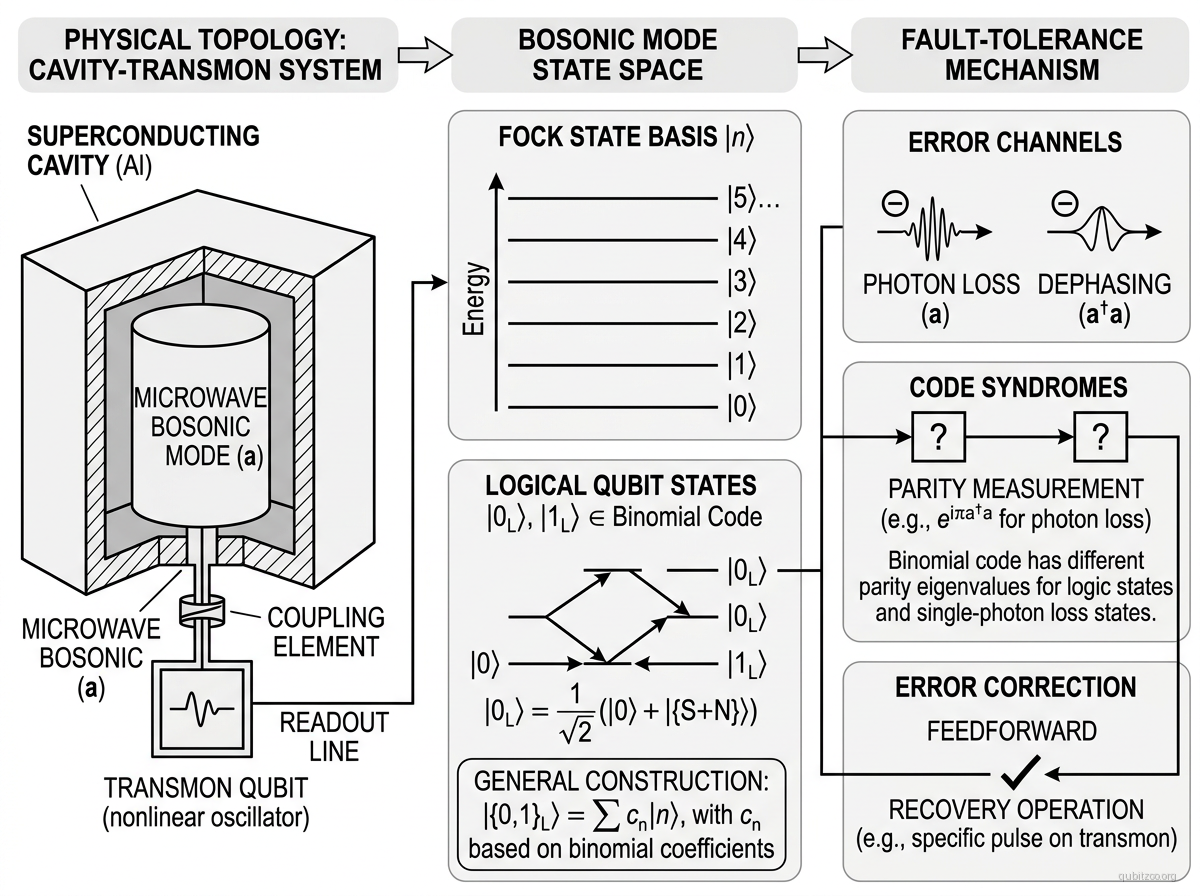
Description
Binomial codes are a family of bosonic quantum error-correcting codes that encode a logical qubit in weighted superpositions of Fock states of a single harmonic oscillator mode, typically a superconducting microwave cavity. The code words use Fock states spaced by with coefficients given by square roots of binomial coefficients, enabling exact correction of errors that are polynomial up to a specific degree in bosonic creation and annihilation operators.
The simplest binomial code protecting against single photon loss () encodes the logical qubit as:
The general code words take the form , where the spacing parameter and order determine how many photon loss (), gain (), and dephasing () events can be exactly corrected, subject to .
The physical platform consists of a long-lifetime 3D aluminum cavity coupled to a transmon ancilla via circuit QED. The transmon provides the nonlinearity needed for universal control of the bosonic mode, including state preparation, error syndrome extraction via photon number parity measurement (), and conditional recovery operations. The logical states are constructed from Fock states of the same generalized photon number parity, so that photon loss events map the code space to an orthogonal error subspace detectable by parity measurement.
Binomial codes are closely related to cat codes (which use coherent state superpositions) but offer several advantages: smaller mean photon number, exact orthonormality of code words, and an explicit unitary repumping operation to restore lost energy.
Hamiltonian
The cavity mode is a quantum harmonic oscillator with annihilation operator . The dominant error channel is amplitude damping (photon loss), described by the Lindblad operator where is the single-photon loss rate.
The error correction condition for the binomial code is:
for all correctable error operators with . The code is stabilized by the generalized parity operator , where is the photon number operator.
For the simplest single-loss-correcting code, the parity operator has eigenvalue on both logical states (even Fock states) and after a single photon loss (odd Fock states), enabling non-destructive error detection.
Motivation
- Provides a hardware-efficient bosonic quantum error correction scheme requiring only a single cavity mode plus an ancilla transmon, avoiding the overhead of multi-qubit surface codes.
- The dominant error channel (photon loss) is well-characterized and detectable via simple parity measurements, enabling a streamlined QEC cycle.
- Demonstrated beyond break-even error correction: the logical qubit lifetime exceeds that of any individual component in the system.
- Smaller mean photon number than cat codes for equivalent error protection, reducing sensitivity to higher-order nonlinearities.
- Compatible with the well-developed circuit QED platform and 3D cavity technology at Yale and elsewhere.
Experimental Status
Original proposal — Michael et al. (2016):
- Introduced the binomial code family with explicit constructions for correcting photon loss, gain, and dephasing errors.
- Showed codes are realizable with existing superconducting circuit technology.
Break-even QEC — Ofek et al. (2016):
- Demonstrated that a binomial-code-encoded logical qubit in a 3D aluminum cavity can have a lifetime exceeding the best uncorrected encoding in the same system.
- Achieved logical error rate below break-even using real-time parity feedback.
Universal gate set — Heeres et al. (2017):
- Implemented a universal gate set on a logical qubit encoded in an oscillator using the binomial code framework.
- Demonstrated high-fidelity logical operations with active error detection.
Key Metrics
| Metric | Value | Notes | Fidelity reference |
|---|---|---|---|
| Logical error rate | Below break-even | Ofek et al. 2016 | Ofek et al. 2016 |
| Cavity | >1 ms | 3D machined aluminum cavity | Ofek et al. 2016 |
| QEC cycle time | ~1–5 μs | Parity measurement + feedback | — |
| Fock space size | For single-loss-correcting code | — | |
| Ancilla (transmon) | 50–200 μs | Limits QEC performance | — |
| Operating temperature | 10–20 mK | Dilution refrigerator | — |
References
Original proposal
- M. H. Michael, M. Silveri, R. T. Brierley, V. V. Albert, J. Salmilehto, L. Jiang, and S. M. Girvin, “New class of quantum error-correcting codes for a bosonic mode,” Phys. Rev. X 6, 031006 (2016) — arXiv:1602.00008
Experimental demonstrations
- N. Ofek, A. Petrenko, R. Heeres, P. Reinhold, Z. Leghtas, B. Vlastakis, Y. Liu, L. Frunzio, S. M. Girvin, L. Jiang, M. Mirrahimi, M. H. Devoret, and R. J. Schoelkopf, “Extending the lifetime of a quantum bit with error correction in superconducting circuits,” Nature 536, 441 (2016)
- R. W. Heeres, P. Reinhold, N. Ofek, L. Frunzio, L. Jiang, M. H. Devoret, and R. J. Schoelkopf, “Implementing a universal gate set on a logical qubit encoded in an oscillator,” Nat. Commun. 8, 94 (2017)
Related theory
- P. T. Cochrane, G. J. Milburn, and W. J. Munro, “Macroscopically distinct quantum-superposition states as a bosonic code for amplitude damping,” Phys. Rev. A 59, 2631 (1999)
Linked Papers
- michael-2016-binomial-codes
- cochrane-1999-macroscopically-distinct-superposition
- gottesman-2001-gkp
- heeres-2017-implementing-universal-gate
- ofek-2016-extending-lifetime-bit
Evergreen context
- bosonic-code-hierarchy — the comparison class for cat and GKP encodings
- dispersive-readout-mechanism — parity-based syndrome extraction in cavity-transmon realizations is the concrete readout layer that makes the code practical
- erasure-error-vs-pauli-error — useful when distinguishing loss-dominated oscillator channels from Pauli abstractions
Related Entries
- cat-codes — related bosonic code using coherent state superpositions
- gkp-codes — related bosonic code using grid states in phase space
- circuit-qed — hardware platform for cavity-transmon implementation
- bosonic-qubit — parent category for bosonic encodings
- transmon — ancilla qubit used for binomial code state preparation and error syndrome extraction