 Qubit Zoo
Figure
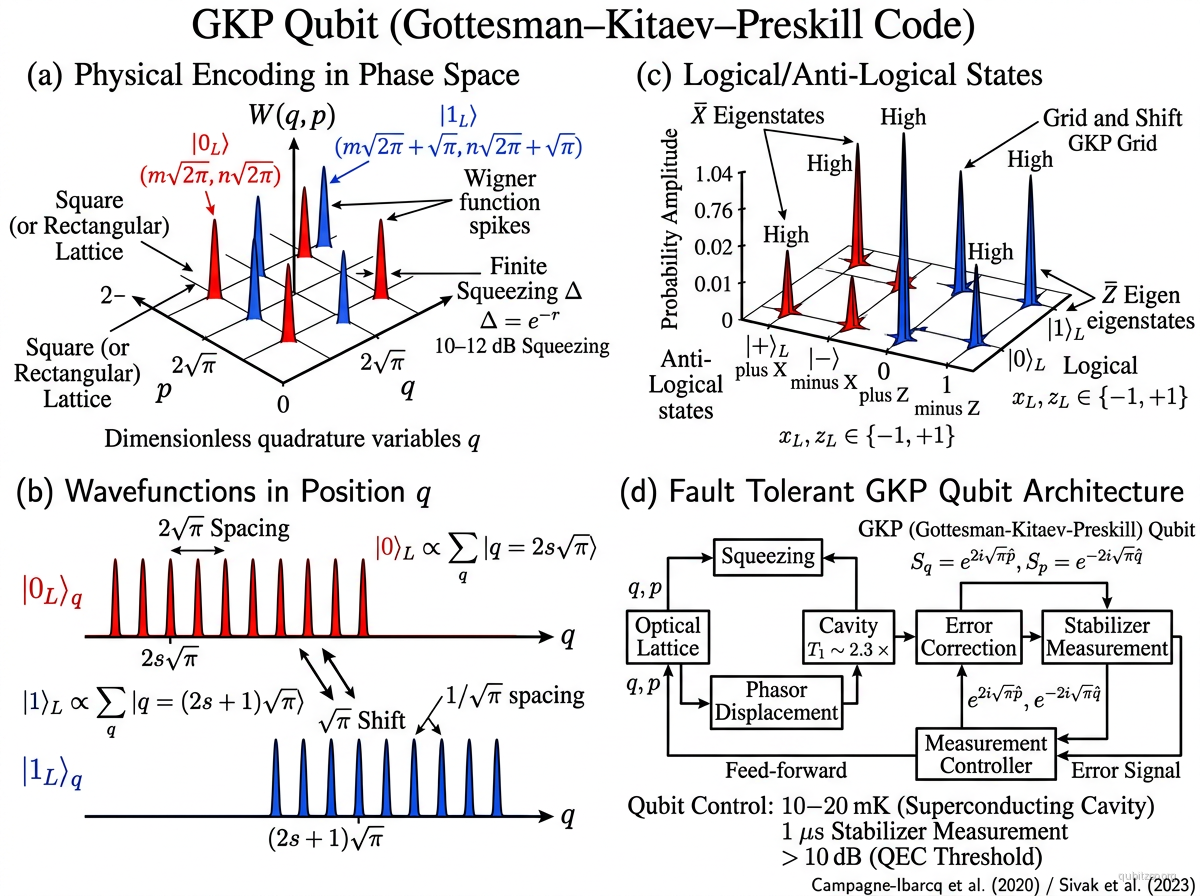
Description
The GKP (Gottesman-Kitaev-Preskill) code, proposed in 2001, encodes a qubit in the position/momentum space of a harmonic oscillator using grid states — superpositions of periodically spaced position (or momentum) eigenstates. The ideal logical states are:
These states have a comb-like structure in position space with spacing and are displaced by between and . The key property is that small displacement errors or (with ) can be detected and corrected by measuring the stabilizers and .
In practice, ideal GKP states have infinite energy. Physical (approximate) GKP states are formed from finitely squeezed peaks, with squeezing level controlling the code quality. The error correction threshold requires ( squeezing).
GKP qubits have been realized in trapped-ion motional modes (Flühmann et al. 2019) and superconducting cavities (Campagne-Ibarcq et al. 2020), with the latter demonstrating beyond-break-even quantum error correction — the encoded logical qubit outlived the best physical component.
Hamiltonian
GKP states are eigenstates of the stabilizer operators:
with eigenvalue +1. The logical Pauli operators are:
For approximate (finite-energy) GKP states with envelope width :
The squeezing level in dB: .
Motivation
GKP codes protect against the dominant error channel in bosonic systems — small displacements in phase space caused by photon loss, thermal noise, and dephasing. Unlike cat or binomial codes, GKP codes correct both quadrature errors simultaneously, achieving the hashing bound for Gaussian displacement channels. They are the only known bosonic code to demonstrate beyond-break-even error correction in a superconducting circuit.
Experimental Status
First realization in trapped-ion motional mode — Flühmann et al. (2019):
- Prepared approximate GKP states in the motional mode of a trapped ion
- Demonstrated stabilizer measurements and small displacement error correction
- Verified grid structure via Wigner function tomography
Superconducting cavity realization — Campagne-Ibarcq et al. (2020):
- GKP states prepared in a 3D superconducting microwave cavity using a transmon ancilla
- Demonstrated SBS (small-Big-small) displacement gates with 99.7% single-qubit gate fidelity
- First real-time GKP error correction in a circuit QED platform
Beyond-break-even QEC — Sivak et al. (2023):
- Logical qubit lifetime 2.3× the best physical component
- First demonstration of beyond-break-even quantum error correction
- Used real-time feedback with optimized control via reinforcement learning
Key Metrics
| Metric | Value | Notes | Fidelity reference |
|---|---|---|---|
| (logical) | ~1.8 ms | Cavity photon lifetime limited; logical qubit outlives best physical component | Sivak et al. 2023 |
| Logical lifetime / physical | 2.3× | Beyond break-even QEC | Sivak et al. 2023 |
| 1Q gate fidelity (logical) | 99.7% | SBS displacement gates | Campagne-Ibarcq et al. 2020 |
| 2Q gate fidelity (logical) | ~96–98% (projected) | eSWAP-based; not yet independently benchmarked | Rojkov et al. 2024 |
| Squeezing level (best) | 9–12 dB | Approximate GKP state quality | — |
| Stabilizer measurement time | ~1 μs | In superconducting cavities | — |
| Phase space grid spacing | In position quadrature | — | |
| Error correction threshold | ~10 dB squeezing | Below this, QEC helps | Gottesman et al. 2001 |
| Operating temperature | 10–20 mK | Superconducting implementation | — |
Note: For bosonic code entries, “T₁” refers to the logical qubit lifetime (cavity-limited), not a bare qubit relaxation time. Gate fidelities are logical-level operations.
References
Original proposal
- D. Gottesman, A. Kitaev, and J. Preskill, “Encoding a qubit in an oscillator,” Phys. Rev. A 64, 012310 (2001) — arXiv:quant-ph/0008040
Experimental demonstrations
- C. Flühmann et al., “Encoding a qubit in a trapped-ion mechanical oscillator,” Nature 566, 513 (2019) — arXiv:1807.01033
- P. Campagne-Ibarcq et al., “Quantum error correction of a qubit encoded in grid states of an oscillator,” Nature 584, 368 (2020) — arXiv:1907.12487
- V. V. Sivak et al., “Real-time quantum error correction beyond break-even,” Nature 616, 50 (2023) — arXiv:2211.09116
Linked Papers
- gottesman-2001-gkp
- campagneibarcq-2020-error-correction-qubit
- flhmann-2019-encoding-qubit-trapped
- michael-2016-binomial-codes
- sivak-2023-real-time-error
- shiina-2026-high-rate-and-resource-efficient-all-photonic
- vyas-2026-homomorphic-aggregation-of-continuous-variable
- kumar-2026-deterministic-universal-logical-gates
- roberts-2026-bosonic-codes-from-compact
- wadewitz-2026-probabilistic-error-cancellation-for
- burgath-2026-spin-grid-states-for
- koudia-2026-joint-gkp-encoding-for
Evergreen context
- bosonic-code-hierarchy — the broader map of bosonic encodings
- dispersive-readout-mechanism — superconducting GKP experiments still cash out as repeated ancilla-assisted stabilizer readout inside a cavity-transmon stack
- motional-mode-coupling-in-ion-traps — the shared phonon-bus coupling underlying trapped-ion GKP implementations (Flühmann et al. 2019)
- threshold-theorem — why finite-energy GKP states matter for fault-tolerant thresholds
- erasure-error-vs-pauli-error — clarifies what kinds of oscillator errors GKP is designed to convert and correct
Related Entries
- cat-codes — alternative bosonic code using coherent state superpositions
- circuit-qed — underlying hardware platform for superconducting GKP
- binomial-codes — another bosonic code family