 Qubit Zoo
Figure
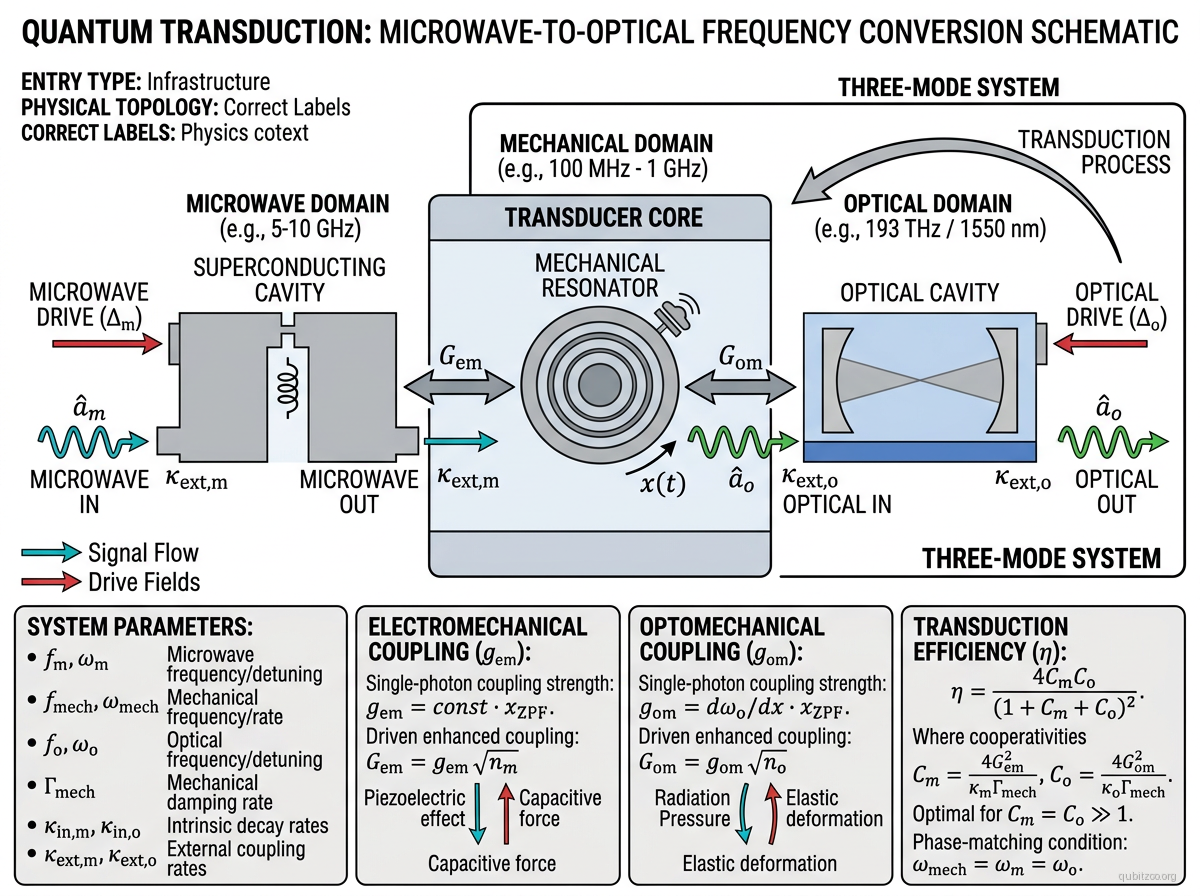
Description
Quantum transduction converts quantum information between different frequency domains — most critically from microwave (~5–10 GHz, where superconducting and spin qubits operate) to optical/telecom (~200 THz, where photons can travel in fiber). This is the essential bridge for networking superconducting quantum processors and building distributed quantum computers.
Superconducting qubits encode information at microwave frequencies (~5 GHz), where single photons carry ~25 μeV of energy — far below room-temperature thermal noise (~25 meV). Microwave photons cannot travel through optical fiber, and cryogenic microwave links are limited to meters. Optical photons at telecom wavelengths (1.3–1.5 μm) travel kilometers in fiber with negligible loss.
The main approaches include:
- Electro-optic: Direct coupling of microwave and optical modes in nonlinear crystals (LiNbO₃, AlN). Fastest, but typically low efficiency without resonant enhancement.
- Piezoelectric/optomechanical: Microwave → mechanical → optical. Uses an intermediate phonon mode. Higher efficiency demonstrated but adds noise from thermal phonons.
- Magnonic: Microwave → magnon → optical via ferrimagnetic materials (YIG). Leverages strong magnon-photon coupling.
- Rare-earth ion: Microwave-optical coupling via electronic transitions in rare-earth-doped crystals (Er³⁺ in Y₂SiO₅). Intrinsic quantum transducer, no moving parts.
Transduction efficiency remains the key challenge: quantum-limited operation requires added noise < 1 photon, while current devices typically add ~1–100 thermal photons. The best demonstrated efficiencies are ~50% (pulsed piezo-optomechanical) and ~10% (electro-optic), though not simultaneously quantum-noise-limited.
Hamiltonian
Generic three-mode transduction (microwave-mechanical-optical):
where , , are microwave, mechanical, and optical mode operators, and , are the electromechanical and optomechanical coupling rates.
Motivation
- Quantum internet: Essential bridge for connecting superconducting QPUs across distances > meters via optical fiber.
- Modular quantum computing: Enables chip-to-chip entanglement distribution for modular quantum computer architectures.
- Hybrid platform bridge: Connects superconducting, spin, and photonic quantum platforms into unified systems.
- Distributed error correction: Non-local connectivity required by qLDPC codes can be provided by optical interconnects via transduction.
Experimental Status
Electro-optic transduction — Fan et al. (2018):
- Demonstrated microwave-to-optical conversion using resonantly enhanced LiNbO₃ cavities
- Efficiency ~10%, limited by coupling rates and optical absorption
Piezo-optomechanical transduction — Mirhosseini et al. (2020):
- Pulsed conversion with ~50% efficiency using AlN piezoelectric resonators
- Near quantum-limited noise performance demonstrated in pulsed operation
Key Metrics
| Metric | Value | Notes | Fidelity reference |
|---|---|---|---|
| Electro-optic efficiency | ~10% | Resonantly enhanced LiNbO₃ | Lauk et al. 2020 |
| Piezo-optomechanical efficiency | ~50% | Pulsed, AlN on Si | Lauk et al. 2020 |
| Added noise target | <1 photon | Required for quantum operation | Lauk et al. 2020 |
| Bandwidth | ~1–100 MHz | Platform-dependent | Lauk et al. 2020 |
Scaling Considerations
- Quantum internet: Essential for connecting superconducting QPUs across distances > meters.
- Modular architectures: Enables chip-to-chip entanglement distribution for modular quantum computers.
- Hybrid systems: Bridges superconducting, spin, and photonic platforms.
- Noise challenge: Must operate at millikelvin temperatures with minimal added thermal noise.
References
Review
- N. Lauk et al., “Perspectives on quantum transduction,” Quantum Sci. Technol. 5, 020501 (2020) — arXiv:1910.04821
Key experiments
- M. Mirhosseini et al., “Superconducting qubit to optical photon transduction,” Nature 588, 599 (2020) — arXiv:2004.04838
Related theory
- L. Fan et al., “Superconducting cavity electro-optics: A platform for coherent photon conversion between superconducting and photonic circuits,” Sci. Adv. 4, eaar4994 (2018) — arXiv:1806.04244
Linked Papers
- lauk-2020-transduction-review
- fan-2018-superconducting-cavity-electro
- mirhosseini-2020-superconducting-qubit-optical
- sahu-2022-quantum-enabled-operation-microwave-optical-interface
- zhao-2025-quantum-enabled-microwave-optical-transduction-silicon-nanomechanics
- gautam-2026-coherent-microwave-to-optical-transduction-with
Evergreen context
- divincenzo-criteria — transduction matters because most microwave-native qubits satisfy the computing criteria but fail the communication criteria until a stationary-to-flying qubit interface is added.
- quantum-hardware — this is not a qubit modality by itself but a systems-level interconnect layer that turns otherwise isolated chips into modular quantum hardware.
- spin-photon-interfaces-separate-emission-collection-and-wavelength-matching — transduction and native spin-photon emission are the two architectural paths to networking; this evergreen’s three-part framework (emission quality, collection efficiency, wavelength matching) makes the comparison explicit rather than collapsing all three into a single generic “optical interface” score.
- coherence-time-hierarchy — transduction latency and added noise must both fit within the coherence budget that the qubit and the deployed code define; the hierarchy determines whether a transduced link or a native-emission path preserves usable entanglement under realistic cryogenic and fiber constraints.
- noise-bias-and-asymmetric-error-channels — transduction introduces thermal-photon noise that is fundamentally asymmetric relative to qubit-local relaxation and dephasing, so the systems-level error model for a distributed code must account for a noise source with a different structure than the processor-local one.
Related Entries
- circuit-qed — Microwave-frequency quantum information that transduction aims to convert
- dual-rail-photonic-qubit — Optical-frequency quantum information target
- t-center-qubit — Silicon spin-photon interface with native telecom emission (alternative to transduction)