 Qubit Zoo
Figure
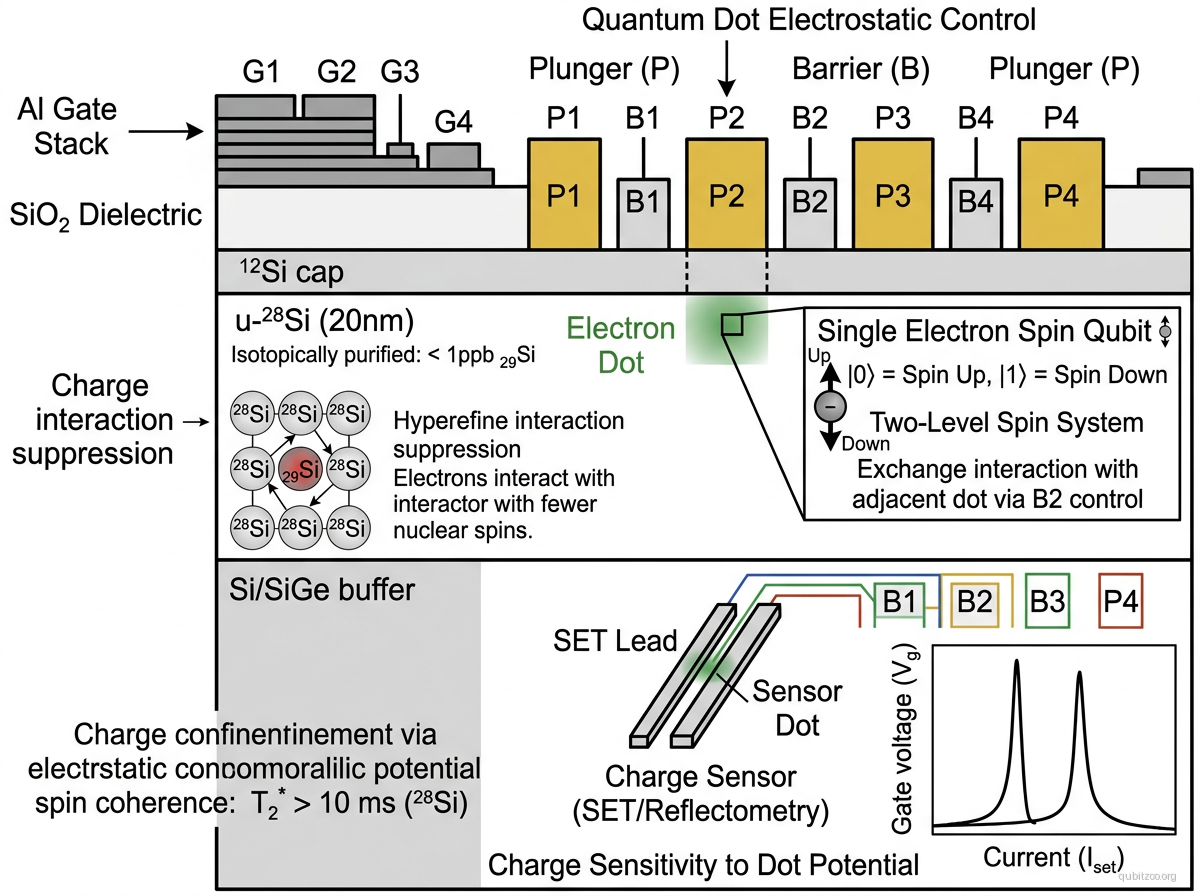
Description
The silicon spin qubit encodes quantum information in the spin of a single electron (or hole) confined in a gate-defined quantum dot fabricated on a silicon substrate (Si/SiGe heterostructure or Si-MOS). Silicon is uniquely suited to spin qubits because isotopic purification (²⁸Si) eliminates hyperfine noise from nuclear spins, enabling coherence times exceeding 10 ms — orders of magnitude beyond III-V semiconductors.
Gate-defined quantum dots in silicon confine individual electrons using electrostatic potentials created by nanoscale metallic gates on a Si/SiGe or Si-MOS stack. Qubit states are the spin-up and spin-down states of a single electron, split by an external magnetic field (Zeeman splitting, typically ~14–42 GHz at 0.5–1.5 T, with giving ~28 GHz/T). Single-qubit gates use electric dipole spin resonance (EDSR) via a micromagnet gradient or oscillating gate voltages exploiting spin-orbit coupling. Two-qubit gates use the exchange interaction between neighboring dots, controlled by barrier gate voltages.
Silicon’s key advantage is the availability of isotopically enriched ²⁸Si, which has zero nuclear spin. In natural silicon (~4.7% ²⁹Si), hyperfine interaction is the dominant dephasing mechanism. With enrichment to >99.99% ²⁸Si, improves from ~1 μs to >100 μs, and (Hahn echo) exceeds 10 ms.
The materials system also benefits from decades of CMOS fabrication infrastructure, making silicon the most plausible path to industrial-scale qubit manufacturing.
Hamiltonian
Single-qubit Hamiltonian:
Two-qubit exchange Hamiltonian:
where is the exchange coupling controlled by the barrier gate voltage , tunable from <1 kHz to >100 MHz. In the , subspace, this generates a gate. A controlled-phase (CZ) gate is obtained when (the Zeeman energy difference between qubits), which converts the exchange into an effective Ising interaction.
Valley splitting Hamiltonian (silicon-specific):
where is the valley splitting (typically 0.03–1 meV in Si/SiGe, 0.3–1.5 meV in Si-MOS). Insufficient valley splitting is a yield-limiting factor.
Motivation
- CMOS compatibility: Fabrication leverages existing semiconductor foundry processes — the only qubit technology with a direct path to billion-transistor-scale manufacturing.
- Isotopic purification: Enriched ²⁸Si eliminates hyperfine noise, giving coherence times 3–4 orders of magnitude better than GaAs spin qubits.
- Small footprint: Quantum dot pitch ~60–100 nm enables extremely dense qubit arrays.
- High-temperature operation: Demonstrated at 1 K (vs. 10–20 mK for superconducting qubits), significantly reducing cryogenic overhead.
- Industry backing: Intel, GlobalFoundries, imec, and UNSW/SQC actively pursuing silicon spin qubits at foundry scale.
Experimental Status
First single-electron spin qubit in Si — Veldhorst et al. (2014):
- Demonstrated a single-qubit gate with fault-tolerant control fidelity of 99.6% in isotopically enriched ²⁸Si MOS device
- = 120 μs, (Hahn echo) = 28 ms
Above-threshold two-qubit gates — Noiri et al. (2022):
- Single-qubit gate fidelity 99.8%, two-qubit gate fidelity 99.5% in ²⁸Si/SiGe
- Exchange-based CZ gate via barrier control
Hot silicon qubits — Petit et al. (2020):
- Universal quantum logic at 1.1 K operating temperature
- Two-qubit gate fidelity >98% above 1 K
Six-qubit processor — Philips et al. (2022):
- 6-qubit linear array in ²⁸Si/SiGe with nearest-neighbor exchange coupling and universal control
Industry-compatible CMOS qubits — Steinacker, Stuyck et al. / Diraq & imec (2025):
- First 300mm foundry-fabricated silicon spin qubits exceeding fault-tolerance threshold
- SPAM fidelity >99.9%, 1Q and 2Q gate fidelities >99%
- T₁ up to 9.5 s, T₂(Hahn) = 1.9 ms in isotopically enriched ²⁸Si
11-qubit atom processor — Edlbauer, Wang et al. / SQC (2025):
- 9 nuclear + 2 electron spin qubits in precision-placed phosphorus donors
- 1Q gate fidelity up to 99.99% (nuclear spin), 2Q CROT fidelity 99.64%
- Scaling demonstrated without fidelity degradation
Key Metrics
| Metric | Value | Notes | Fidelity reference |
|---|---|---|---|
| 1Q gate fidelity | 99.8% | EDSR with ²⁸Si/SiGe | Noiri et al. 2022 |
| 1Q gate fidelity (nuclear) | 99.99% | P donor nuclear spin in ²⁸Si | Edlbauer, Wang et al. / SQC 2025 |
| 2Q gate fidelity | 99.5% | Exchange-based CZ, Si/SiGe | Noiri et al. 2022 |
| 2Q gate fidelity (CROT) | 99.64% | Electron exchange CROT, P donors | Edlbauer, Wang et al. / SQC 2025 |
| SPAM fidelity | >99.9% | 300mm CMOS foundry Si-MOS | Steinacker, Stuyck et al. / Diraq & imec 2025 |
| T₂* | 120 μs | Enriched ²⁸Si, single electron | Veldhorst et al. 2014 |
| T₂ (Hahn echo) | 28 ms | Enriched ²⁸Si MOS | Veldhorst et al. 2014 |
| T₁ | 9.5 s | 300mm CMOS foundry Si-MOS | Steinacker, Stuyck et al. / Diraq & imec 2025 |
| Operating temperature | 1–1.2 K demonstrated | Higher T eases cryogenic requirements | Petit et al. 2020 |
| Qubit pitch | 60–100 nm | Gate-defined dot spacing | — |
Scaling Considerations
- CMOS compatibility: Fabrication leverages existing semiconductor foundry processes (Intel, GlobalFoundries, imec).
- Valley splitting variability: Atomic-scale interface roughness causes dot-to-dot variation in valley splitting, currently a yield limiter.
- Wiring density: Each dot requires ~3–5 DC gates + RF lines. Crossbar architectures and shared gate control are active research areas.
- Operating temperature: Demonstrations at 1 K (vs. 10–20 mK for superconducting) significantly reduce cryogenic overhead.
- Largest demonstrated (gate-defined QD): 6-qubit linear array (Philips et al. 2022), 12-dot devices in testing.
- Largest demonstrated (donor-based): 11-qubit atom processor with 9 nuclear + 2 electron spin qubits (SQC, 2025).
- Industrial fabrication: Diraq/imec demonstrated fault-tolerant-threshold fidelities on standard 300mm CMOS line (2025).
References
Original proposal
- D. Loss and D. P. DiVincenzo, “Quantum computation with quantum dots,” Phys. Rev. A 57, 120 (1998) — arXiv:cond-mat/9701055
Experimental demonstrations
- M. Veldhorst et al., “An addressable quantum dot qubit with fault-tolerant control-fidelity,” Nat. Nanotechnol. 9, 981 (2014)
- A. Noiri et al., “Fast universal quantum gate above the fault-tolerance threshold in silicon,” Nature 601, 338 (2022) — arXiv:2108.02626
- L. Petit et al., “Universal quantum logic in hot silicon qubits,” Nature 580, 355 (2020) — arXiv:1910.05289
- S. G. J. Philips et al., “Universal control of a six-qubit quantum processor in silicon,” Nature 609, 919 (2022) — arXiv:2202.09252
- P. Steinacker, N. D. Stuyck et al., “A 300 mm foundry silicon spin qubit unit cell exceeding 99% fidelity in all operations,” Nature 646, 81 (2025) — arXiv:2410.15590
- H. Edlbauer, J. Wang et al., “An 11-qubit atom processor in silicon,” Nature 648, 569 (2025) — arXiv:2506.03567
Linked Papers
- noiri-2022-silicon-1q-fidelity
- veldhorst-2014-silicon-coherence
- petit-2020-hot-silicon
- philips-2022-universal-control-six
- steinacker-2025-300mm-foundry-silicon
- edlbauer-2025-11-qubit-atom-processor
- golovach-2006-electric-dipole-induced-spin-resonance
- hendrickx-2020-fast-two-qubit-logic-holes-germanium
- hendrickx-2021-ge-4qubit
- jiang-2025-sige-rx-resonator
- kane-1998-silicon-nuclear-spin
- loss-divincenzo-1998-quantum-dots
- nowack-2007-coherent-control-electric-fields
- reed-2016-reduced-sensitivity-charge-noise
- scappucci-2021-ge-review
- shim-2014-bottom-up-sc
Evergreen context
- divincenzo-criteria — silicon is one of the cleanest examples of a platform competing on every criterion at once: long coherence, high-fidelity gates, scalable fabrication, and qubit-specific readout
- spin-orbit-coupling-for-qubit-control — clarifies why silicon usually needs micromagnets or synthetic SOC, unlike hole-spin devices
- exchange-interaction-in-quantum-dots — barrier-tuned exchange remains the standard entangling mechanism in gate-defined silicon dot arrays
- heisenberg-exchange-in-quantum-dots — useful when the silicon-specific device story has already been absorbed and the remaining question is whether exchange is being used as a -style entangler or in the Zeeman-mismatched CZ limit
- sqrt-swap-as-universal-gate — the cleanest gate-level lens for the short exchange pulses used in neighboring-dot silicon entangling gates
Related Entries
- spin-qubit — General spin qubit concept
- loss-divincenzo-qubit — Original Loss-DiVincenzo proposal
- singlet-triplet-qubit — Two-electron encoding variant
- exchange-only-qubit — Three-electron variant with all-electrical control
- hole-spin-qubit — Hole-spin variant with intrinsic spin-orbit coupling
- kane-qubit — Donor-based silicon spin qubit