 Qubit Zoo
Description
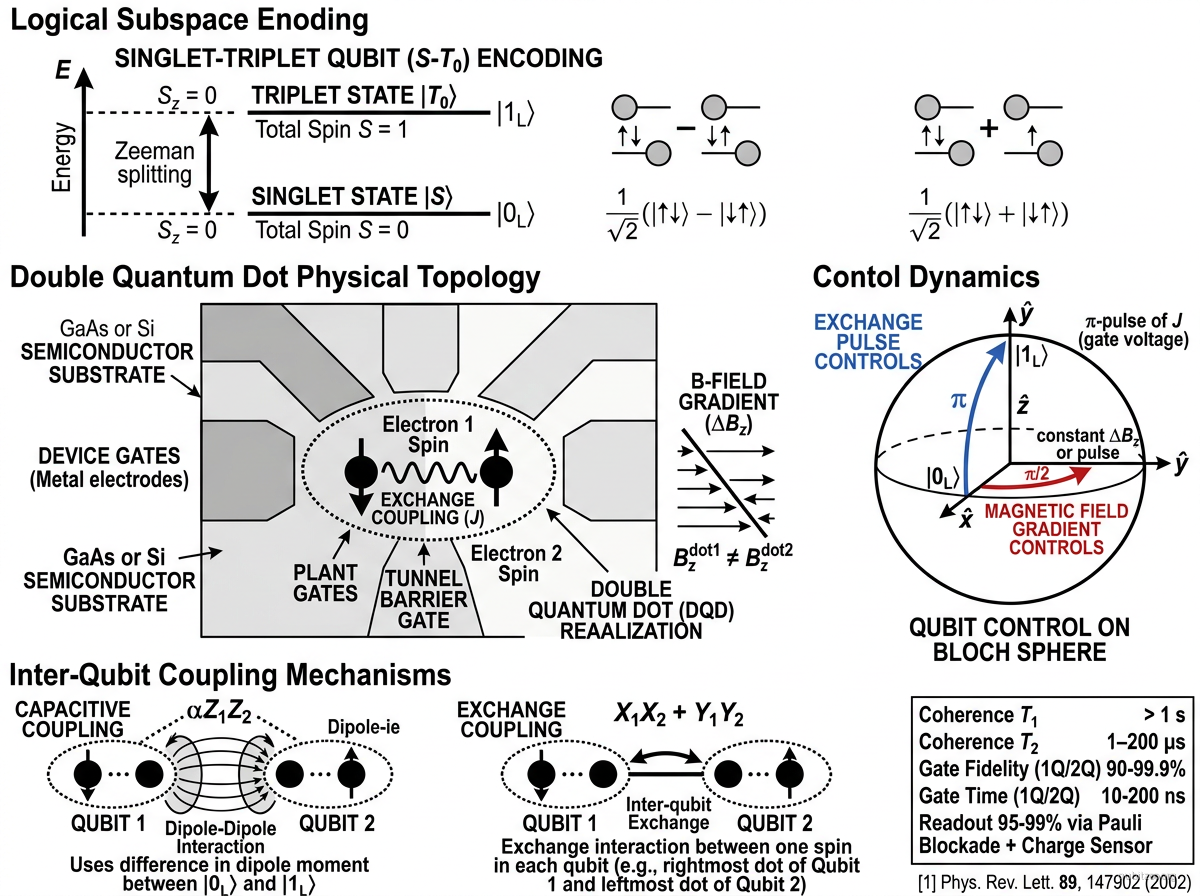
The singlet-triplet (–) qubit encodes a logical qubit in the subspace of two exchange-coupled spin- carriers in a double quantum dot (DQD). The canonical implementation uses electrons, while recent silicon and germanium devices also use holes. The singlet and unpolarized triplet form the computational basis; the polarized triplets and are leakage states split from the logical manifold by the mean Zeeman field.
Universal single-qubit control uses voltage pulses together with a static magnetic-field or Zeeman-energy gradient:
- rotations (around the logical axis): tuning the exchange coupling via the gate voltage on the barrier or detuning between dots
- rotations (around the logical axis): evolution under a Zeeman-energy gradient between the dots, produced by a micromagnet, nuclear polarization, or a -factor difference
No oscillating magnetic drive is required for the basic baseband protocol. Resonant modulation of is an alternative that permits operation near a symmetric point. Two-qubit coupling uses either a capacitive interaction, exploiting the state-dependent charge admixture of , or direct exchange between adjacent physical spins of neighboring qubits.
After the single-spin Loss-DiVincenzo qubit, this is the next-simplest spin qubit — requiring only 2 dots per logical qubit — and was the first encoded spin qubit to be experimentally demonstrated (Petta et al. 2005).
Figure
Hamiltonian
In the basis, define . After removing a common energy offset,
Here is the exchange splitting. In a symmetric two-site Hubbard model with on-site charging energy , detuning , and spin-conserving tunnel amplitude , second-order perturbation theory in the charge sector gives
valid away from the – charge anticrossings. At the symmetric operating point , . Barrier control changes while remaining at this first-order detuning-noise sweet spot.
Logical encoding
Both states have , giving first-order insensitivity to uniform magnetic field fluctuations.
Two-qubit coupling
Capacitive coupling between DQDs produces state-dependent energy shifts. After absorbing single-qubit terms, its entangling component can be written
where depends on inter-DQD capacitance and on the charge admixture of the logical states.
Exchange coupling acts first on the physical boundary spins, for example . Its projection generates logical two-qubit interactions, but an abrupt pulse can also populate non-computational four-spin states; exchange-gate sequences therefore have to control leakage rather than treating as a simple logical Heisenberg term.
Motivation
- All-electrical control — no microwave drive needed (unlike Loss-DiVincenzo)
- Only 2 dots per logical qubit — simpler than exchange-only (3 dots)
- Fast gates — exchange pulses at ns timescales
- Well-established platform — demonstrated with electron and hole spins in GaAs, Si/SiGe, silicon MOS, and Ge/SiGe
- Foundation for more complex encodings (exchange-only, AEON, RX)
Experimental Status
First demonstration: Petta et al. (2005) in a GaAs/AlGaAs DQD — coherent singlet-triplet oscillations via exchange control, with ns limited by hyperfine fluctuations.
Key experimental milestones:
- Bluhm et al. (2011): Dynamical decoupling extended to ~200 μs in GaAs
- Maune et al. (2012): First Si/SiGe singlet-triplet qubit — isotopic purification dramatically improved coherence
- Shulman et al. (2012): Two-qubit entangling gate via capacitive coupling, Bell state fidelity ~72% (GaAs)
- Nichol et al. (2017): ~99% single-qubit fidelity and 90% entangling-gate fidelity in capacitively coupled GaAs – qubits
- Bøttcher et al. (2022): Parametric longitudinal coupling to high-impedance SC resonator
- Ungerer et al. (2024): Strong single-photon coupling in an InAs nanowire – device, MHz
- Song et al. (2024): ~100 MHz field-gradient-driven oscillations with quality factor in Si/SiGe
- Ma et al. (2024): Enhanced-latching Pauli-spin-blockade readout in a Si-MOS DQD with 97.59% average experimental state-readout fidelity by threshold classification
- Zhang et al. (2025): Universal control of four neighboring – hole-spin qubits in a germanium dot array; this is a related polarized-triplet variant, not the – encoding defined above
- Tsoukalas et al. (2026): Resonantly driven germanium hole – qubit with 99.68(2)% average gate fidelity; continuous dressing extended rotating-frame coherence to while retaining 99.63(7)% gates
References
Original proposal
- J. Levy, “Universal quantum computation with spin-1/2 pairs and Heisenberg exchange,” PRL 89, 147902 (2002)
Landmark experiment
- J. R. Petta et al., “Coherent manipulation of coupled electron spins in semiconductor quantum dots,” Science 309, 2180 (2005)
Coherence advances
- H. Bluhm et al., “Dephasing time of GaAs electron-spin qubits coupled to a nuclear bath exceeding 200 μs,” Nature Phys. 7, 109 (2011)
- B. M. Maune et al., “Coherent singlet-triplet oscillations in a silicon-based double quantum dot,” Nature 481, 344 (2012)
Two-qubit gates
- M. D. Shulman et al., “Demonstration of entanglement of electrostatically coupled singlet-triplet qubits,” Science 336, 202 (2012)
- J. M. Nichol et al., “High-fidelity entangling gate for double-quantum-dot spin qubits,” npj Quantum Information 3, 3 (2017), arXiv:1608.04258
Readout
- C. Barthel et al., “Rapid single-shot measurement of a singlet-triplet qubit,” PRL 103, 160503 (2009)
- R.-L. Ma et al., “Singlet-triplet-state readout in silicon metal-oxide-semiconductor double quantum dots,” Physical Review Applied 21, 034022 (2024), arXiv:2309.09723
Resonator coupling
- C. G. L. Bøttcher et al., “Parametric longitudinal coupling between a high-impedance superconducting resonator and a semiconductor quantum dot singlet-triplet spin qubit,” Nature Commun. 13, 4773 (2022)
- J. H. Ungerer et al., “Strong coupling between a microwave photon and a singlet-triplet qubit,” Nature Communications 15, 1068 (2024), arXiv:2303.16825
Recent control and scaling
- Y. Song et al., “Coherence of a field-gradient-driven singlet-triplet qubit coupled to many-electron spin states in Si/SiGe,” npj Quantum Information 10, 77 (2024), arXiv:2310.12603
- X. Zhang et al., “Universal control of four singlet-triplet qubits,” Nature Nanotechnology 20, 209 (2025), arXiv:2312.16101
- K. Tsoukalas et al., “A dressed singlet-triplet qubit in germanium,” Nature Communications 17, 699 (2026), arXiv:2501.14627
Linked Papers
- petta-2005-singlet-triplet
- barthel-2009-rapid-single-shot
- bluhm-2011-dephasing-time-gaas
- bttcher-2022-parametric-longitudinal-coupling
- levy-2002-universal-computation-spin
- loss-divincenzo-1998-quantum-dots
- ma-2024-singlet-triplet-state-readout
- martins-2016-symmetric-exchange-gates
- maune-2012-coherent-singlet-triplet
- nichol-2017-high-fidelity-entangling-gate
- reed-2016-reduced-sensitivity-charge-noise
- shulman-2012-demonstration-entanglement-electrostatically
- song-2024-field-gradient-driven-singlet-triplet
- tsoukalas-2026-dressed-singlet-triplet
- ungerer-2024-strong-coupling-microwave-photon
- zhang-2025-universal-control-four-singlet-triplet
Evergreen context
- exchange-interaction-in-quantum-dots — the physical origin of electrically tuned
J(\epsilon)control - heisenberg-exchange-in-quantum-dots — the minimal exchange Hamiltonian behind the logical rotation generated by
- decoherence-free-subspace — why the
m_S = 0manifold partially protects against uniform field noise - charge-noise-sweet-spot — where symmetric detuning helps, and where the tradeoffs remain
- vacuum-rms-field-scaling — the resonator-side lever behind the high-impedance longitudinal-coupling route, distinct from the qubit-side charge admixture that supplies the electric response
Related Entries
Key Metrics
| Metric | Value | Notes | Fidelity reference |
|---|---|---|---|
| Inhomogeneous coherence | ~10 ns (GaAs); s in the ergodic Si/SiGe measurement; s (Ge holes) | Platform- and protocol-dependent; hyperfine-limited in GaAs, with distinct noise regimes in enriched Si and Ge | Petta et al. 2005; Song et al. 2024; Tsoukalas et al. 2026 |
| Protected/dressed coherence | s (GaAs CPMG); s (dressed Ge holes) | Different coherence definitions and platforms; values should not be read as a direct ranking | Bluhm et al. 2011; Tsoukalas et al. 2026 |
| Gate fidelity (1Q) | 99.68(2)% bare resonant; 99.63(7)% dressed | Average physical-gate fidelity for a Ge hole – qubit | Tsoukalas et al. 2026 |
| Entangling-gate fidelity (2Q) | 90% | Capacitively coupled GaAs – qubits; process estimate from self-consistent tomography | Nichol et al. 2017 |
| Representative 1Q gate time | 327 ns bare; 500 ns dressed | gates in the 2026 Ge hole device | Tsoukalas et al. 2026 |
| Readout fidelity | 97.59% average experimental state fidelity (Si-MOS); in ~7 μs (GaAs) | Enhanced-latching Pauli spin blockade with threshold classification in Si-MOS; the separately reported 99.67% machine-learning number was obtained on simulated traces and is not used as the experimental benchmark | Ma et al. 2024; Barthel et al. 2009 |
| Spin-photon coupling | MHz | Strong-coupling InAs nanowire experiment; MHz and MHz | Ungerer et al. 2024 |
| Scaled control milestone | Four neighboring – qubits; 1Q fidelities 99.49(8)–99.84(1)% | Related polarized-triplet encoding in a Ge hole array; Bell-state fidelities 73(1)–90(1)% | Zhang et al. 2025 |