 Qubit Zoo
Figure
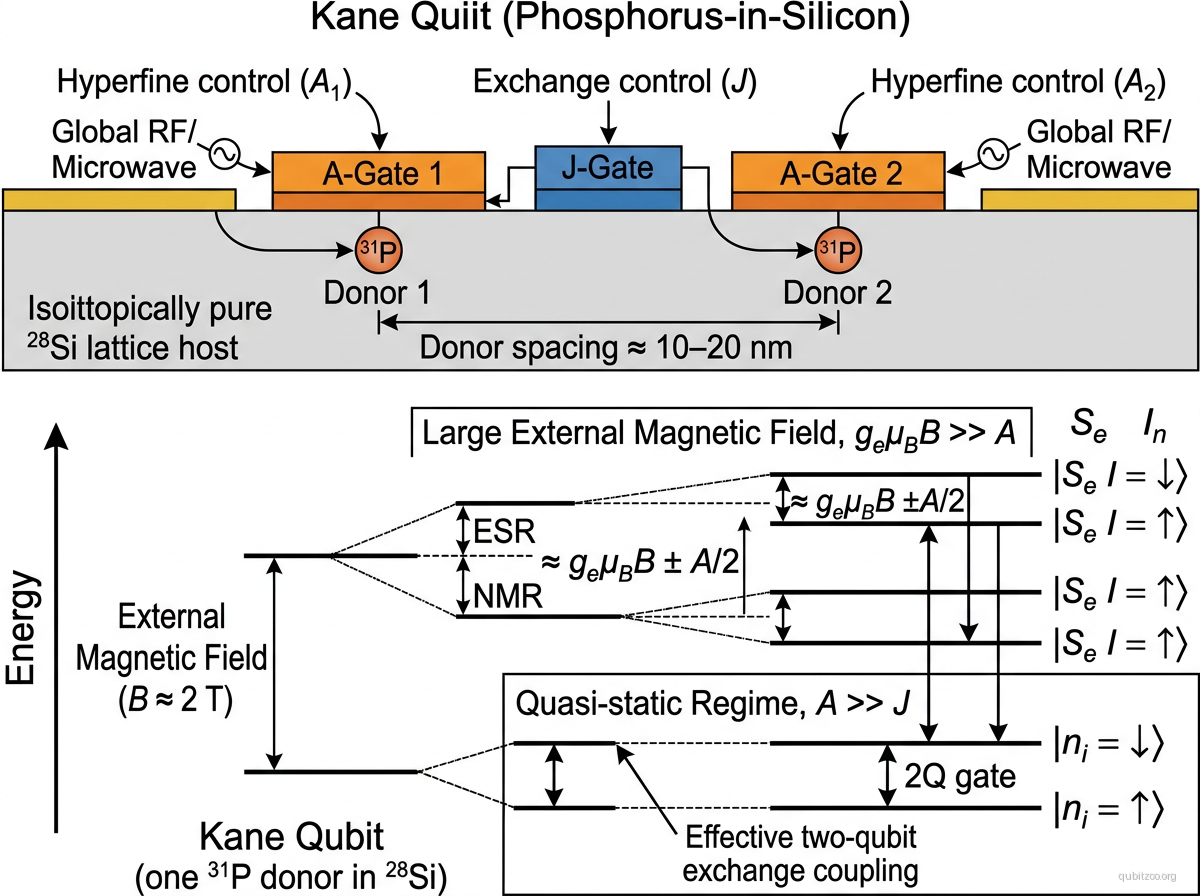
Description
The Kane qubit, proposed by Bruce Kane in 1998, encodes quantum information in the nuclear spin of individual donor atoms embedded in isotopically pure . The nuclear spin () of phosphorus has extraordinarily long coherence times — has been demonstrated — because the nuclear spin couples very weakly to the environment.
The architecture uses three types of gate electrodes above each donor:
- A-gates: control the hyperfine coupling between the donor electron and nuclear spin, enabling selective NMR addressing of individual nuclei.
- J-gates: control the exchange interaction between electrons on neighboring donors, mediating two-qubit gates.
- Global RF/microwave fields: drive ESR/NMR transitions.
Single-qubit gates are performed by NMR pulses on individual nuclei (made distinguishable by A-gate detuning of the hyperfine coupling). Two-qubit gates use the electron-mediated exchange interaction, controlled by the J-gate voltage.
The silicon host is chosen for its nuclear-spin-free isotope (), eliminating magnetic noise from the lattice. Single-atom placement with scanning tunneling microscope (STM) lithography has been demonstrated by the Simmons group (UNSW), achieving atomic-precision donor placement.
Hamiltonian
Two-donor system:
where is the gate-tunable contact hyperfine coupling for donor , is the exchange coupling between donor electrons, () is the electron (nuclear) -factor, and is the applied magnetic field.
At , the electron Zeeman splitting () far exceeds the hyperfine coupling ( in bulk), so the electron spin adiabatically follows the nuclear spin state, mediating an effective nuclear-nuclear interaction.
Motivation
Nuclear spins in silicon offer the longest coherence times of any solid-state qubit, and silicon fabrication is the most mature semiconductor technology on Earth. Kane’s proposal connects quantum computing to the existing trillion-dollar silicon fab infrastructure, with qubit densities potentially approaching CMOS transistor scales.
Experimental Status
Record solid-state coherence — Muhonen et al. (2014):
- Demonstrated nuclear for in , the world record for a solid-state qubit
- Nuclear hours at 1.5 K
- Single-qubit gate fidelity of 99.95% via NMR control
Three-qubit donor processor — Mądzik et al. (2022):
- Precision tomography of a three-qubit donor quantum processor in silicon
- Two-qubit gate fidelity of 99.4% via exchange-mediated coupling
- Full process tomography with gate set tomography characterization
Atomic-precision fabrication (Simmons group, UNSW):
- STM lithography placement of individual donors with atomic precision
- Donor spacing of 10–20 nm demonstrated
- Foundation for scalable Kane architecture manufacturing
Key Metrics
| Metric | Value | Notes | Fidelity reference |
|---|---|---|---|
| Nuclear | >30 hours | P in Si at 1.5 K | Muhonen et al. 2014 |
| Nuclear (echo) | >35 s | World record for solid-state qubit | Muhonen et al. 2014 |
| Electron | 0.5–1 s | In Si | — |
| 1Q gate fidelity | 99.95% | Nuclear spin, NMR control | Muhonen et al. 2014 |
| 2Q gate fidelity | 99.4% | Exchange-mediated | Mądzik et al. 2022 |
| Donor spacing | 10–20 nm | STM lithography placement | — |
| Hyperfine coupling | ~117 MHz | Bulk value; gate-tunable | — |
| Operating temperature | 100 mK – 1 K | Electron spin relaxation limited | — |
References
Original proposal
- B. E. Kane, “A silicon-based nuclear spin quantum computer,” Nature 393, 133 (1998)
Experimental demonstrations
- J. T. Muhonen et al., “Storing quantum information for 30 seconds in a nanoelectronic device,” Nat. Nanotechnol. 9, 986 (2014)
- M. T. Mądzik et al., “Precision tomography of a three-qubit donor quantum processor in silicon,” Nature 601, 348 (2022)
Linked Papers
- kane-1998-silicon-nuclear-spin
- edlbauer-2025-11-qubit-atom-processor
- mdzik-2022-precision-tomography-three
- muhonen-2014-storing-information-seconds
- thorvaldson-2026-the-magic-scroll-leveraging
Evergreen context
- divincenzo-criteria — donor spins are especially strong on qubit definition, initialization, and coherence, but they make the scalability challenge show up in fabrication precision and dense control wiring.
- coherence-time-hierarchy — the architecture only makes sense if you separate the ultralong nuclear-memory timescale from the much faster donor-electron control and readout channel.
- exchange-interaction-in-quantum-dots — the Kane J-gate is the donor-spin analogue of electrically tuned exchange, even though the confinement comes from dopants rather than lithographic dots.
Related Entries
- loss-divincenzo-qubit — foundational semiconductor spin qubit proposal
- spin-qubit — broader spin qubit family