 Qubit Zoo
Figure
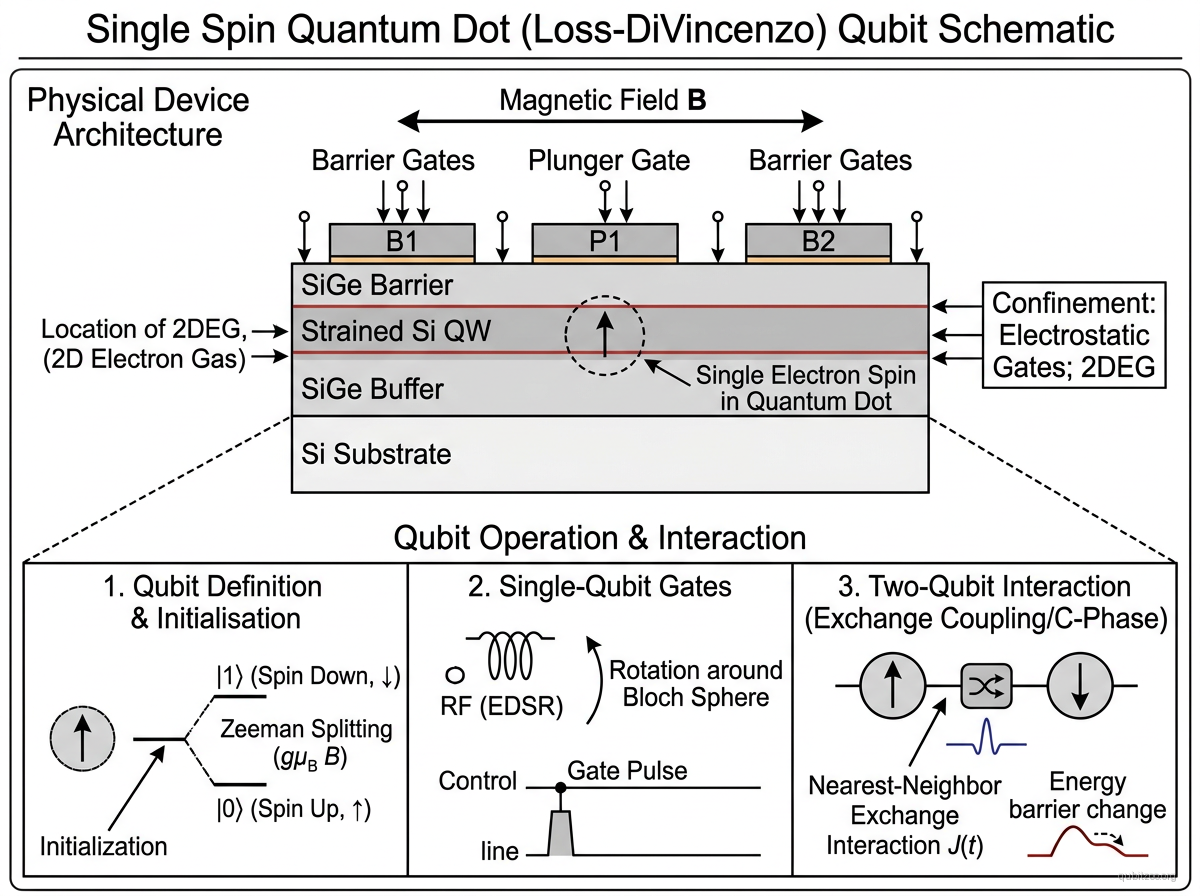
Description
The Loss-DiVincenzo qubit encodes quantum information in the spin-1/2 of a single excess electron (, ) trapped in a gate-defined quantum dot in a semiconductor heterostructure, typically Si/SiGe or Si-MOS. Proposed by Loss and DiVincenzo (1998), it is arguably the simplest physical realization of a qubit: a single electron spin in a magnetic field.
Since spin is a magnetic property, the qubit does not directly couple to the dominant electrical noise sources in the semiconductor environment, leading to inherently long coherence times — particularly in isotopically purified , where the nuclear spin bath is eliminated. coherence times exceeding 28 ms have been demonstrated.
Single-qubit gates are implemented via electric-dipole spin resonance (EDSR), which uses an AC electric field combined with a spin-orbit coupling gradient (or micromagnet) to drive spin rotations without requiring oscillating magnetic fields. Two-qubit entangling gates use the exchange interaction: by electrically tuning the tunnel barrier between adjacent quantum dots, the Heisenberg exchange coupling is switched on, producing a gate that, combined with single-qubit rotations, forms a universal gate set.
The extremely small qubit footprint (~50–100 nm pitch) and compatibility with CMOS fabrication technology make spin qubits a leading candidate for large-scale quantum computing.
Hamiltonian
The single-spin Zeeman Hamiltonian in an external magnetic field :
where is the electron g-factor in silicon, is the Bohr magneton, and is the Zeeman splitting (typically at ).
The two-qubit exchange Hamiltonian when the tunnel barrier between adjacent dots is lowered:
where is the exchange coupling, is the interdot tunneling matrix element (electrically tunable via gate voltage), and is the on-site charging energy. Pulsing produces a gate.
Motivation
Individual spin with is the simplest realization of a qubit. The electron spin qubit in a semiconductor quantum dot provides easy electrical control of exchange coupling, potentially excellent scalability via lithographic patterning, and compatibility with existing CMOS semiconductor fabrication technology. Isotopically purified eliminates the nuclear spin bath, yielding coherence times orders of magnitude longer than in GaAs. The extremely small qubit footprint makes it a strong candidate for the high qubit densities needed for fault-tolerant quantum computing.
Experimental Status
Single-shot spin readout — Elzerman et al. (2004):
- First single-shot readout of an individual electron spin in a quantum dot using spin-to-charge conversion.
High-fidelity single-qubit gates — Yoneda et al. (2018):
- Demonstrated 99.9% single-qubit gate fidelity in a Si/SiGe quantum dot with charge-noise-limited coherence.
Universal gate set in silicon — Noiri et al. (2022):
- Demonstrated fast universal two-qubit gates above the fault-tolerance threshold in silicon.
- Exchange-based gate fidelity of 99–99.8%.
Long coherence in — Veldhorst et al. (2014):
- Demonstrated electrical control of a long-lived spin qubit in a Si/SiGe quantum dot.
- Hahn echo in isotopically purified silicon.
Key Metrics
| Metric | Value | Notes | Fidelity reference |
|---|---|---|---|
| 1–45 s | Electron spin in Si/SiGe | Elzerman et al. 2004 | |
| (echo) | 0.5–28 ms | Hahn echo in Si | Veldhorst et al. 2014 |
| 1Q gate fidelity | 99.6–99.95% | EDSR driven | Yoneda et al. 2018 |
| 2Q gate fidelity | 99–99.8% | Exchange-based | Noiri et al. 2022 |
| Gate time (1Q) | 1–100 μs | Depends on drive mechanism | — |
| Gate time (2Q) | 1–100 ns | Exchange pulse | — |
| Readout fidelity | 98–99.5% | Spin-to-charge conversion + SET | Noiri et al. 2022 |
| Qubit footprint | ~50–100 nm pitch | Very small; CMOS-compatible | — |
| Operating temperature | 20 mK–1 K | Silicon: some operation at >1 K | — |
| Connectivity | Nearest-neighbor (1D/2D) | Exchange range ~100 nm | — |
References
Original proposal
- D. Loss and D. P. DiVincenzo, “Quantum computation with quantum dots,” Phys. Rev. A 57, 120 (1998) — arXiv:cond-mat/9701055
Experimental demonstrations
- J. M. Elzerman et al., “Single-shot read-out of an individual electron spin in a quantum dot,” Nature 430, 431 (2004)
- J. Yoneda et al., “A quantum-dot spin qubit with coherence limited by charge noise and fidelity higher than 99.9%,” Nat. Nanotechnol. 13, 102 (2018)
- A. Noiri et al., “Fast universal quantum gate above the fault-tolerance threshold in silicon,” Nature 601, 338 (2022)
Coherence characterization
- E. Kawakami et al., “Electrical control of a long-lived spin qubit in a Si/SiGe quantum dot,” Nat. Nanotechnol. 9, 666 (2014)
Linked Papers
- loss-divincenzo-1998-quantum-dots
- divincenzo-2000-physical-implementation
- elzerman-2004-single-shot-read
- golovach-2006-electric-dipole-induced-spin-resonance
- kawakami-2014-electrical-control-long
- nowack-2007-coherent-control-electric-fields
- reed-2016-reduced-sensitivity-charge-noise
- yoneda-2018-dot-spin-qubit
Evergreen context
- exchange-interaction-in-quantum-dots — the original two-spin control primitive in the proposal, including how tunnel-gate tuning actually creates
- heisenberg-exchange-in-quantum-dots — the Hamiltonian-level view of why a calibrated exchange pulse becomes a partial-SWAP entangler inside the two-spin manifold
- sqrt-swap-as-universal-gate — the native entangling gate of the Loss-DiVincenzo architecture
Related Entries
- singlet-triplet-qubit — two-spin encoding, no local fields needed for universal control
- exchange-only-qubit — three-spin encoding, exchange-only control
- aeon-qubit — always-on exchange variant
- semiconductor-charge-qubit — charge-based encoding (shorter coherence)
- kane-qubit — donor spin in silicon, similar physics with different confinement
- silicon-spin-qubit — broader family of silicon-based spin qubits