 Qubit Zoo
Figure
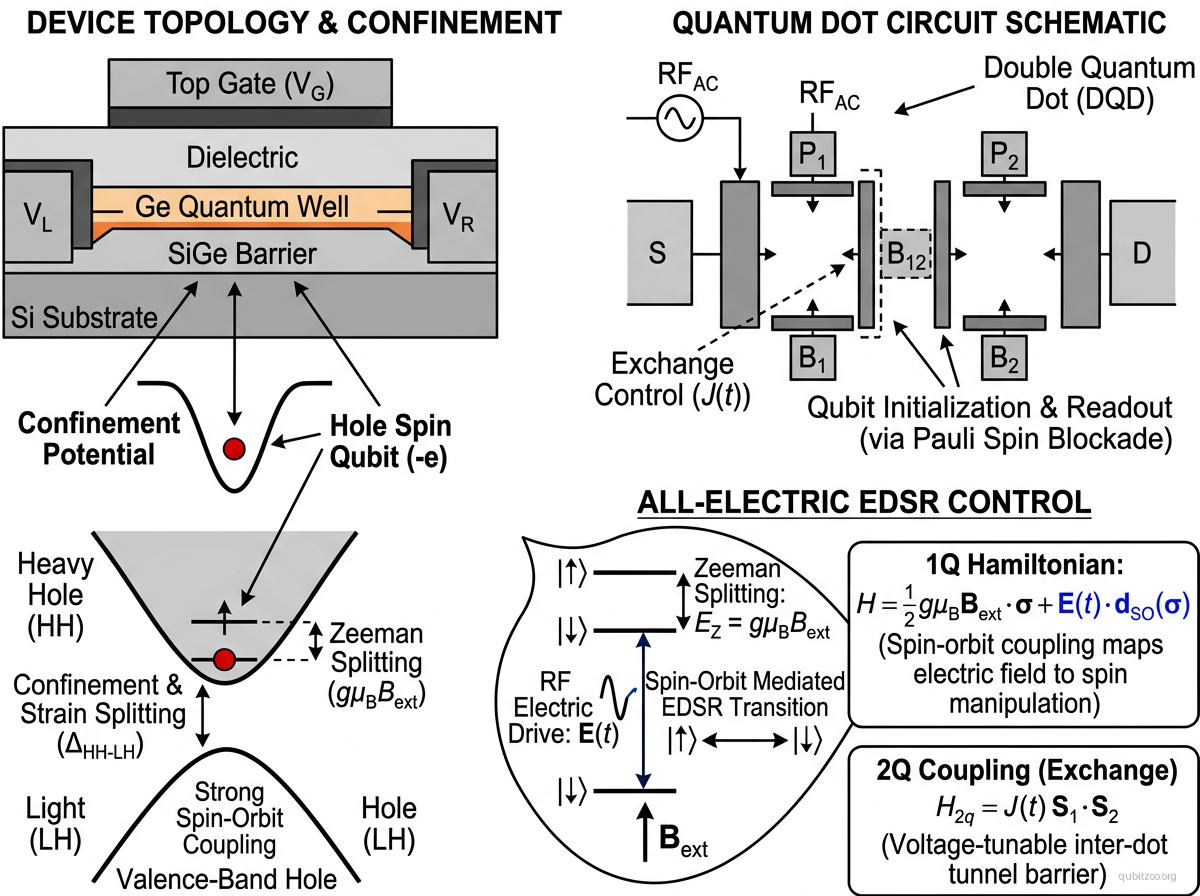
Description
Hole spin qubits encode quantum information in the spin of valence-band holes confined in semiconductor quantum dots, most commonly in Ge/SiGe heterostructures. Unlike electron spin qubits that require micromagnets or oscillating magnetic fields for spin manipulation, hole spins benefit from strong spin-orbit coupling that enables all-electrical control via electric dipole spin resonance (EDSR).
The underlying physics originates from the character of valence-band holes. In a Ge/SiGe quantum well under biaxial compressive strain, the heavy-hole () and light-hole () subbands split, with the ground state being predominantly heavy-hole. Mixing between heavy-hole and light-hole states (mediated by confinement asymmetry, electric fields, and strain) generates the spin-orbit coupling that enables electrical spin control. This mixing also makes the hole g-factor highly anisotropic — the g-tensor depends strongly on the magnetic field direction relative to the confinement plane.
Two-qubit coupling uses exchange interaction between holes in neighboring dots, compatible with existing semiconductor gate-defined quantum dot control architectures. Recent progress in Ge/SiGe platforms has been rapid, with multi-qubit devices demonstrated.
The tradeoff is that the same spin-orbit coupling enabling fast control also couples the spin to electrical noise, requiring careful sweet-spot design and materials engineering to balance speed against coherence.
Hamiltonian
Effective single-qubit model:
where the first term is the Zeeman interaction (with an anisotropic g-tensor in general) and the second term is the spin-orbit-mediated electric driving, with the spin-orbit-induced electric dipole operator. Two-qubit coupling is typically exchange:
Motivation
- Spin-orbit coupling turns electric fields into effective spin-control channels, eliminating micromagnets and oscillating magnetic field infrastructure needed for electron-spin ESR.
- Supports dense integration and fast gate operations in CMOS-compatible semiconductor processes.
- Ge/SiGe is isotopically purifiable (Ge, Ge are spin-0), enabling low nuclear spin noise environments.
- The Ge/SiGe platform has shown the fastest progress toward multi-qubit semiconductor processors.
Experimental Status
Four-qubit Ge processor — Hendrickx et al. (2021):
- Demonstrated a four-qubit germanium quantum processor in a 2×2 quantum dot array.
- Achieved universal quantum logic with all-electrical control via EDSR.
- Single-qubit gate fidelities of 99–99.9% and two-qubit exchange gate fidelities of 98–99.5%.
Ongoing rapid progress (2021–present):
- Multiple groups (Veldhorst, Katsaros, Scappucci) scaling Ge/SiGe hole-spin devices to larger arrays.
- Hot-qubit operation demonstrated at elevated temperatures (up to ~1 K).
- Sweet-spot engineering reducing charge-noise sensitivity while maintaining fast gate speeds.
18-qubit modular array — Dijkema et al. (2026):
- Demonstrated operation of an 18-qubit array in germanium based on an extendable 2×N modular architecture.
- Achieved simultaneous initialization, control, and readout across the entire array using parallel operation of modular unit cells.
- Average single-qubit gate fidelities of 99.8% and median of 99.9% across the array.
- Characterized nearest-neighbor exchange couplings throughout the device and implemented controlled-Z gates.
- Generated a three-qubit Greenberger–Horne–Zeilinger (GHZ) state.
- Establishes a modular, extendable architecture for planar semiconductor quantum processors.
Key Metrics
| Metric | Value | Notes | Fidelity reference |
|---|---|---|---|
| 1Q gate time | 1–50 ns | Fast EDSR control | — |
| 1Q fidelity | 99.8–99.9% | 18-qubit Ge array | Dijkema et al. 2026 |
| 2Q fidelity | 98–99.5% | Exchange-based | Hendrickx et al. 2021 |
| 1–20 μs | Device/material dependent | — | |
| Operating temperature | 20 mK – 1 K | Some hot-qubit demonstrations | — |
| Largest array | 18 qubits | Modular 2×N architecture | Dijkema et al. 2026 |
References
Key experimental demonstration
- N. W. Hendrickx et al., “A four-qubit germanium quantum processor,” Nature 591, 580 (2021)
Scaling milestone
- J. J. Dijkema et al., “Simultaneous operation of an 18-qubit modular array in germanium,” arXiv:2604.01063 (2026)
Review
- G. Scappucci et al., “The germanium quantum information route,” Nature Rev. Mater. 6, 926 (2021)
Linked Papers
- hendrickx-2021-ge-4qubit
- scappucci-2021-ge-review
- dijkema-2026-simultaneous-operation-of-an
- golovach-2006-electric-dipole-induced-spin-resonance
- hendrickx-2020-fast-two-qubit-logic-holes-germanium
- massai-2026-engineering-two-qubit-gates-via
- wang-2026-superfast-hole-spin-qubits
- ibad-2026-coherence-protection-of-a
- gyorgy-2026-switchable-heavy-hole-light-hole-spin-qubit
- valvo-2026-light-hole-spin-qubits-in
- tan-2026-strain-tunable-spin-relaxation-in
- medeiros-2026-spin-to-polarization-mapping-with-a
- wang-2026-chiral-classical-and-quantum
- orekhov-2026-coherent-and-ultra-low-power-edsr
Evergreen context
- spin-orbit-coupling-for-qubit-control — the canonical semiconductor example where strong heavy-hole SOC turns gate voltages directly into spin rotations
- exchange-interaction-in-quantum-dots — the device-level view of how neighboring Ge dots generate the tunable coupling used for two-qubit gates
- charge-noise-sweet-spot — frames the core speed-versus-dephasing tradeoff and why Ge devices keep pushing sweet-spot engineering
Related Entries
- spin-qubit — broader spin qubit family; holes offer faster electrical control than electrons
- singlet-triplet-qubit — electron-spin two-dot encoding; related control physics
- kane-qubit — donor-based spin qubit in silicon