 Qubit Zoo
Figure
Description
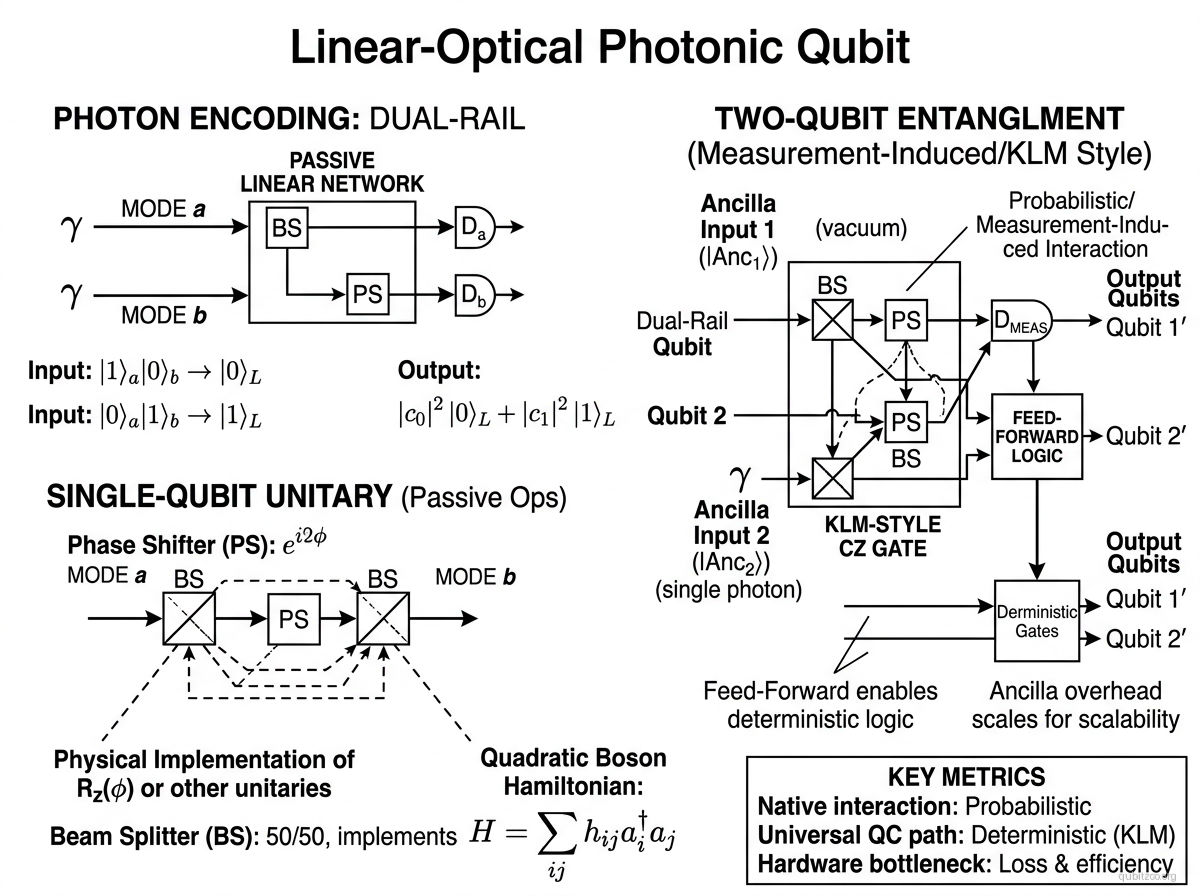
A photonic qubit architecture based on single-photon encoding (typically dual-rail or polarization) with state preparation, gates, and measurement implemented using linear optical elements, single-photon sources, and photodetectors.
A common encoding is dual-rail, where the logical states are defined by a single photon occupying one of two spatial modes:
Beam splitters and phase shifters implement single-qubit unitaries as passive transformations that conserve photon number. Entangling gates are induced through measurement and feed-forward (KLM-style), trading deterministic interactions for optical network + ancilla overhead.
The foundational result of Knill, Laflamme, and Milburn (KLM, 2001) established that scalable universal quantum computation is possible using only linear optics, single-photon sources, and photon detectors — with no photon-photon nonlinearity required. The key insight is that measurement-induced nonlinearities, combined with teleportation-based gate constructions and offline resource state preparation, can achieve asymptotically deterministic entangling gates at the cost of significant ancilla overhead.
Hamiltonian
In integrated linear optics, passive transformations are generated by a quadratic bosonic Hamiltonian:
which induces a unitary mode transformation acting on creation operators as:
Single-qubit operations in dual-rail encoding are realized with beam splitters and phase shifters (Mach-Zehnder interferometers), while effective entangling operations are implemented by measurement-induced nonlinearities (ancilla photons + feed-forward in KLM-style protocols).
Motivation
- Photons have negligible decoherence during transmission, making this architecture naturally network-compatible
- The KLM result established that scalable quantum computing is possible with linear optics + measurement alone — no photon-photon interaction needed
- Provides a central route to distributed and communication-first quantum architectures
- Room-temperature operation for the photonic components (only detectors require cryogenics)
Experimental Status
KLM foundational result — Knill, Laflamme, and Milburn (2001):
- Proved that efficient quantum computation is possible using only linear optics, single-photon sources, and photon detectors
- Probabilistic nonlinear sign (NS) gate succeeds with probability 1/4; CZ gate with probability 1/16 in the basic scheme
- Teleportation-based constructions boost effective success probability at the cost of ancilla overhead
Experimental demonstrations:
- Two-photon entangling gates demonstrated using linear optics and post-selection (O’Brien et al., 2003)
- Integrated photonic circuits on silicon and silicon nitride chips have realized high-visibility single-qubit operations
- Boson sampling demonstrations validated the linear optical platform
Scaling challenges:
- Loss and source/detector efficiency remain the dominant practical scaling limits
- Photon indistinguishability (Hong-Ou-Mandel interference) is critical for gate operation
- KLM overhead motivates alternative approaches (cluster-state MBQC, fusion-based QC)
Key Metrics
| Metric | Value | Notes | Fidelity reference |
|---|---|---|---|
| Native 2Q interaction | Measurement-induced (probabilistic) | No direct photon-photon interaction | Knill et al. 2001 |
| Deterministic universal QC path | Yes (with ancilla + feed-forward) | Core KLM result; large overhead | Knill et al. 2001 |
| Hardware bottleneck | Loss + source/detector efficiency | Dominant practical scaling limit | Kok et al. 2007 |
| Operating temperature | 300 K (optics) / 1–4 K (detectors) | SNSPDs require cryogenics | — |
References
Original proposal
- E. Knill, R. Laflamme, and G. J. Milburn, “A scheme for efficient quantum computation with linear optics,” Nature 409, 46 (2001)
Reviews
- P. Kok et al., “Linear optical quantum computing with photonic qubits,” Rev. Mod. Phys. 79, 135 (2007)
Linked Papers
Evergreen context
- erasure-error-vs-pauli-error — source, circuit, and detector loss are central because missing photons are often flagged absence events rather than arbitrary unknown rotations.
- threshold-theorem — KLM is historically important because it showed that probabilistic entangling operations plus teleportation and feed-forward can still support scalable quantum computing in principle.
- quantum-hardware — helpful umbrella for the linear-optics tradeoff: minimal transport decoherence and natural networking, paid for with non-deterministic entangling operations.
Related Entries
- photonic-qubit — umbrella entry for the broader photonic-qubit family
- dual-rail-photonic-qubit — specific encoding used in linear-optical QC
- fusion-based-photonic-qubit — evolved architecture that embraces probabilistic gates
- gkp-codes — bosonic code approach to photonic error correction
- cat-codes — alternative bosonic encoding