 Qubit Zoo
Figure
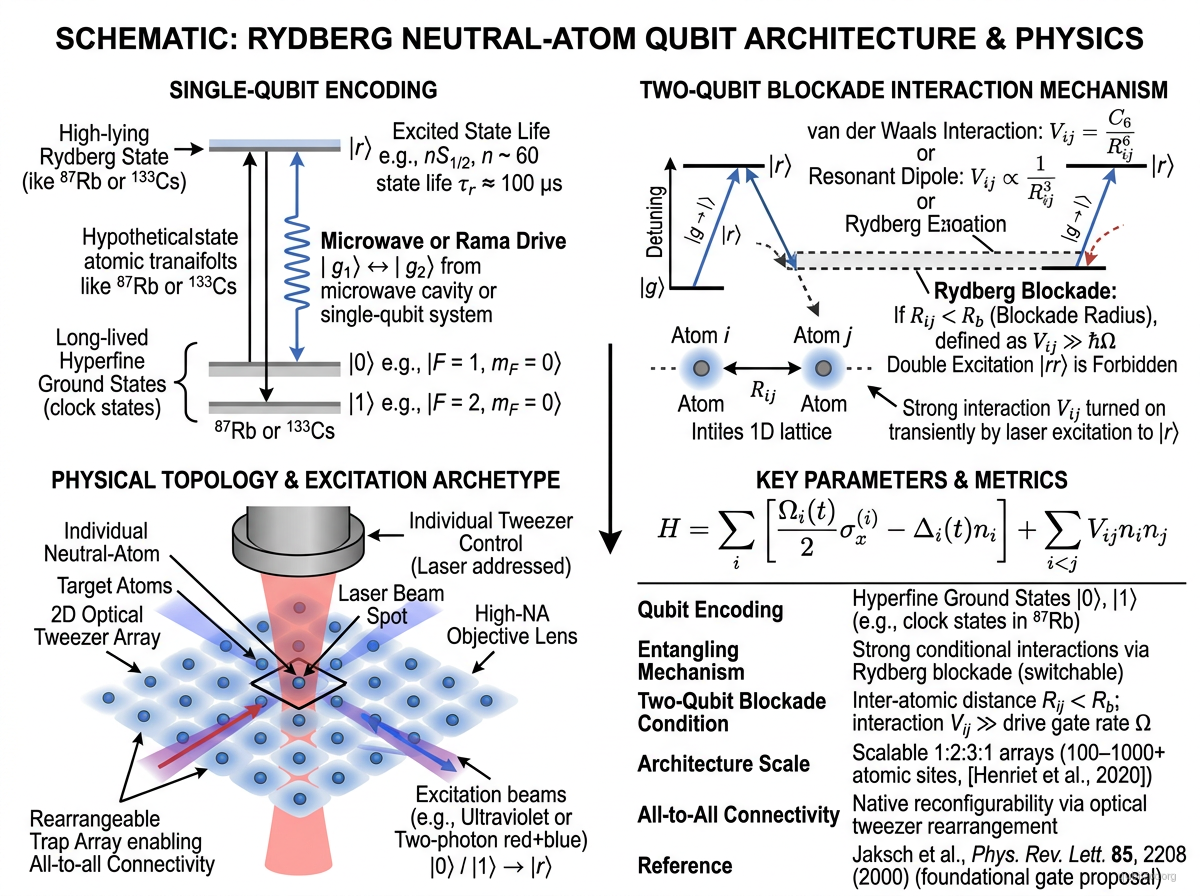
Description
The Rydberg neutral-atom qubit architecture encodes quantum information in long-lived hyperfine ground states of neutral atoms (typically alkali species such as or ), with and defined in hyperfine “clock” states that are first-order insensitive to magnetic field fluctuations.
Entangling interactions are turned on transiently by laser excitation to high-lying Rydberg states (principal quantum number –). The Rydberg blockade effect is the key mechanism: when one atom is excited to a Rydberg state, nearby atoms within the blockade radius experience a large energy shift from the van der Waals interaction (), preventing simultaneous double excitation. This conditional dynamics enables controlled-phase (CZ) entangling gates.
Atoms are individually trapped and positioned using reconfigurable optical tweezer arrays, providing native all-to-all connectivity at the array level through tweezer rearrangement. Arrays of 100–1000+ atoms have been demonstrated, making this one of the most scalable qubit platforms.
This is the core hardware model for modern optical-tweezer neutral-atom processors being developed by Harvard/MIT (Lukin group), QuEra, Pasqal, Atom Computing, and others.
Hamiltonian
A standard driven Rydberg-array Hamiltonian (rotating frame) is:
where projects onto the Rydberg state, is the Rabi drive, detuning, and (van der Waals) or in resonant dipole regimes.
Blockade condition for two atoms :
suppresses double excitation , enabling controlled-phase entangling gates.
Motivation
Rydberg neutral-atom qubits combine three key advantages: (1) native all-to-all reconfigurability via tweezer rearrangement at the array level, (2) strong, switchable interactions for fast entangling gates with no residual always-on coupling, and (3) a direct path from analog quantum simulation to digital gate-based computing on the same hardware. The platform has demonstrated the largest qubit arrays of any technology and is a leading candidate for near-term fault-tolerant quantum computing.
Experimental Status
Foundational Rydberg blockade gate proposal — Jaksch et al. (2000):
- Proposed fast quantum gates for neutral atoms using the Rydberg blockade mechanism
- Established the theoretical basis for the entire Rydberg entangling gate paradigm
Logical quantum processor — Bluvstein et al. (2024):
- Demonstrated a logical quantum processor based on reconfigurable atom arrays
- 48 logical qubits with entangling operations between logical qubits
- Two-qubit CZ gate fidelity of 99.5% with erasure conversion
- Single-qubit gate fidelity of 99.5–99.9% via global and local Raman gates
- Hyperfine clock state coherence of 1–4 s with spin-echo
Key Metrics
| Metric | Value | Notes | Fidelity reference |
|---|---|---|---|
| (qubit lifetime) | 1–10 s | Hyperfine clock states in optical traps; vacuum-limited | Bluvstein et al. 2024 |
| (coherence) | 1–4 s | With spin-echo; limited by trap-induced dephasing | Bluvstein et al. 2024 |
| 1Q gate fidelity | 99.5–99.90% | Global and local Raman gates | Bluvstein et al. 2024 |
| 2Q gate fidelity (CZ) | 99.5% | Rydberg blockade CZ; SOTA with erasure conversion | Bluvstein et al. 2024 |
| Gate time (2Q) | 200–500 ns | Rydberg pulse sequence | Bluvstein et al. 2024 |
| Architecture scale | 100–1000+ physical atoms | Optical tweezer arrays; reconfigurable | — |
| 2Q gate mechanism | Rydberg blockade | van der Waals interaction | — |
| Operating temperature | ~10–50 μK | Laser-cooled; in ultrahigh vacuum | — |
References
Original proposal
- D. Jaksch et al., “Fast Quantum Gates for Neutral Atoms,” Phys. Rev. Lett. 85, 2208 (2000)
Experimental demonstrations
- D. Bluvstein et al., “Logical quantum processor based on reconfigurable atom arrays,” Nature 626, 58 (2024) — arXiv:2312.03982
Linked Papers
- jaksch-2000-rydberg-gate
- henriet-2020-quantum-computing-with-neutral
- wu-2020-a-concise-review-of
- bluvstein-2024-logical-processor-reconfigurable
- ebadi-2021-256-atom-simulator
- grassl-1997-codes-quantum-erasure-channel
- isenhower-2010-rydberg-cnot
- wu-2022-erasure-neutral-atoms
- zeytinoglu-2026-fast-quantum-interconnects-via
- wang-2026-neutral-atom-quantum-computing
- sagi-2026-motional-refocusing-for-trap-off
- zhang-2026-robust-controlled-z-gate-for
- jung-2026-shots-to-approximate-solution-scaling-in-neutral
- wang-2026-an-exchange-assisted-entangling-gate
- banger-2026-finite-blockade-dynamics-of-a
- kobayashi-2026-quantifying-the-dual-isotope-advantage
- jin-2026-a-programmable-rydberg-quantum
- gong-2026-out-of-control-hamiltonian-learning
Evergreen context
- rydberg-blockade-mechanism — the interaction mechanism behind fast neutral-atom entangling gates
- coherence-time-hierarchy — useful for comparing hyperfine memory versus Rydberg-state gate timescales
- erasure-error-vs-pauli-error — erasure conversion is why atom loss and Rydberg leakage in the Bluvstein 2024 logical processor become a strategic advantage rather than a plain error burden
- threshold-theorem — the 48-logical-qubit processor demonstration is precisely an empirical probe of below-threshold operation on reconfigurable atom arrays
Related Entries
- trapped-ion-qubit — competing digital quantum computing platform
- alkaline-earth-neutral-atom-clock-qubit — related neutral-atom qubit using alkaline-earth species
- nuclear-spin-neutral-atom-qubit — related neutral-atom qubit using nuclear spin encoding