 Qubit Zoo
Figure
Description
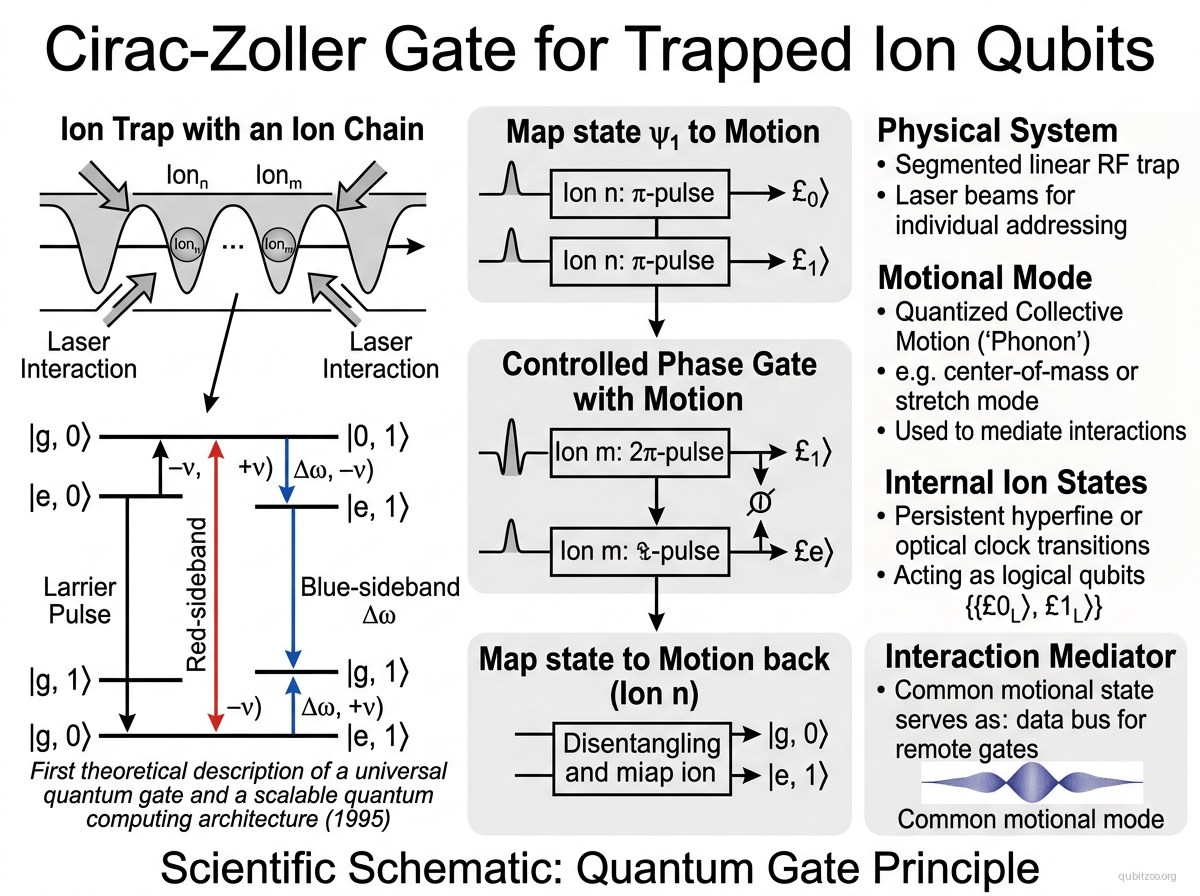
The Cirac-Zoller gate is the first proposal for a universal two-qubit quantum gate and a scalable quantum computing architecture, published by J. I. Cirac and P. Zoller in 1995. The key idea is to mediate the interaction between two long-lived ion qubits through the quantized collective motion (phonon mode) of a chain of trapped ions in a linear Paul trap.
Each qubit is encoded in two long-lived internal electronic states of a trapped ion — typically hyperfine ground states (e.g., Yb) or optical clock transitions (e.g., Ca). The shared motional mode of the ion chain serves as a quantum bus, enabling highly controllable entangling interactions between any pair of ions via individually addressed laser beams.
The gate operates through a three-step sequence:
-
Red sideband -pulse on ion : Maps the qubit state information of ion onto the shared phonon mode. The transition transfers one quantum of excitation from the internal state to the motional degree of freedom.
-
Conditional -pulse on ion : A resonant Rabi cycle is driven on ion using an auxiliary internal level, connecting through the auxiliary state and back. This acquires a geometric phase of (sign flip) conditional on both the phonon state and ion ‘s internal state. If the phonon number is zero, the transition is off-resonant and no phase is acquired.
-
Reverse red sideband -pulse on ion : Maps the phonon state back to ion ‘s internal state, returning the motional mode to its ground state .
The gate requires ground-state cooling of the motional mode () and operation in the Lamb-Dicke regime (), where is the Lamb-Dicke parameter, is the ion mass, and is the trap frequency.
Hamiltonian
The ion-laser interaction in the Lamb-Dicke regime is described by:
where is the Rabi frequency, is the internal state raising operator, and , are the motional mode operators. In the Lamb-Dicke limit (), this decomposes into:
- Carrier: — flips the internal state without changing motion
- Red sideband: — exchanges quanta between internal and motional states
- Blue sideband: — creates/destroys correlated excitations
The Cirac-Zoller gate uses red sideband pulses for state mapping and a pulse on an auxiliary transition for the conditional phase.
Motivation
- First concrete proposal for a scalable, universal quantum computer — established trapped ions as a leading platform for quantum information processing.
- The phonon bus concept enables all-to-all connectivity within an ion chain, a major advantage over nearest-neighbor architectures.
- Demonstrated that long-lived atomic qubits (coherence times of seconds to minutes) combined with laser-mediated interactions could achieve the DiVincenzo criteria for quantum computation.
- Inspired subsequent entangling gate schemes (Mølmer-Sørensen, geometric phase gates) that are more robust to motional heating and do not require ground-state cooling.
Experimental Status
First two-qubit gate — Monroe et al. (1995):
- Demonstrated the first quantum logic gate (CNOT) with a single trapped Be ion, using two internal states as the qubit and a motional state as the target.
- Achieved the essential Cirac-Zoller mechanism within months of the theoretical proposal.
Cirac-Zoller CNOT realization — Schmidt-Kaler et al. (2003):
- First complete realization of the Cirac-Zoller CNOT gate between two individually addressed Ca ions in a linear Paul trap.
- Gate fidelity limited by motional heating and laser intensity fluctuations.
Modern trapped-ion gates (Mølmer-Sørensen variants):
- Two-qubit gate fidelities now exceed 99.9% using geometric phase gates that evolved from the Cirac-Zoller concept.
- Single-qubit gate fidelities reach 99.9999% (Harty et al. 2014).
Key Metrics
| Metric | Value | Notes | Fidelity reference |
|---|---|---|---|
| Qubit coherence | >1000 s | Hyperfine qubits (e.g., Yb) | Wang et al. 2021 |
| Qubit coherence | 1–600 s | With dynamical decoupling | Wang et al. 2021 |
| Gate fidelity (1Q) | 99.9999% | Record: Ca | Harty et al. 2014 |
| Gate fidelity (2Q) | 99.5–99.9% | Mølmer-Sørensen or CZ variant | Ballance et al. 2016 |
| Gate time (1Q) | 1–10 μs | Microwave or Raman | — |
| Gate time (2Q) | 10–200 μs | Laser-mediated | — |
| Readout fidelity | 99.9%+ | Fluorescence detection | Myerson et al. 2008 |
| Qubit footprint | ~5 μm ion spacing | In linear Paul trap | — |
| Operating temperature | Room temp (trap) / 4K (cryo) | Vacuum chamber | — |
| Connectivity | All-to-all (small chains) | Via shared phonon modes | — |
References
Original proposal
- J. I. Cirac and P. Zoller, “Quantum Computations with Cold Trapped Ions,” Phys. Rev. Lett. 74, 4091 (1995)
Experimental demonstrations
- C. Monroe, D. M. Meekhof, B. E. King, W. M. Itano, and D. J. Wineland, “Demonstration of a Fundamental Quantum Logic Gate,” Phys. Rev. Lett. 75, 4714 (1995)
- F. Schmidt-Kaler, H. Häffner, M. Riebe, S. Gulde, G. P. T. Lancaster, T. Deuschle, C. Becher, C. F. Roos, J. Eschner, and R. Blatt, “Realization of the Cirac–Zoller controlled-NOT quantum gate,” Nature 422, 408 (2003)
Modern gate benchmarks
- J. P. Gaebler, T. R. Tan, Y. Lin, Y. Wan, R. Bowler, A. C. Keith, S. Glancy, K. Coakley, E. Knill, D. Leibfried, and D. J. Wineland, “High-Fidelity Universal Gate Set for Be Ion Qubits,” Phys. Rev. Lett. 117, 060505 (2016)
Linked Papers
- cirac-zoller-1995-trapped-ion-gate
- burd-2021-amplification-boson-mediated
- divincenzo-2000-physical-implementation
- harty-2014-high-fidelity-preparation
- monroe-1995-demonstration-fundamental-logic
- myerson-2008-high-fidelity-readout
- schmidtkaler-2003-realization-cirac-zoller
Evergreen context
- motional-mode-coupling-in-ion-traps — the sideband-resolved phonon bus that makes the original three-pulse gate sequence possible
- divincenzo-criteria — why this proposal mattered as an early full-stack answer to initialization, control, coupling, and readout in one platform
- threshold-theorem — clarifies why the original gate concept later turned into a fidelity race: sideband-mediated entangling errors only become fault-tolerant once they sit below code thresholds
Related Entries
- molmer-sorenson-gate — geometric phase gate that evolved from the Cirac-Zoller concept
- trapped-ion-qubit — the qubit platform
- loss-divincenzo-qubit — semiconductor analogue of bus-mediated two-qubit gates
- shuttling-ion-trap-qubit — scaling architecture for trapped-ion quantum computing