 Qubit Zoo
Figure
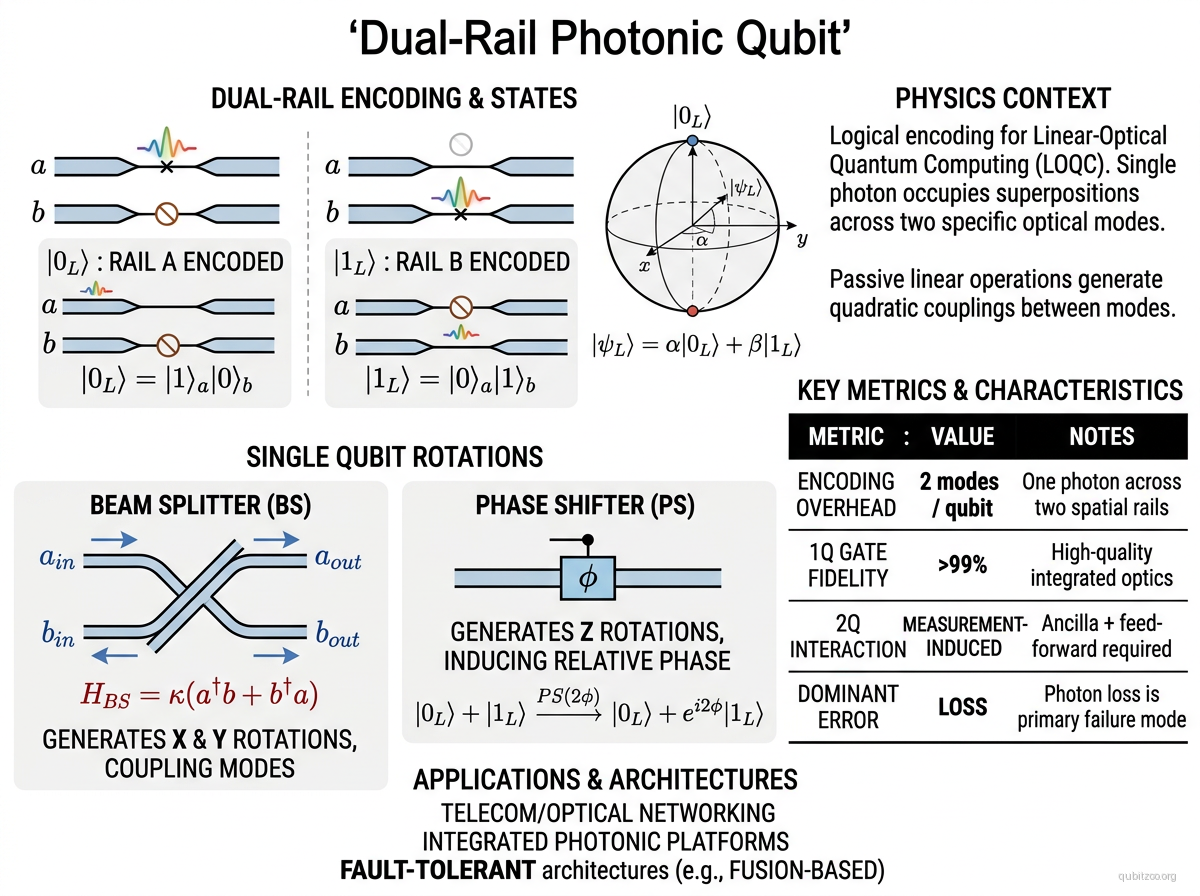
Description
The dual-rail photonic qubit encodes logical states in the occupation of two optical modes by a single photon:
This is the canonical encoding for linear-optical quantum computing (LOQC) and integrated photonic platforms. A single photon propagating in one of two spatial modes (waveguides, polarization rails, or fiber paths) defines the computational basis. Because the encoding is in the path of the photon rather than its internal degrees of freedom, global phase noise on both rails cancels out, leaving the qubit insensitive to common-mode fluctuations.
Single-qubit gates are implemented deterministically using passive linear optics: beam splitters perform rotations in the - plane of the Bloch sphere, while phase shifters generate rotations. Any SU(2) operation can be decomposed into a sequence of beam splitters and phase shifters following the Reck–Zeilinger decomposition.
Two-qubit entangling gates cannot be implemented deterministically with linear optics alone (no photon-photon interaction). Instead, the Knill–Laflamme–Milburn (KLM) scheme uses ancilla photons, interference, and photon detection with classical feed-forward to implement probabilistic but heralded entangling gates. Boosted variants and cluster-state approaches reduce the resource overhead.
The primary error channel is photon loss, which takes the qubit out of the computational subspace entirely. This has motivated the development of loss-tolerant and erasure-based error correction codes specifically designed for photonic architectures.
Hamiltonian
Passive linear-optical operations on the two-mode system are generated by the bilinear Hamiltonian:
For a beam splitter coupling modes and :
which implements rotations about the axis of the logical Bloch sphere. Combined with a relative phase shifter on one mode (generating rotations), this provides universal single-qubit control in the dual-rail subspace.
Motivation
- Dual-rail encoding is naturally robust to global phase noise — both rails accumulate the same phase, so only the relative phase matters.
- Directly compatible with telecom-wavelength fiber and integrated silicon/silicon-nitride photonics, enabling optical networking of quantum processors.
- The default logical encoding in most photonic fault-tolerant architectures, including fusion-based and measurement-based schemes.
- Photon loss maps to a detectable erasure error, which is easier to correct than depolarizing noise.
Experimental Status
KLM scheme proposed — Knill, Laflamme, and Milburn (2001):
- Showed that scalable quantum computing is possible with linear optics, single-photon sources, and photon detectors.
- Probabilistic but heralded two-qubit gates using ancilla photons and feed-forward.
Integrated photonic demonstrations (2008–present):
- High-fidelity single-qubit gates (>99%) demonstrated on silicon photonic chips using Mach–Zehnder interferometers as beam splitters.
- Two-qubit entangling gates demonstrated with heralded success probabilities in integrated waveguide circuits.
PsiQuantum and Xanadu architectures (2020s):
- Industry efforts building large-scale dual-rail photonic processors using fusion-based and cluster-state approaches.
- Integrated single-photon sources and detectors improving overall system efficiency.
Key Metrics
| Metric | Value | Notes | Fidelity reference |
|---|---|---|---|
| Encoding overhead | 2 modes / qubit | One photon across two rails | — |
| 1Q gate fidelity | >99% | Passive integrated optics (beam splitter + phase shifter) | Knill et al. 2001 |
| 2Q interaction | Measurement-induced | Ancilla photons + feed-forward (KLM-type) | Knill et al. 2001 |
| Dominant error | Photon loss | Takes qubit out of computational subspace; detectable as erasure | — |
| Photon indistinguishability | >99% | Required for high-visibility interference | — |
References
Original proposal
- E. Knill, R. Laflamme, and G. J. Milburn, “A scheme for efficient quantum computation with linear optics,” Nature 409, 46 (2001)
Foundational theory
- M. Reck, A. Zeilinger, H. J. Bernstein, and P. Bertani, “Experimental realization of any discrete unitary operator,” Phys. Rev. Lett. 73, 58 (1994)
- P. Kok et al., “Linear optical quantum computing with photonic qubits,” Rev. Mod. Phys. 79, 135 (2007)
Linked Papers
Evergreen context
- quantum-hardware — dual rail is the cleanest answer when the hardware question is, “what is the default qubit abstraction for integrated or networked photonics once transport matters as much as local interaction strength?”
- erasure-error-vs-pauli-error — photon loss is especially important here because it usually leaves the dual-rail codespace as a flagged vacuum event rather than an undetected rotation.
- noise-bias-and-asymmetric-error-channels — photonic fault-tolerance schemes work best when the hardware stays in a strongly loss-dominated regime and the decoder is built around that asymmetry.
- threshold-theorem — KLM, cluster-state, and fusion approaches are all different ways of pushing probabilistic optics and loss below a scalable fault-tolerance threshold.
Related Entries
- photonic-qubit — umbrella entry for the broader photonic-qubit family
- dual-rail-superconducting-qubit — superconducting analog of the dual-rail encoding
- linear-optical-photonic-qubit — broader class of linear-optical qubit schemes
- photonic-cluster-state-mbqc-qubit — measurement-based architecture using photonic cluster states
- fusion-based-photonic-qubit — fusion-gate approach to photonic QC