 Qubit Zoo
Figure
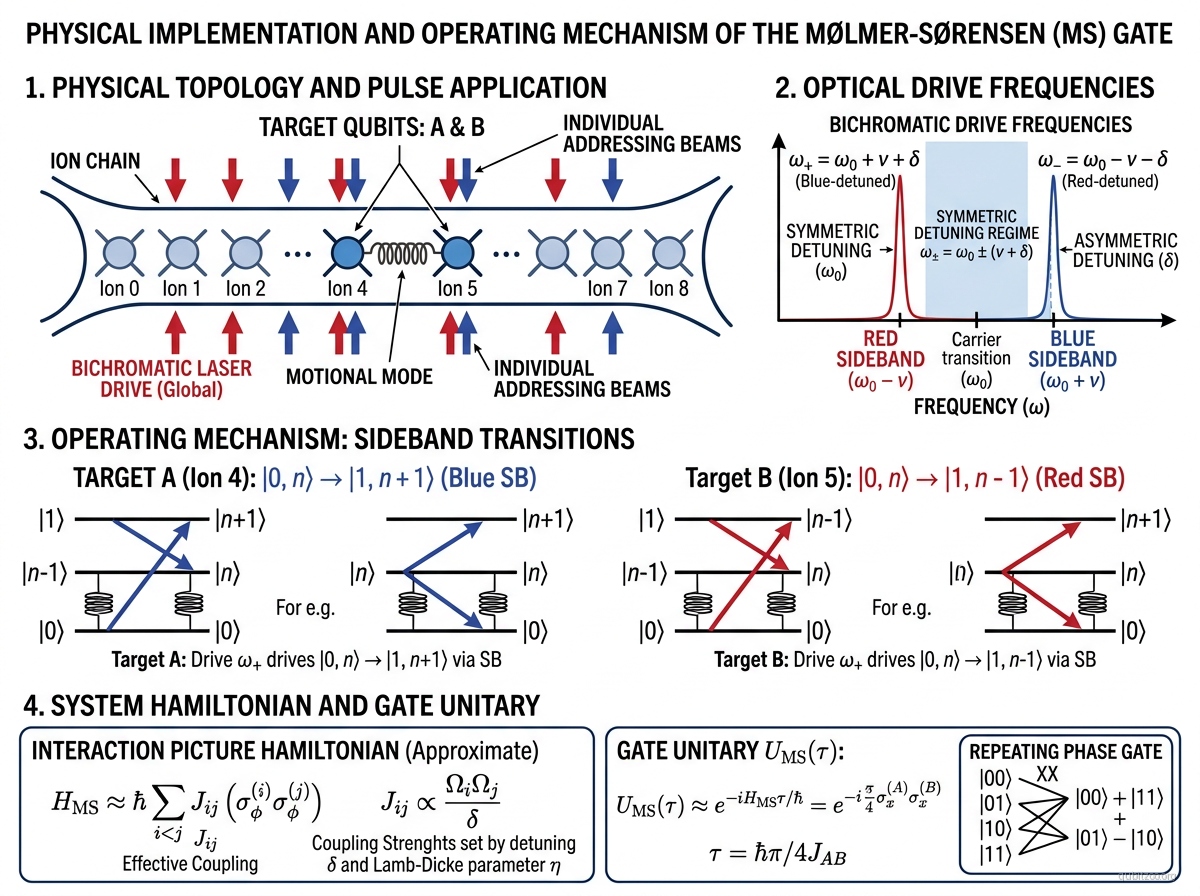
Description
The Mølmer-Sørensen (MS) gate is the standard high-fidelity entangling gate in trapped-ion quantum computing. It uses a bichromatic laser field — two tones placed symmetrically around the qubit carrier frequency, near the red and blue motional sidebands — to generate an effective spin-spin (XX) interaction between two or more ions sharing a common motional mode.
The key physics is that each drive tone couples the ion’s internal state to the shared motional bus: the blue-detuned tone drives transitions while the red-detuned tone drives . When both tones act simultaneously on all addressed ions, the motional excitation is virtual — the motional state returns to its initial value after the gate duration — while a geometric phase accumulates that depends on the product of the ions’ spin states. This produces the desired entangling interaction.
A crucial practical advantage is that the MS gate does not require ground-state cooling of the motional mode. Because the interaction is mediated through virtual phonon excitation, the gate works for thermal motional states as long as the Lamb-Dicke parameter is satisfied.
Hamiltonian
In the interaction picture, the MS gate Hamiltonian for ions is:
where is the Rabi frequency, is the Lamb-Dicke parameter for ion , is the detuning from the motional sideband, and , are the motional mode operators. After adiabatic elimination of the motional degrees of freedom, this reduces to an effective spin-spin interaction:
For a two-ion gate, evolution for time produces the maximally entangling unitary:
Motivation
- The MS gate became the dominant trapped-ion entangling gate because it is experimentally robust to motional-state preparation errors — unlike early Cirac–Zoller gates, it does not require ground-state cooling.
- Maps naturally onto global-beam plus local-addressing hardware used in modern ion-trap systems.
- Scalable to multi-ion entangling operations via amplitude/frequency pulse shaping.
- Achieves the highest two-qubit gate fidelities reported for any qubit platform (99.9%+).
Experimental Status
Original proposal — Mølmer and Sørensen (1999):
- Proposed bichromatic driving scheme for entangling hot trapped ions without ground-state cooling.
- Two papers: Mølmer and Sørensen, PRL 82, 1835 (1999) and Sørensen and Mølmer, PRL 82, 1971 (1999).
First multi-particle entanglement — Sackett et al. (2000):
- Demonstrated entanglement of up to 4 ions using the MS interaction at NIST.
High-fidelity demonstration — Benhelm et al. (2008):
- Achieved 99.3% Bell-state fidelity with Ca ions using an MS gate.
- First demonstration approaching fault-tolerant thresholds.
State-of-the-art — Ballance et al. (2016):
- Achieved 99.9% two-qubit gate fidelity with Ca hyperfine qubits.
- Used careful pulse shaping and error suppression techniques.
Key Metrics
| Metric | Value | Notes | Fidelity reference |
|---|---|---|---|
| 2Q gate fidelity | 99.9%+ | State-of-the-art trapped-ion MS gate | Ballance et al. 2016 |
| Gate time | 10–200 μs | Detuning/fidelity tradeoff | — |
| Cooling requirement | No ground-state cooling required | Major practical advantage over Cirac–Zoller | — |
| Gate type | XX (or YY) entangling | Geometric phase gate | — |
| Scalability | Multi-ion entangling | Via pulse shaping; demonstrated for 4+ ions | Sackett et al. 2000 |
References
Original proposals
- K. Mølmer and A. Sørensen, “Multiparticle Entanglement of Hot Trapped Ions,” Phys. Rev. Lett. 82, 1835 (1999)
- A. Sørensen and K. Mølmer, “Quantum Computation with Ions in Thermal Motion,” Phys. Rev. Lett. 82, 1971 (1999)
Experimental demonstrations
- C. A. Sackett et al., “Experimental entanglement of four particles,” Nature 404, 256 (2000)
- J. Benhelm et al., “Towards fault-tolerant quantum computing with trapped ions,” Nature Phys. 4, 463 (2008)
- C. J. Ballance et al., “High-Fidelity Quantum Logic Gates Using Trapped-Ion Hyperfine Qubits,” Phys. Rev. Lett. 117, 060504 (2016)
Linked Papers
- sorensen-1999-ms-gate
- ballance-2016-ion-gate-fidelity
- benhelm-2008-fault-tolerant-computing
- gaebler-2016-ms-gate
- mlmer-1999-multiparticle-entanglement-hot
- sackett-2000-experimental-entanglement-four
Evergreen context
- motional-mode-coupling-in-ion-traps — the bichromatic red/blue-sideband picture behind the virtual-phonon XX interaction
- threshold-theorem — why the jump from proof-of-principle gates to 99.9% entangling fidelity matters for fault-tolerant viability
- divincenzo-criteria — the MS gate is the practical answer to the universal two-qubit-control criterion in modern ion-trap stacks
Related Entries
- trapped-ion-qubit — qubit platform where the MS gate is standard
- cirac-zoller-gate — earlier trapped-ion entangling gate requiring ground-state cooling