 Qubit Zoo
Figure
Description
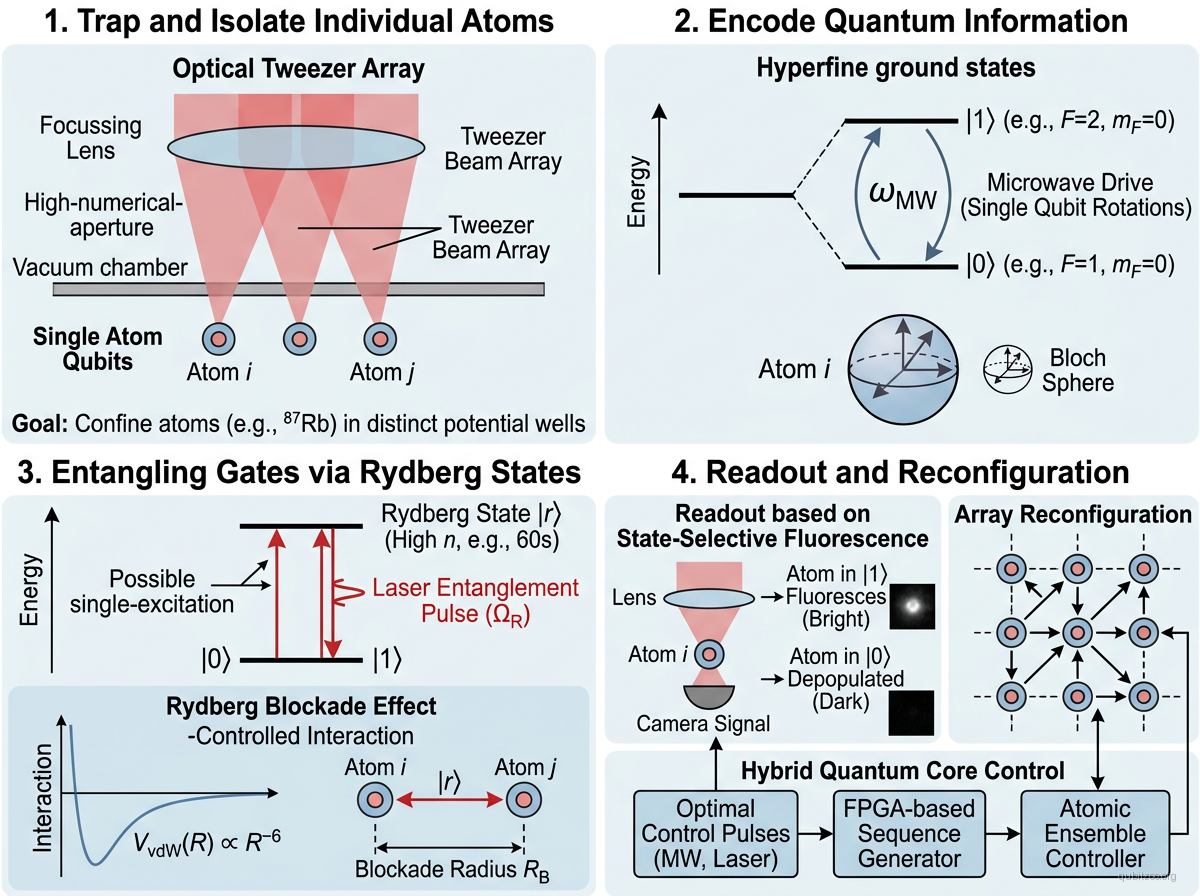
The neutral atom qubit encodes quantum information in internal states (typically hyperfine ground states) of individual neutral atoms trapped in optical tweezers or optical lattices. Entangling gates exploit strong dipole–dipole interactions via transient excitation to Rydberg states.
Neutral atom platforms trap individual alkali atoms (⁸⁷Rb, ¹³³Cs) or alkaline-earth atoms (⁸⁸Sr, ¹⁷¹Yb) in tightly focused optical tweezer arrays. Qubit states are encoded in two hyperfine ground states |0⟩ and |1⟩, which have long coherence times due to weak coupling to the environment. Single-qubit gates are driven by microwave or two-photon Raman transitions. Two-qubit entangling gates use the Rydberg blockade mechanism: when one atom is excited to a high-lying Rydberg state (n ~ 50–100), the strong van der Waals interaction shifts the doubly-excited state out of resonance, creating a conditional phase.
Key advantages include identical qubits (no fabrication disorder), reconfigurable geometry via tweezer rearrangement, and mid-circuit atom reloading. Arrays of 1000+ atoms have been demonstrated, with programmable connectivity set by Rydberg interaction range (~5–10 μm), requiring atom shuttling for longer-range gates.
Hamiltonian
Single-qubit Hamiltonian in the rotating frame:
where is the Rabi frequency and the detuning.
Rydberg blockade Hamiltonian for two atoms separated by distance :
The blockade condition prevents simultaneous Rydberg excitation, enabling a controlled-Z gate.
Motivation
- Identical qubits: Every atom of the same species is physically identical — no fabrication disorder, no frequency collisions.
- Massive parallelism: Global Rydberg pulses entangle all non-interacting pairs simultaneously.
- Reconfigurable connectivity: Atom shuttling via tweezer rearrangement enables arbitrary graph connectivity within a single zone.
- Scalability: 1000+ atom arrays demonstrated; scaling beyond 10,000 atoms is plausible but requires solving control, cooling, and readout challenges at scale.
- Mid-circuit operations: Erasure detection and atom reloading demonstrated, enabling erasure-error conversion and real-time error mitigation.
Experimental Status
First Rydberg blockade gate — Isenhower et al. (2010):
- Demonstrated controlled-NOT gate between two individually trapped ⁸⁷Rb atoms via Rydberg blockade
- Gate fidelity ~73% (limited by atomic motion and laser phase noise)
Large-scale programmable arrays — Ebadi et al. (2021):
- 256-atom programmable quantum simulator using ⁸⁷Rb tweezer arrays
- Demonstrated quantum phases of matter and optimization algorithms
High-fidelity entanglement — Bluvstein et al. (2024):
- Two-qubit CZ gate fidelity of 99.5% in ¹³³Cs tweezer arrays
- Single-qubit gate fidelity of 99.97%
- Logical qubit operations with error correction demonstrated
1000+ atom arrays — Pause et al. (2024):
- 1225-atom ⁸⁷Rb tweezer array with >97% loading efficiency
Key Metrics
| Metric | Value | Notes | Fidelity reference |
|---|---|---|---|
| 1Q gate fidelity | 99.97% | ¹³³Cs tweezers | Bluvstein et al. 2024 |
| 2Q gate fidelity (CZ) | 99.5% | ¹³³Cs tweezers | Bluvstein et al. 2024 |
| T₂ (Ramsey) | ~1 s | ⁸⁷Rb hyperfine | Kleine Büning et al. 2011 |
| T₂ (spin echo) | ~10 s | ¹⁷¹Yb clock states | Ma et al. 2022 |
| Readout fidelity | 99.8% | ¹³³Cs fluorescence | Bluvstein et al. 2024 |
| Array size | 1225 atoms | Rb tweezer array | Pause et al. 2024 |
| Atom loss per circuit | ~0.5% per layer | ¹³³Cs | Bluvstein et al. 2024 |
Scaling Considerations
- Connectivity: Reconfigurable via atom shuttling; effective all-to-all within Rydberg range (~5–10 μm). Longer-range gates require physical atom transport with associated decoherence.
- Parallelism: Global Rydberg pulses enable parallel entangling gates on non-interacting pairs.
- Error budget: Dominated by Rydberg state decay, atomic motion (Doppler shifts), and atom loss (~0.5% per circuit layer, compounding in deep circuits).
- Mid-circuit operations: Erasure detection via shelving to auxiliary states demonstrated; enables erasure-error conversion.
Limitations & Challenges
- Gate speed: Two-qubit gate times (~μs) are ~1000× slower than superconducting qubits (~ns), limiting circuit depth per unit time.
- Atom loss: Probabilistic atom loss during Rydberg excitation and imaging compounds at ~0.5% per circuit layer, requiring active reloading strategies.
- Probabilistic loading: Initial tweezer loading is stochastic (~50% per site); defect-free assembly via rearrangement is time-costly and scales with array size.
- Vacuum requirements: Ultra-high vacuum (~10⁻¹¹ Torr) systems are large, expensive, and have long pump-down times.
- Laser noise & stability: Rydberg excitation requires high-power, frequency-stabilized lasers; laser phase noise is a dominant gate error source.
- Crosstalk: At high site densities, residual Rydberg interactions and optical crosstalk between closely spaced tweezers can introduce correlated errors.
References
Original proposal
- D. Jaksch et al., “Fast Quantum Gates for Neutral Atoms,” Phys. Rev. Lett. 85, 2208 (2000) — arXiv:quant-ph/0004038
Experimental demonstrations
- A. Isenhower et al., “Demonstration of a Neutral Atom Controlled-NOT Quantum Gate,” Phys. Rev. Lett. 104, 010503 (2010) — arXiv:0907.5552
- G. Kleine Büning et al., “Extended Coherence Time on the Clock Transition of Optically Trapped Rubidium,” Phys. Rev. Lett. 106, 240801 (2011)
- S. Ebadi et al., “Quantum phases of matter on a 256-atom programmable quantum simulator,” Nature 595, 227 (2021) — arXiv:2012.12281
- S. Ma et al., “Universal Gate Operations on Nuclear Spin Qubits in an Optical Tweezer Array of ¹⁷¹Yb Atoms,” Phys. Rev. X 12, 021028 (2022) — arXiv:2203.04340
- D. Bluvstein et al., “Logical quantum processor based on reconfigurable atom arrays,” Nature 626, 58 (2024) — arXiv:2312.03982
- L. Pause et al., “Supercharged two-dimensional tweezer array with more than 1000 atomic qubits,” Optica 11, 222 (2024) — arXiv:2310.09191
Linked Papers
- jaksch-2000-rydberg-gate
- bluvstein-2024-logical-processor-reconfigurable
- ma-2022-nuclear-spin-atom
- pause-2024-supercharged-dimensional-tweezer
- ebadi-2021-256-atom-simulator
- isenhower-2010-rydberg-cnot
- kleine-buning-2011-clock-coherence
- wu-2022-erasure-neutral-atoms
- sturm-2026-efficient-assembly-of-a
- ikari-2026-do-not-let-cnots
- liu-2026-architecture-and-compilation-co-design
- roschinski-2026-programmable-cavity-qed-with
- saffman-2026-neutral-atom-quantum-computing
- patil-2026-a-platform-aware-compilation-framework
- sharma-2026-loss-correcting-fault-tolerant-quantum-computing
Evergreen context
- rydberg-blockade-mechanism — the interaction primitive that sets neutral-atom gate range, parallelism, and a large fraction of the error budget
- erasure-error-vs-pauli-error — explains why atom loss plus mid-circuit detection is strategically important rather than just a nuisance
- quantum-hardware — the right umbrella note when comparing neutral atoms against superconducting, ion-trap, and photonic system stacks
- coherence-time-hierarchy — hyperfine clock-state storage versus Rydberg gate timescales is the standard frame for judging idle fidelity against gate speed
- threshold-theorem — the surface-code and logical-qubit results on atom arrays are claims about operating below threshold, not just about raw gate fidelity
Related Entries
- rydberg-neutral-atom-qubit — Rydberg-specific encoding variant
- alkaline-earth-neutral-atom-clock-qubit — Clock-state variant with narrower optical transitions
- nuclear-spin-neutral-atom-qubit — Nuclear spin encoding in ¹⁷¹Yb
- surface-code-logical-qubit — Error correction demonstrated on neutral atom arrays
- erasure-qubit — Erasure-error conversion demonstrated in neutral atom systems via shelving to detectable loss channels
- trapped-ion-qubit — Closest competing atomic-physics platform; similar individual-atom control but electromagnetic trapping and Coulomb-mediated gates