 Qubit Zoo
Figure
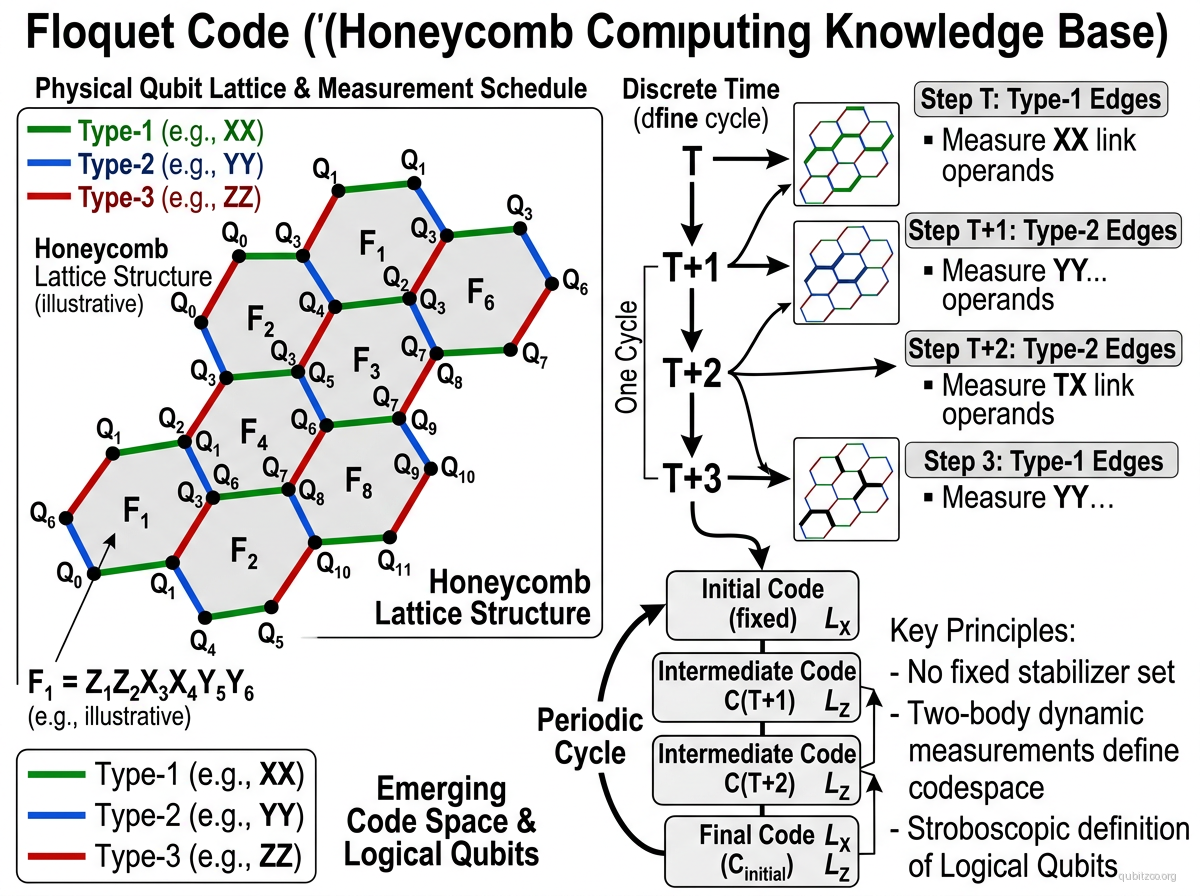
Description
Floquet codes are a family of dynamical quantum error-correcting codes where the code space is not defined by a fixed set of stabilizers but instead emerges from a periodic sequence of two-body measurements. The codespace changes at each time step but returns to itself after a complete measurement cycle, defining logical qubits that persist stroboscopically.
Introduced by Hastings and Haah (2021), the honeycomb Floquet code is the prototypical example. The physical qubits sit on vertices of a honeycomb lattice, and at each time step, two-body Pauli measurements (XX, YY, or ZZ) are performed on pairs of qubits sharing an edge. The three edge colors are measured in a repeating 3-step cycle.
Key advantages:
- Two-body measurements only: No multi-qubit stabilizer measurements needed (vs. weight-4 checks in surface code), simplifying hardware.
- Inherent fault tolerance: The dynamical structure naturally detects errors from measurement failures.
- Competitive thresholds: Comparable to surface code despite simpler measurements.
- Potential for qLDPC integration: Floquet techniques may help implement non-local codes on local hardware.
The main subtlety is that the instantaneous stabilizer group changes at each step — logical information is only well-defined when viewed over complete cycles.
Measurement Cycle
On a honeycomb lattice with edge coloring (r, g, b), the 3-step cycle measures:
The effective code after one complete cycle is equivalent to a topological code with distance set by the lattice size. The check operators from consecutive rounds combine to form the stabilizers of a toric/surface code.
Motivation
- Hardware simplification: Two-body measurements are natively available on most platforms (superconducting, neutral atom, trapped ion) — no ancilla overhead for syndrome extraction.
- Dynamic error detection: The time-varying stabilizer structure provides redundant error information across measurement rounds.
- Competitive performance: Achieves thresholds comparable to surface code with dramatically simpler measurements.
- Beyond surface code: Active area of research for next-generation error correction, with Google and others exploring Floquet codes as alternatives to the surface code.
Key Metrics
| Metric | Value | Notes | Fidelity reference |
|---|---|---|---|
| Measurement weight | 2 | Only two-body measurements (vs. weight-4 for surface code) | Hastings and Haah 2021 |
| Threshold (circuit-level) | ~0.2–0.5% | Depends on noise model and decoder | Hastings and Haah 2021 |
| Code distance | = linear lattice dimension | — | |
| Encoding rate | Same scaling as surface code for 2D | — |
Scaling Considerations
- Hardware simplicity: Two-body measurements are natively available on most platforms (especially superconducting and neutral atom).
- Decoding: Requires decoders that handle the time-varying stabilizer structure; matching-based decoders adapted from surface code work well.
- Google interest: Active exploration for next-generation error correction beyond the surface code.
References
Original proposal
- M. B. Hastings and J. Haah, “Dynamically Generated Logical Qubits,” Quantum 5, 564 (2021) — arXiv:2107.02194
Related theory
- M. B. Hastings and J. Haah, “Measurement sequences for magic state distillation,” arXiv:2302.12292
- M. S. Kesselring et al., “Anyon condensation and the color code,” arXiv:2212.00042
Linked Papers
Evergreen context
- threshold-theorem — Floquet codes are best understood as a different path to fault-tolerant scaling, trading static stabilizer structure for simpler repeated measurements.
- quantum-hardware — the main appeal is hardware-facing: two-body checks fit platforms that struggle with deeper ancilla-assisted stabilizer extraction.
- erasure-error-vs-pauli-error — useful when comparing decoder assumptions, because Floquet-code advantages shift noticeably with the underlying flagged-loss versus Pauli-dominated noise model.
- noise-bias-and-asymmetric-error-channels — adds the orthogonal question of whether the unflagged residual channel has a dominant Pauli direction that the measurement schedule and decoder should exploit.
Related Entries
- surface-code-logical-qubit — Static topological code; Floquet codes can emulate its effective stabilizers
- color-code-logical-qubit — Alternative topological code with transversal gates
- qldpc-codes — Floquet techniques may help implement qLDPC codes on local hardware