 Qubit Zoo
Figure
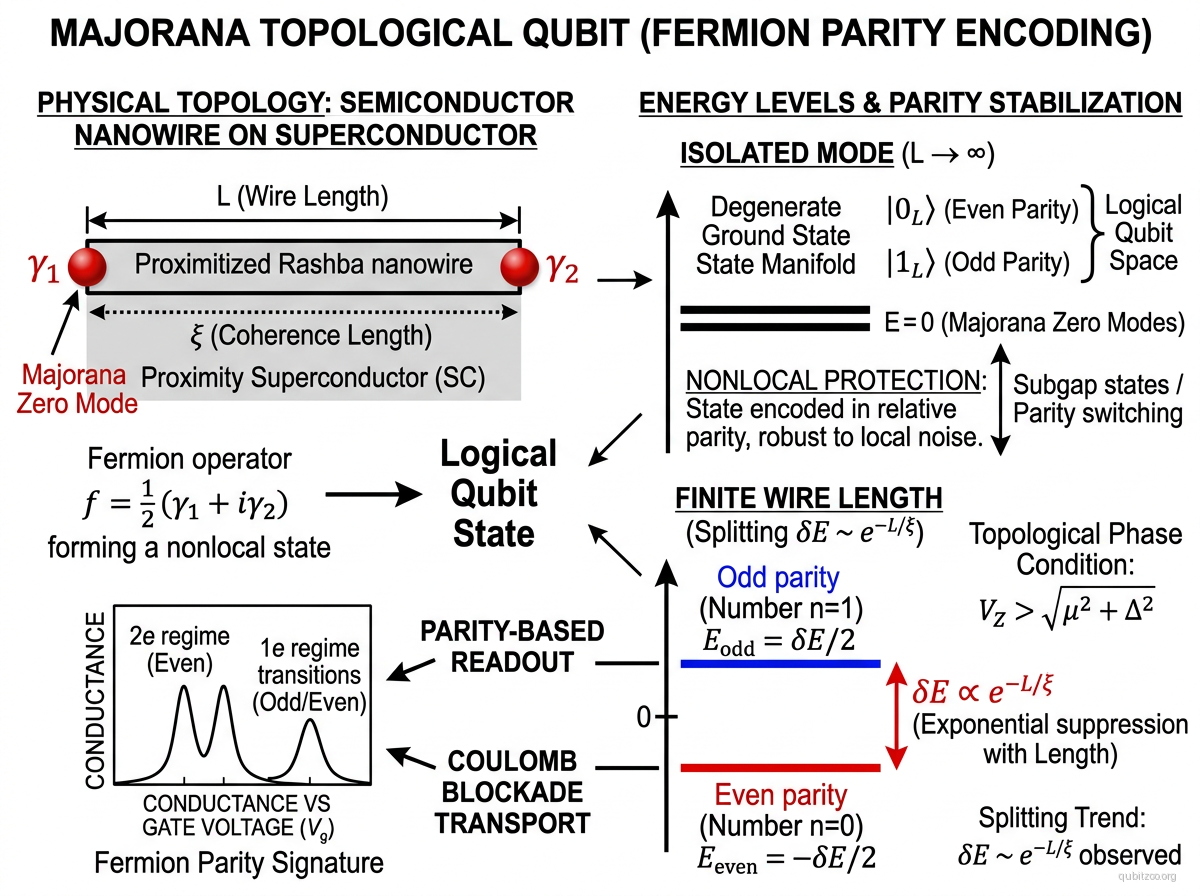
Description
The Majorana topological qubit encodes quantum information in fermion parity degrees of freedom built from spatially separated Majorana zero modes (MZMs) in hybrid semiconductor-superconductor nanostructures. The qubit states (even parity) and (odd parity) are defined by the occupation of a nonlocal fermion mode constructed from two Majorana operators localized at opposite ends of a proximitized semiconductor nanowire.
In finite nanowires, overlapping end Majorana modes split away from zero energy. A central scaling requirement is exponential suppression of this splitting with wire length:
where is the Majorana separation and is the Majorana localization length. Coulomb-blockade transport in Majorana islands is a primary diagnostic channel for parity states and near-zero modes, with transitions between 2 and 1 periodicity serving as experimental signatures.
The topological protection arises from the nonlocal encoding: information stored in the relative parity of spatially separated modes is immune to local perturbations, offering a candidate path to hardware-level error suppression before full quantum error correction overhead. A minimal operational qubit requires four MZMs (two pairs) to define a logical qubit within a fixed total parity sector.
Hamiltonian
A minimal 1D semiconductor-superconductor nanowire model (proximitized Rashba wire) is:
Topological phase condition (idealized):
In the topological regime, Majorana zero modes localize at wire ends with overlap-induced splitting:
which motivates long wires and hard-gap devices for robust parity protection.
Motivation
- Encodes information nonlocally, targeting intrinsic protection against local noise channels
- Offers a candidate path to hardware-level error suppression before full QEC overhead
- Topological braiding operations would implement certain gates fault-tolerantly by geometry
- Scalable architectures (tetron, hexon) proposed for integration with surface code error correction
Evergreen context
- quantum-hardware places Majorana devices inside the broader hardware map, but with the unusual claim that materials design can suppress errors before conventional code overhead is paid.
- spin-orbit-coupling-for-qubit-control is part of the nanowire recipe: Rashba spin-orbit coupling, Zeeman splitting, and induced pairing together create the topological regime that supports end Majorana modes.
- divincenzo-criteria is still the right scorecard here, because zero-bias spectroscopy and parity signatures are not yet the same as scalable initialization, protected gates, and high-fidelity readout.
- threshold-theorem is the downstream test for whether nonlocal parity encoding actually buys a fault-tolerance advantage rather than just a distinctive spectroscopy signal.
Experimental Status
Exponential protection — Albrecht et al. (2016):
- Observed exponential suppression of zero-mode splitting with wire length in InAs/Al nanowire devices
- Key milestone toward establishing topological protection in solid-state systems
- Nature 531, 206 (2016)
Parity signatures:
- Coulomb-blockade parity signatures observed: 2/1 regime transitions consistent with subgap-state / Majorana phenomenology
- Theoretical framework for Coulomb-blockaded Majorana devices developed (Shen et al., Lai et al.)
Microsoft topological qubit program (2025):
- Extensive spectroscopy and interferometric measurements on InAs/Al devices
- Topological gap protocol developed for identifying topological regime
- Full braiding-grade protected gates and logical qubit operations remain open experimental challenges
Current status:
- Robust topological protection must still be established under full control/readout stacks
- Still pre-fault-tolerant experimentally; demonstrated topological logical gate fidelity not yet established
Key Metrics
| Metric | Value | Notes | Fidelity reference |
|---|---|---|---|
| Zero-mode splitting trend | Exponential suppression with | Key milestone toward topological protection | Albrecht et al. 2016 |
| Coulomb-blockade parity signatures | 2/1 regime transitions observed | Consistent with Majorana phenomenology | — |
| Topological logical gate fidelity | Not yet established | Full braiding-grade protected gates remain open | — |
| Topological phase condition | Idealized Rashba wire model | — |
References
Foundational theory
- A. Y. Kitaev, “Unpaired Majorana fermions in quantum wires,” Phys.-Usp. 44, 131 (2001)
Experimental milestones
- S. M. Albrecht et al., “Exponential protection of zero modes in Majorana islands,” Nature 531, 206 (2016)
Related theory
- J. Shen et al., “Parity transitions in the superconducting ground state of hybrid InSb–Al Coulomb islands,” Nat. Commun. 9, 4801 (2018)
Linked Papers
- albrecht-2016-exponential-protection-of-zero
- lai-2021-theory-of-coulomb-blockaded
- shen-2018-parity-transitions-in-the
- aghaee-2021-majorana-spectroscopy
- karzig-2017-tetron
- kitaev-2001-unpaired-majorana-fermions
- pientka-2017-planar-jj
- chang-2026-half-a-qubit-an
- hance-2026-why-three-a-two-level
- cespedes-2026-geometric-quantifier-of-the
- laubscher-2026-measurement-induced-enhancement-of-the
- hanotel-2026-from-majorana-to-bloch
Related Entries
- tetron-qubit — proposed scalable Majorana qubit architecture
- planar-josephson-junction-qubit — alternative topological superconductor platform
- surface-code-logical-qubit — error correction code compatible with topological qubits
- color-code-logical-qubit — alternative topological error correction code