 Qubit Zoo
Figure
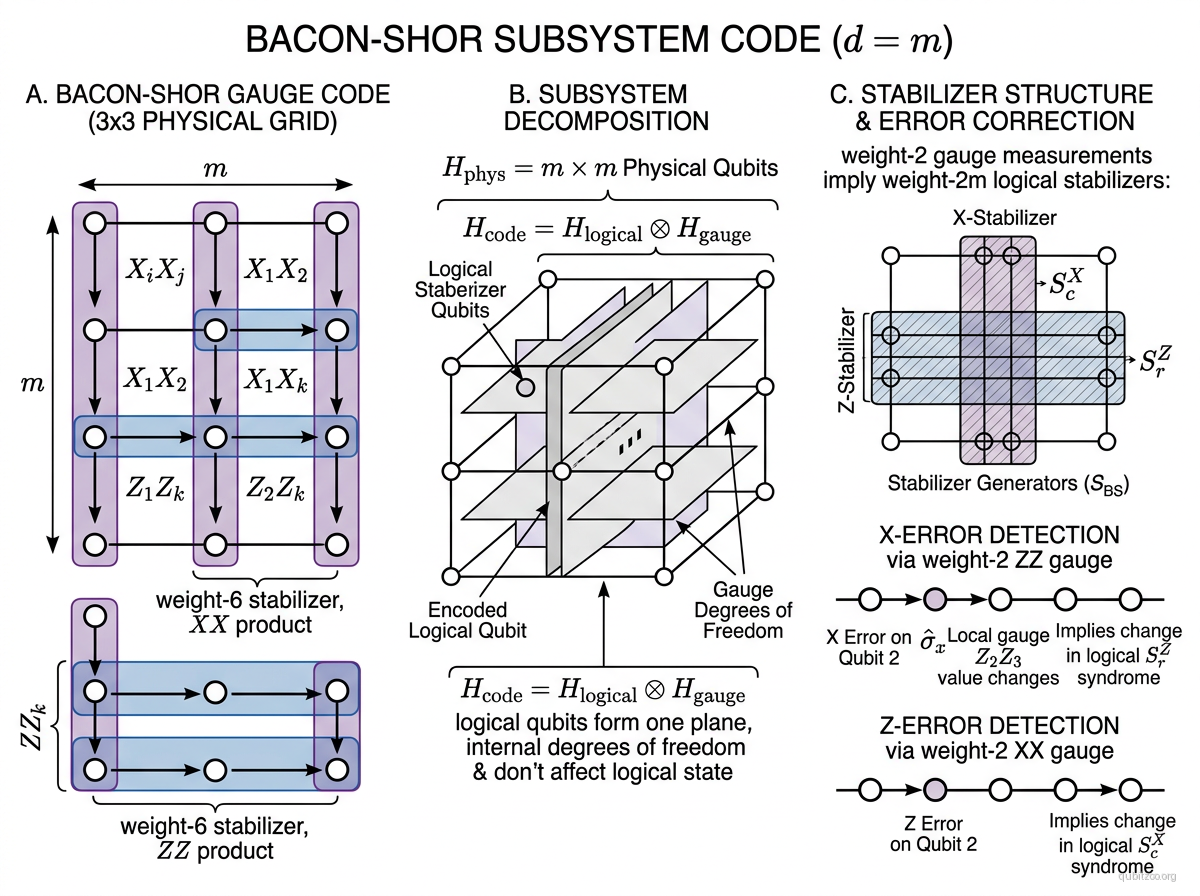
Description
The Bacon-Shor code is a family of subsystem quantum error-correcting codes defined on a 2D grid of physical qubits. It encodes one logical qubit in physical qubits with distance , using only two-body gauge measurements (weight-2 XX and ZZ checks on neighboring pairs). The stabilizers are products of gauge operators and have weight , but syndrome extraction requires only weight-2 measurements — a major hardware simplification.
The Bacon-Shor code exploits the subsystem code framework: the physical Hilbert space decomposes into a logical subsystem, a gauge subsystem, and a stabilizer-fixed subsystem. Only the logical subsystem encodes information; the gauge subsystem is “don’t care” degrees of freedom.
For the code on an grid:
- X stabilizers: Products of along each pair of adjacent rows.
- Z stabilizers: Products of along each pair of adjacent columns.
- Gauge operators: Individual (horizontal pairs) and (vertical pairs).
Syndrome extraction measures only the weight-2 gauge operators, then classically computes the stabilizer syndrome from their products. This avoids the need for ancilla-mediated multi-qubit parity measurements entirely.
Stabilizer Structure
For the Bacon-Shor code on a 3×3 grid:
Gauge generators (weight 2):
Stabilizers (weight 6, but measured via weight-2 gauge operators):
Logical operators:
Motivation
- Hardware simplicity: Only weight-2 nearest-neighbor measurements required — no ancilla qubits, no multi-qubit parity checks.
- Noise-bias exploitation: Rectangular variants can correct more X than Z errors (or vice versa), naturally matching biased-noise hardware like cat qubits or fluxonium.
- Concatenation-friendly: Effective when concatenated with other codes, especially for noise with strong bias.
- Pedagogical importance: Simplest subsystem code, used as a building block for understanding gauge codes and operator QEC.
Experimental Status
First demonstration on trapped ions — Egan et al. (2021):
- Implemented the Bacon-Shor code on a 13-ion trapped-ion processor (Honeywell/Quantinuum H1)
- Demonstrated fault-tolerant syndrome extraction using only weight-2 measurements
- Achieved logical error rate suppression below physical error rate
Key Metrics
| Metric | Value | Notes | Fidelity reference |
|---|---|---|---|
| Physical qubits | For distance | Bacon 2006 | |
| Measurement weight | 2 | Only nearest-neighbor two-body measurements | Bacon 2006 |
| Encoding rate | Same as surface code | — | |
| Threshold | ~0.1% (concatenated) | Lower than surface code, but simpler measurements | — |
| Distance | Linear in grid dimension | — |
Scaling Considerations
- Simplicity: Weight-2 measurements only, no ancilla overhead for syndrome extraction.
- Asymmetric protection: Naturally biased — can be rectangular () to correct more X than Z errors or vice versa, matching hardware noise bias.
- Concatenation: Effective when concatenated with other codes (e.g., repetition code for dominant error type).
- Threshold limitation: Lower threshold than surface code makes it less competitive for depolarizing noise, but advantageous for biased noise.
References
Original proposal
- D. Bacon, “Operator quantum error-correcting subsystems for self-correcting quantum memories,” Phys. Rev. A 73, 012340 (2006) — arXiv:quant-ph/0506023
Experimental demonstrations
- L. Egan et al., “Fault-tolerant control of an error-corrected qubit,” Nature 598, 281 (2021) — arXiv:2009.11482
Related theory
- P. Aliferis and A. W. Cross, “Subsystem fault tolerance with the Bacon-Shor code,” Phys. Rev. Lett. 98, 220502 (2007) — arXiv:quant-ph/0610063
Linked Papers
Evergreen context
- threshold-theorem — the big-picture reason Bacon-Shor matters despite its lower depolarizing threshold: it is a hardware tradeoff about what syndrome extraction you can do reliably.
- noise-bias-and-asymmetric-error-channels — Bacon-Shor becomes much more compelling when the physical noise is strongly asymmetric and the rectangular code can lean into that bias.
- decoherence-free-subspace — useful contrast for the word “subsystem”: Bacon-Shor is an active subsystem code, not passive symmetry protection.
Related Entries
- surface-code-logical-qubit — Higher threshold but requires weight-4 measurements
- color-code-logical-qubit — Alternative topological code with transversal gates
- kerr-cat-qubit — Biased-noise qubit that pairs well with Bacon-Shor