 Qubit Zoo
Figure
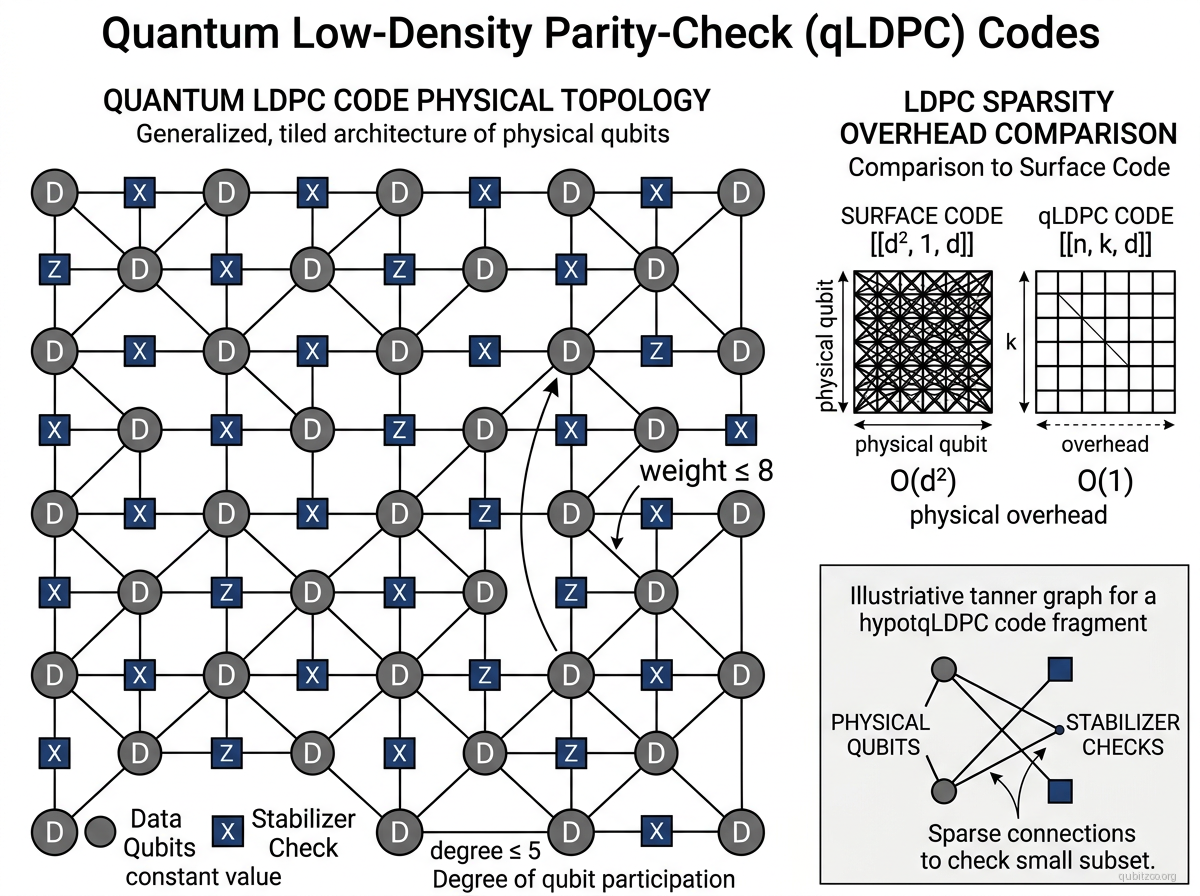
Description
Quantum low-density parity-check (qLDPC) codes are a family of quantum error-correcting codes where each stabilizer check acts on a bounded number of qubits and each qubit participates in a bounded number of checks, regardless of code size. This sparsity enables asymptotically constant encoding overhead — potentially requiring only physical qubits per logical qubit — a dramatic improvement over the overhead of the surface code.
Classical LDPC codes revolutionized telecommunications (5G, Wi-Fi, DVB-S2). Their quantum analogues face additional constraints: stabilizer checks must commute, which makes constructing good qLDPC codes far harder. The breakthrough came in 2021–2022 with several families achieving constant-rate, growing-distance codes:
- Hypergraph product codes (Tillich-Zémor 2014): with and .
- Lifted product / balanced product codes (Breuckmann-Eberhardt 2021): Improved constructions with better distance scaling.
- Asymptotically good codes (Panteleev-Kalachev 2022): First codes with and — the qLDPC holy grail.
- Fiber bundle codes (Hastings, Haah, O’Donnell 2021): .
The key practical challenge is that qLDPC codes require non-local connectivity: each physical qubit must interact with a constant number of other qubits that may be far apart in any 2D layout. This conflicts with the local connectivity of superconducting and neutral-atom hardware, requiring either long-range couplers, atom shuttling, or modular architectures.
Stabilizer Formalism
A qLDPC code is defined by a pair of sparse parity-check matrices and satisfying:
with column and row weights bounded by constants and independent of . The code parameters are:
- = number of physical qubits
- = number of logical qubits
- = minimum weight of a non-trivial logical operator
For asymptotically good codes: , , giving constant encoding rate .
Motivation
- Constant overhead: Physical-to-logical qubit ratio approaches for large codes, vs. for surface codes — potentially 100–1000× reduction in resource overhead.
- Asymptotically good parameters: Panteleev-Kalachev codes achieve and simultaneously — the theoretical optimum for stabilizer codes.
- Practical thresholds: Simulated thresholds of ~1–5% are competitive with surface codes.
- Architecture synergy: Non-local connectivity naturally matches platforms with reconfigurable connectivity (neutral atom shuttling, photonic interconnects, modular superconducting).
Key Metrics
| Metric | Value | Notes | Fidelity reference |
|---|---|---|---|
| Encoding rate | Constant rate (vs. for surface code) | Panteleev and Kalachev 2022 | |
| Distance | Linear distance for best constructions | Panteleev and Kalachev 2022 | |
| Check weight | 10–20 | Constant, independent of code size | — |
| Threshold (simulated) | ~1–5% | Depends on decoder and specific code family | — |
| Physical-to-logical overhead | vs. for surface code | — |
Scaling Considerations
- Connectivity: Non-local stabilizer checks are the main implementation barrier. Neutral atom shuttling and modular superconducting architectures are promising paths.
- Decoding: Belief-propagation + OSD decoders show good performance but latency is higher than surface-code decoders.
- Practical crossover: At small code sizes, surface codes still win due to local connectivity. qLDPC becomes advantageous at large where the rate savings dominate.
References
Original proposal (asymptotically good)
- P. Panteleev and G. Kalachev, “Asymptotically good Quantum and locally testable classical LDPC codes,” STOC 2022 — arXiv:2202.13641
Key constructions
- J.-P. Tillich and G. Zémor, “Quantum LDPC codes with positive rate and minimum distance proportional to the square root of the blocklength,” IEEE Trans. Inf. Theory 60, 1193 (2014) — arXiv:0903.0566
- N. P. Breuckmann and J. N. Eberhardt, “Balanced Product Quantum Codes,” IEEE Trans. Inf. Theory 67, 6653 (2021) — arXiv:2012.09271
Related theory
- M. B. Hastings, J. Haah, and R. O’Donnell, “Fiber bundle codes: breaking the barrier for quantum LDPC codes,” STOC 2021 — arXiv:2009.03921
Linked Papers
- panteleev-2022-asymptotically-good
- breuckmann-2021-balanced-product-codes
- hastings-2021-fiber-bundle-codes
- tillich-2014-ldpc-codes-positive
Evergreen context
- threshold-theorem — qLDPC matters only insofar as its constant-rate promise still lives in a realistic below-threshold regime
- erasure-error-vs-pauli-error — a useful lens for reading qLDPC threshold claims, since decoder advantages depend strongly on whether the hardware exposes flagged loss or ordinary Pauli noise
- noise-bias-and-asymmetric-error-channels — keeps a second decoder assumption explicit: even after separating flagged erasures, the unflagged residual may be strongly biased among , , and errors
Related Entries
- surface-code-logical-qubit — Local 2D code with overhead; qLDPC aims to beat this
- color-code-logical-qubit — Another local 2D code with transversal gates
- floquet-codes — Dynamical codes that may help implement qLDPC on local hardware