 Qubit Zoo
Figure
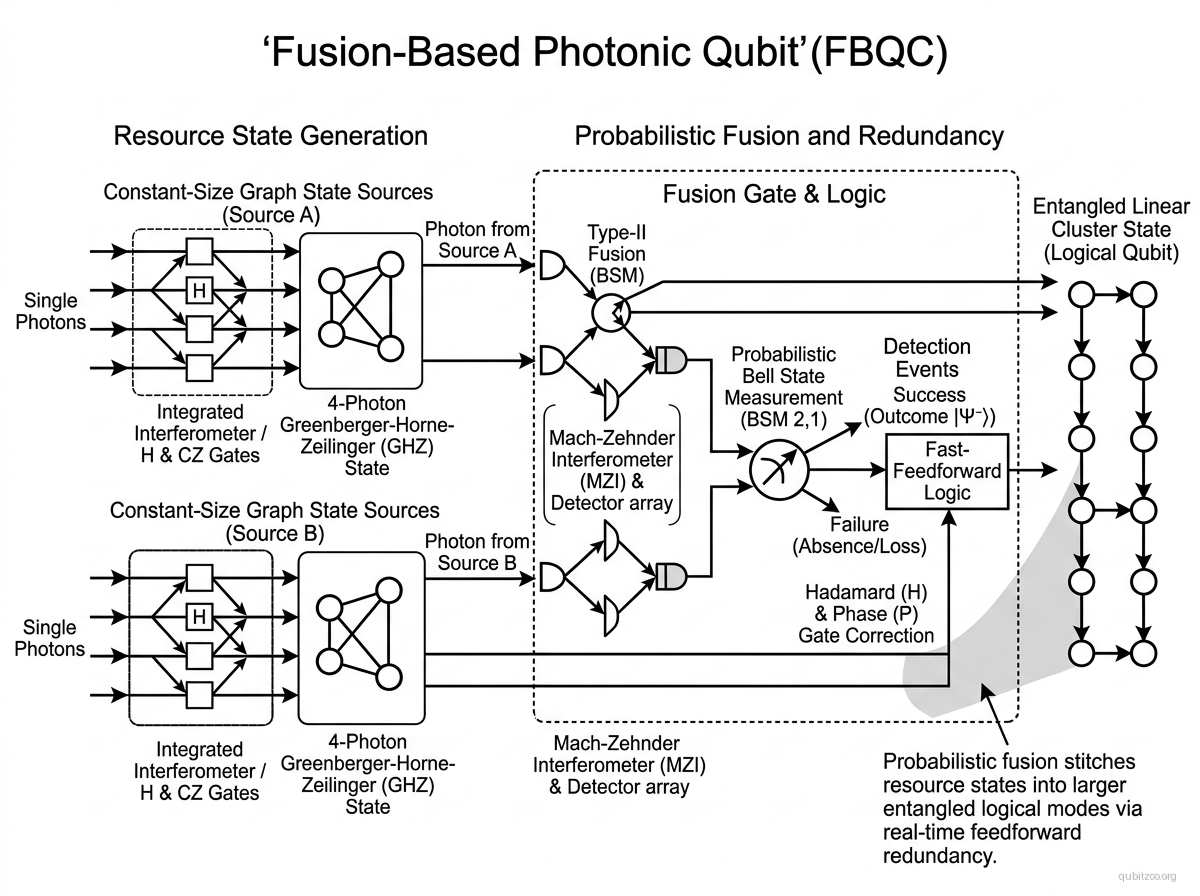
Description
Fusion-based quantum computing (FBQC) is a photonic architecture proposed by Bartolucci et al. (2023) and developed primarily by PsiQuantum. Rather than building large entangled cluster states deterministically and then measuring them (as in standard measurement-based QC), FBQC uses small, constant-size entangled photonic resource states that are stitched together at computation time via probabilistic fusion gates.
A Type II fusion gate is a destructive Bell-state measurement on one photon from each of two resource states, projecting the remaining photons into a larger entangled state. Each fusion succeeds with probability using linear optics alone (boosted to with ancilla photons). The architecture is designed to tolerate this high failure rate: the resource states (e.g., 6-ring states or small graph states) are chosen so that the resulting entanglement structure remains percolated and supports fault-tolerant computation even when roughly half of all fusions fail.
The key advantage of FBQC is that it requires only constant-depth optical circuits: resource state generation is a fixed-size problem (not scaling with computation size), and fusions are local two-photon operations. This is compatible with photonic chip manufacturing, where reproducing many identical small circuits is far easier than building one large reconfigurable circuit.
Hamiltonian
Photonic qubits are non-interacting; computation is performed through measurement. The relevant formalism is the fusion gate operation rather than a Hamiltonian.
A Type II fusion on two photonic qubits (one from each resource state) implements a projective Bell-state measurement:
where in the dual-rail encoding.
The fusion succeeds with probability (linear optics bound) or with single ancilla photon boosting:
The resource state is a small entangled graph state:
where is the edge set of the resource graph (e.g., a 6-ring: , ).
Motivation
Photonic quantum computing offers room-temperature operation, high clock speeds, and natural connectivity to quantum networks. However, photon-photon interactions are negligible, making deterministic two-qubit gates impossible with linear optics (KLM theorem). FBQC embraces this probabilistic nature: instead of demanding deterministic gates, it designs a fault-tolerant architecture around probabilistic fusion operations, tolerating failure rates up to through topological redundancy in the resource state structure. This makes large-scale photonic quantum computing architecturally viable using only single-photon sources, linear optical circuits, and photon detectors — all of which are amenable to semiconductor manufacturing.
Experimental Status
Theoretical foundation — Bartolucci et al. (2023):
- Introduced the FBQC architecture with fault-tolerant threshold of fusion failure rate, matching the linear optical bound
- Identified 6-ring resource states as minimal resource states sufficient for universal fault-tolerant FBQC
- Showed optical depth per resource state, enabling chip-scale photonic manufacturing
Topological fault tolerance — Bombin et al. (2021):
- Demonstrated topological fault tolerance via Raussendorf lattice / foliated surface code structure surviving below-threshold fusion failures and photon loss
Industry development — PsiQuantum:
- Targeting photonic qubits using silicon photonic chips with integrated single-photon sources and detectors
- Architecture designed for foundry-compatible semiconductor manufacturing
Key Metrics
| Metric | Value | Notes | Fidelity reference |
|---|---|---|---|
| Fusion success probability | ~50% (linear optics) | Up to ~75% with boosting | Bartolucci et al. 2023 |
| Loss tolerance threshold | ~2–3% per photon | Below this photon loss rate, fault tolerance achieved | — |
| Resource state size | 6 photons (6-ring) | Minimal for fault-tolerant FBQC | Bartolucci et al. 2023 |
| Optical depth per resource state | Constant, does not scale with computation | Bartolucci et al. 2023 | |
| Clock speed | ~GHz | Limited by photon generation and detection rates | — |
| Operating temperature | 300 K (photonic) / 1–4 K (detectors) | SNSPDs require cryogenics | — |
| Target qubit count | >10⁶ | PsiQuantum silicon photonic platform | — |
References
Original proposal
- S. Bartolucci et al., “Fusion-based quantum computation,” Nat. Commun. 14, 912 (2023)
Fault tolerance theory
- H. Bombin et al., “Interleaving: Modular architectures for fault-tolerant photonic quantum computing,” arXiv:2101.09310 (2021)
Linked Papers
Evergreen context
- threshold-theorem — FBQC is fundamentally a threshold-engineering answer to the 50% linear-optics fusion limit, not just a new photonic layout.
- erasure-error-vs-pauli-error — photon loss and failed fusions matter because they arrive as structured, often flagged failure modes that the decoder and resource lattice are explicitly built to absorb.
- noise-bias-and-asymmetric-error-channels — the architecture only works if those dominant failure channels stay sufficiently biased and interpretable, rather than washing out into generic depolarizing noise.
Related Entries
- photonic-qubit — umbrella entry for the broader photonic-qubit family
- dual-rail-photonic-qubit — underlying photonic encoding
- time-bin-photonic-qubit — alternative photonic qubit compatible with FBQC
- surface-code-logical-qubit — error correction code used in FBQC
- color-code-logical-qubit — alternative topological code