 Qubit Zoo
Figure
Description
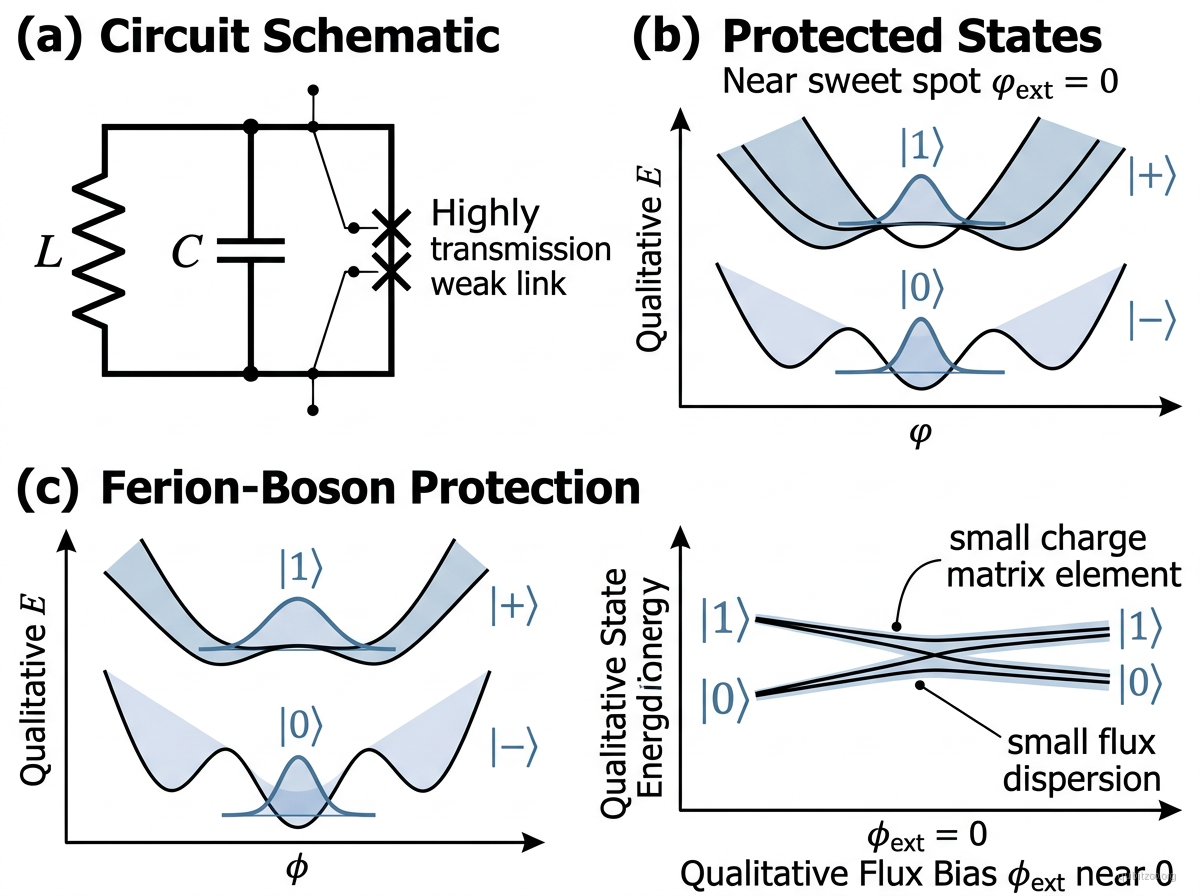
The FerBo qubit is a superconducting quantum circuit proposed by Cáceres, Matute-Cañadas et al. (2026) at CEA-Saclay (Quantronics group) and UAM Madrid. Its name derives from fermion-boson hybridization — the central mechanism by which it achieves simultaneous protection against both relaxation and dephasing. The circuit consists of a parallel arrangement of a large inductance , a small capacitor , and a highly transmissive Josephson weak link (such as a semiconducting nanowire). Structurally, it resembles a light fluxonium (), but with the conventional tunnel junction replaced by a weak link hosting Andreev bound states, introducing a fermionic degree of freedom that hybridizes with the bosonic LC mode.
The key physical insight is that the qubit’s computational states acquire disjoint support in the internal Andreev degree of freedom: the ground state resides predominantly in the Andreev manifold while the excited state resides in the manifold. This separation in Andreev space strongly suppresses matrix elements of bosonic operators — the charge relaxation susceptibility drops by approximately four orders of magnitude at the operating point . Simultaneously, as in light fluxonium, the wavefunctions delocalize across multiple wells in phase space, exponentially suppressing flux dispersion with increasing impedance . These two protection mechanisms — one fermionic, one bosonic — operate simultaneously and independently.
The protected regime is reached when (high impedance) and (high transmission through the weak link), with a sharp boundary at . The qubit operates at a zero external flux sweet spot (), where both computational states share the same parity under phase inversion, providing additional selection-rule protection against relaxation. This is notably different from heavy fluxonium, which operates near .
What distinguishes FerBo from other dual-protected qubits — the 0- qubit, cos(2) qubit, GKP qubit, and bifluxon — is that those designs achieve simultaneous relaxation and dephasing protection through multiple bosonic degrees of freedom with stringent parameter requirements. FerBo achieves the same dual protection using only a single bosonic mode coupled to a fermionic Andreev degree of freedom, opening a wider and more experimentally accessible parameter window. The natural platform for implementation is a semiconducting nanowire weak link (e.g., InAs/Al), whose small intrinsic capacitance (~0.1 fF compared to several fF for tunnel junctions) makes the high-impedance regime significantly more accessible. The required superinductance can be realized with a Josephson junction array or a disordered superconductor.
Hamiltonian
The full Hamiltonian of the FerBo qubit is:
The first term is the charging energy with , where is the number of Cooper pairs on the island. The second term is the inductive energy from the superinductance, with . The third term encodes the Andreev physics of the weak link.
In the atomic limit (weak link treated as a quantum dot with Andreev bound states), the weak link Hamiltonian acting on the even-parity Andreev subspace is:
where are Pauli matrices acting on the two-dimensional even-parity Andreev subspace, is the total coupling to the left and right leads, is the coupling asymmetry, and is the resonant level position controlling the effective transmission. In the high-transmission limit (), the Andreev bound states become nearly degenerate, and the hybridization with the bosonic mode produces the disjoint-support structure that protects against relaxation.
Motivation
- Dual noise protection from minimal hardware: FerBo simultaneously suppresses both relaxation and dephasing using a single bosonic mode coupled to a fermionic Andreev degree of freedom — avoiding the multiple bosonic modes and stringent parameter matching required by the 0- qubit, cos(2) qubit, and bifluxon.
- Wide, experimentally accessible parameter range: The protected regime (, ) has a clearly defined sharp boundary and does not require extreme fine-tuning, making experimental realization more practical than many competing protected-qubit proposals.
- Natural platform compatibility: Semiconducting nanowire weak links (InAs/Al), already developed for gatemon and Andreev qubit experiments, provide the high-transmission channels needed. Their small intrinsic capacitance (~0.1 fF) naturally favors the high-impedance regime.
- Relaxation suppression by four orders of magnitude: The disjoint Andreev support of the computational states suppresses charge-induced relaxation matrix elements by ~ at the zero-flux operating point, a substantial improvement enabled by the fermion-boson hybridization.
- Zero-flux sweet spot: Operating at simplifies experimental operation (no precision flux biasing required) and provides additional selection-rule protection due to shared parity of the computational states under phase inversion.
Key Metrics
| Metric | Value | Notes | Fidelity reference |
|---|---|---|---|
| Charge relaxation suppression | ~10⁻⁴ | at , protected regime | Cáceres, Matute-Cañadas et al. 2026 |
| Flux dispersion | Exponentially suppressed | vs | Cáceres, Matute-Cañadas et al. 2026 |
| Protection boundary | Sharp transition to protected regime | Cáceres, Matute-Cañadas et al. 2026 | |
| Optimal | ~15 GHz | Representative parameter set | Cáceres, Matute-Cañadas et al. 2026 |
| Operating point | Zero external flux sweet spot | Cáceres, Matute-Cañadas et al. 2026 |
References
Original proposal
- J. J. Cáceres, F. J. Matute-Cañadas et al., “FerBo: a noise resilient qubit hybridizing Andreev and fluxonium states,” arXiv:2604.01145 (2026)
Linked Papers
Evergreen context
- josephson-junction-as-nonlinear-element — FerBo replaces the ordinary oxide junction with a high-transmission weak link whose nonlinear Andreev physics is itself part of the protection mechanism.
- charge-noise-sweet-spot — FerBo extends the protected-operating-point idea beyond simple bosonic sweet spots, combining zero-flux biasing with Andreev-mediated relaxation suppression
- cos2phi — useful comparison point for how superconducting circuits chase dual protection with higher-harmonic or interference-based design
- noise-bias-and-asymmetric-error-channels — the Andreev-space disjoint support is best read as a built-in relaxation bias, not just a generic coherence boost
Related Entries
- fluxonium — shares dephasing protection via phase delocalization; FerBo replaces tunnel junction with Andreev weak link
- andreev-spin-qubit — shares Andreev bound state physics; FerBo uses even-parity Andreev sector rather than spin
- heavy-fluxonium-qubit — uses disjoint support in phase space; FerBo achieves disjoint support in Andreev space instead
- 0-pi-qubit — dual-protected qubit using multiple bosonic modes; FerBo uses fermion-boson hybridization instead
- cos2phi-qubit — another dual-protected superconducting circuit; requires more stringent parameters
- gatemon — same nanowire weak link platform; different operating regime