 Qubit Zoo
Figure
Description
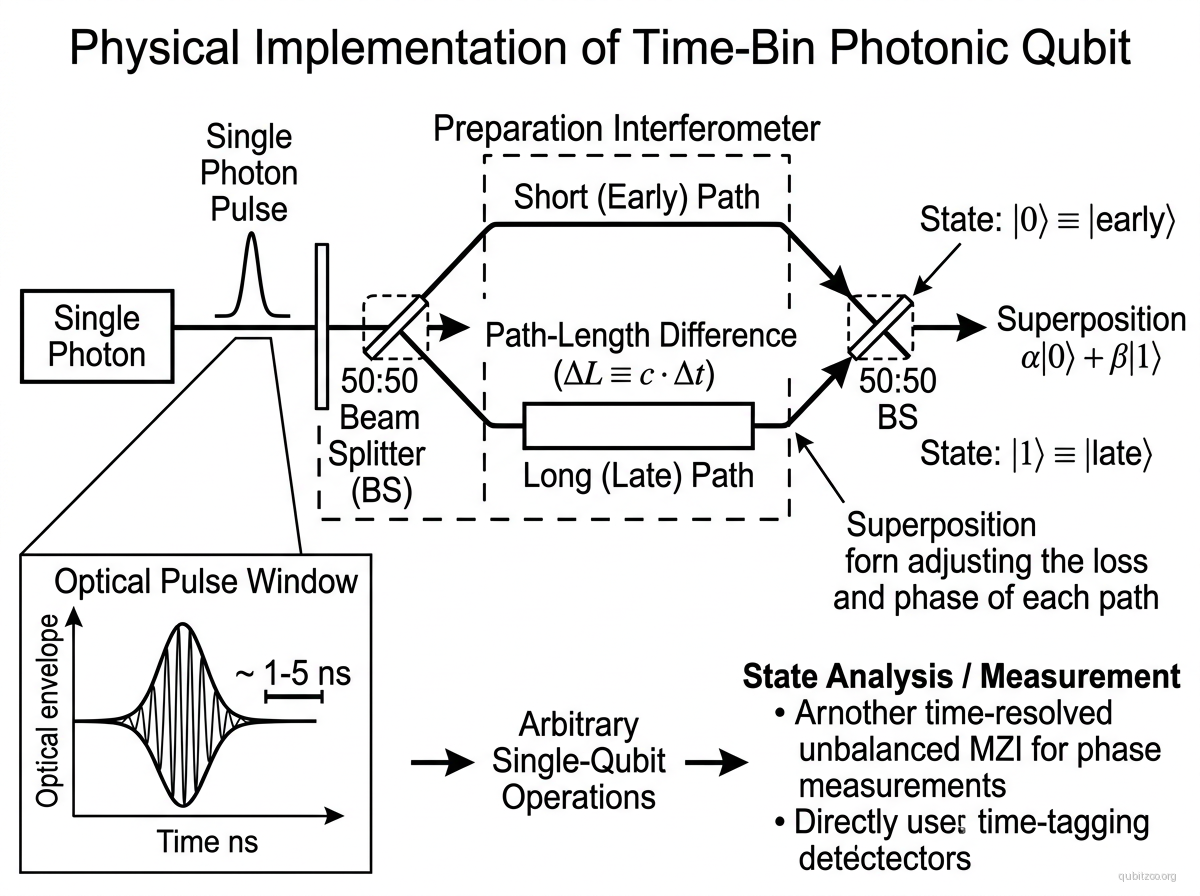
The time-bin qubit encodes quantum information in the temporal degree of freedom of a single photon: and , corresponding to two well-separated time slots (typically ) within a single optical pulse window. Superposition states are prepared by passing a single photon through an unbalanced Mach-Zehnder interferometer, where the path-length difference defines the time-bin separation.
Time-bin encoding is the natural choice for fiber-based quantum communication because it is inherently robust against polarization-mode dispersion and birefringence fluctuations in optical fibers — the dominant decoherence mechanisms that plague polarization-encoded photonic qubits over long distances. The two time bins experience identical polarization transformations in the fiber (assuming slow polarization drift compared to ), making the encoding self-compensating.
Measurement in the computational basis requires only time-resolved single-photon detection, while measurement in the superposition basis uses a second unbalanced interferometer matched to the preparation interferometer. This encoding was introduced by Brendel et al. (1999) and has become the standard for long-distance quantum key distribution and quantum teleportation experiments over deployed fiber networks.
Hamiltonian
The time-bin qubit is described by the single-photon state in a two-mode temporal basis:
where and create a photon in the early and late time bins, respectively.
The unbalanced Mach-Zehnder interferometer implements the beam-splitter transformation:
where is set by the beam-splitter ratio and is the relative phase between the two arms. A balanced beam splitter () with phase prepares:
Motivation
Polarization qubits suffer rapid decoherence in optical fibers due to birefringence, polarization-mode dispersion, and mechanical stress — effects that fluctuate unpredictably over km-scale links. Time-bin encoding eliminates these issues because both temporal modes traverse the same fiber path and experience identical polarization evolution. This makes time-bin qubits the preferred encoding for deployed fiber-based quantum networks, QKD systems, and long-distance quantum teleportation, where stability over hours to days is required without active polarization compensation.
Experimental Status
First demonstration — Brendel et al. (1999):
- Introduced time-bin encoding and demonstrated pulsed energy-time entangled twin-photon source
- Franson interferometry using time-bin entangled photon pairs demonstrated violation of Bell inequalities
Fiber teleportation — Marcikic et al. (2004):
- Distribution of time-bin entangled qubits over 50 km of optical fiber at telecom wavelengths
- Established viability of time-bin encoding for long-distance quantum communication
Long-distance distribution — Takesue et al. (2015):
- Quantum teleportation over 100 km of fiber using highly efficient superconducting nanowire single-photon detectors
- Time-bin encoding at 1550 nm telecom wavelength
Commercial deployment:
- Time-bin encoding adopted in commercial QKD systems (ID Quantique, Toshiba) operating over 100+ km fiber links
- Compatible with integrated photonic circuits: on-chip time-bin sources and interferometers demonstrated in silicon photonics
Key Metrics
| Metric | Value | Notes | Fidelity reference |
|---|---|---|---|
| Time-bin separation | 1–5 ns | Set by interferometer path difference | Brendel et al. 1999 |
| Fiber transmission distance | >100 km | At telecom wavelengths (1550 nm) | Takesue et al. 2015 |
| State preparation fidelity | >99% | Interferometric visibility | Marcikic et al. 2004 |
| Bell-state visibility | >95% | Franson interferometry | Brendel et al. 1999 |
| Photon loss rate | ~0.2 dB/km | Standard telecom fiber at 1550 nm | — |
| Detector timing jitter | <100 ps | Superconducting nanowire SPDs | — |
| Operating temperature | 300 K (fiber) / 1 K (detectors) | SNSPDs require cryogenics | — |
References
Original proposal
- J. Brendel et al., “Pulsed Energy-Time Entangled Twin-Photon Source for Quantum Communication,” Phys. Rev. Lett. 82, 2594 (1999)
Experimental demonstrations
- I. Marcikic et al., “Distribution of Time-Bin Entangled Qubits over 50 km of Optical Fiber,” Phys. Rev. Lett. 93, 180502 (2004)
- H. Takesue et al., “Quantum teleportation over 100 km of fiber using highly efficient superconducting nanowire single-photon detectors,” Optica 2, 832 (2015)
Linked Papers
- brendel-1999-time-bin-entanglement
- marcikic-2004-teleportation-fiber
- takesue-2015-teleportation-100-fiber
Evergreen context
- quantum-hardware — time-bin is the right photonic route when the system-level problem is long-haul fiber transport, deployed-network stability, and detector timing rather than compact on-chip rail geometry.
- coherence-time-hierarchy — unlike stationary matter qubits, the limiting comparison here is less about intrinsic storage and more about how interferometer phase stability, detector timing, and fiber attenuation set the usable coherence window.
- erasure-error-vs-pauli-error — photon loss on long fiber links is usually a flagged absence event, so time-bin systems naturally live in an erasure-aware regime rather than a purely hidden-Pauli one.
- noise-bias-and-asymmetric-error-channels — time-bin encoding deliberately trades polarization drift for a cleaner loss-plus-phase-stability error model, which is exactly the kind of asymmetric noise structure photonic decoders can exploit.
Related Entries
- photonic-qubit — umbrella entry for the broader photonic-qubit family
- dual-rail-photonic-qubit — alternative photonic encoding using spatial modes rather than temporal modes
- photonic-cluster-state-mbqc-qubit — measurement-based photonic architecture that can consume time-bin encoded photons as cluster-state qubits
- fusion-based-photonic-qubit — photonic architecture compatible with time-bin encoding when multiplexing and loss management matter more than on-chip rail geometry