 Qubit Zoo
Figure
Description
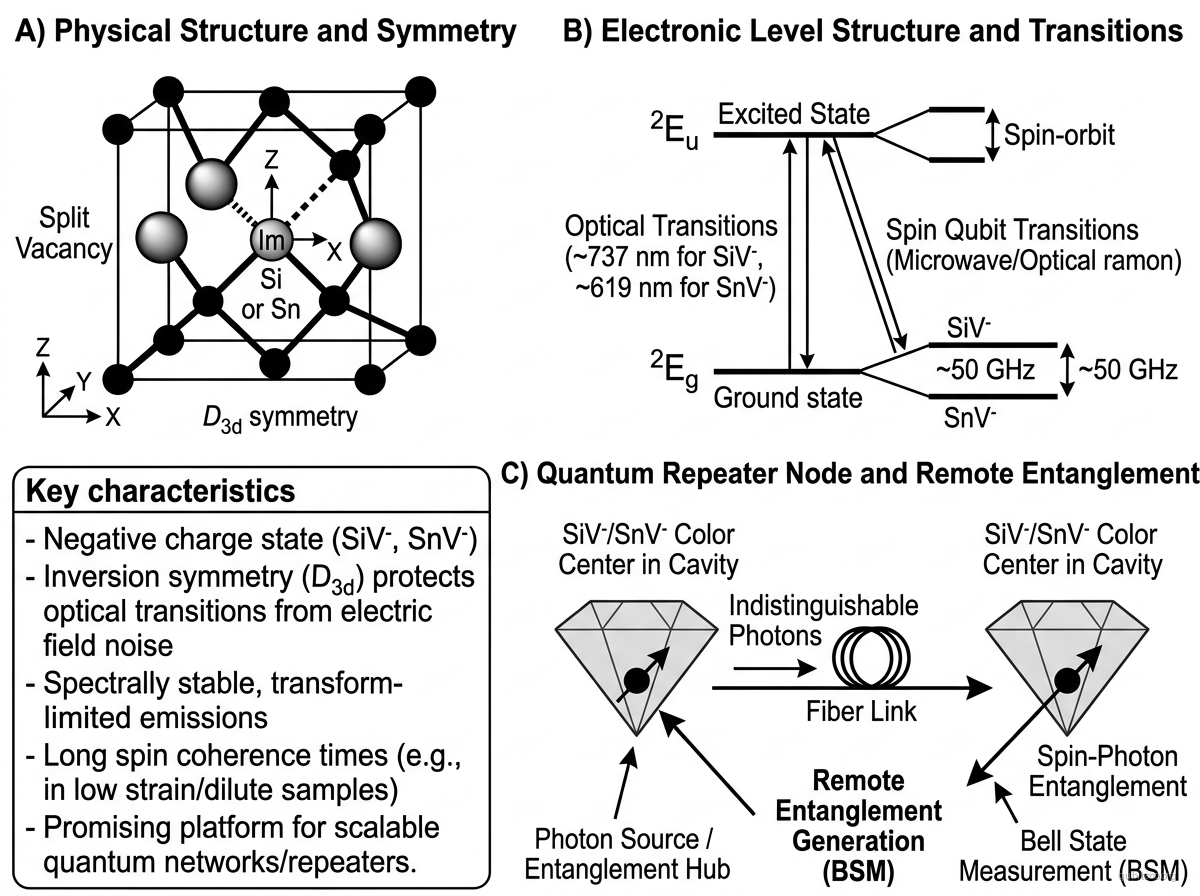
Silicon-vacancy (SiV⁻) and tin-vacancy (SnV⁻) centers in diamond are group-IV color center qubits with inversion symmetry that protects their optical transitions from electric field noise. This gives them spectrally stable, nearly transform-limited optical emission — a critical advantage over NV centers for quantum networking, where photon indistinguishability is essential for remote entanglement.
Group-IV color centers (SiV, GeV, SnV, PbV) share a split-vacancy structure: the impurity atom sits at an inversion center between two vacant carbon sites. This symmetry eliminates first-order coupling to electric fields (Stark effect), producing narrow, stable optical lines even in nanostructures.
SiV⁻: Ground state is a spin-1/2 doublet with ~48 GHz splitting in the orbital ground state. Optical transition at 737 nm with >90% emission into the zero-phonon line (ZPL), vs. ~3% for NV centers. The challenge: the orbital degree of freedom makes the spin sensitive to phonons, requiring operation below ~100 mK for long coherence.
SnV⁻: Larger spin-orbit splitting (~850 GHz) pushes phonon-mediated relaxation to higher temperatures, enabling spin coherence at ~1–2 K — accessible with a standard ³He cryostat rather than a dilution refrigerator. Optical transition at 619 nm.
Both are promising for quantum repeater nodes, where spin-photon entanglement and photon-mediated remote spin-spin entanglement are the core operations.
Hamiltonian
Ground-state spin Hamiltonian in an external magnetic field:
where is the spin-orbit coupling (~48 GHz for SiV, ~850 GHz for SnV), is the orbital angular momentum projection, and captures dynamic Jahn-Teller effects.
Qubit states are typically the spin-up and spin-down states of the lower orbital branch, split by the Zeeman interaction.
Motivation
- Spectral stability: Inversion symmetry eliminates first-order Stark effect, giving ~100× narrower optical lines than NV centers — critical for photon-mediated entanglement.
- High ZPL fraction: >70% (SiV) and >60% (SnV) of emission into the zero-phonon line vs. ~3% for NV — dramatically higher photon collection efficiency.
- Quantum networking: Best-in-class spin-photon interface for diamond platforms; SiV demonstrated metropolitan-scale entanglement.
- Temperature tradeoff spectrum: SiV (100 mK) → SnV (1.5 K) → PbV (potentially higher) — SnV already accessible without dilution refrigerator.
- Nanophotonic integration: High ZPL fraction enables efficient coupling to photonic crystal cavities with >100× Purcell enhancement.
Experimental Status
SiV spin coherence — Sukachev et al. (2017):
- Demonstrated SiV spin qubit as quantum memory exceeding 10 ms coherence
- Single-shot spin readout with >99% fidelity at millikelvin temperatures
SiV quantum network — Nguyen et al. (2019):
- Quantum network nodes based on SiV qubits with efficient nanophotonic interface
- Demonstrated spin-photon entanglement and remote two-node entanglement
Metropolitan entanglement — Knaut et al. (2024):
- Entanglement of SiV quantum memory nodes across a deployed telecom fiber network in Boston
- Remote entanglement fidelity of 94%
SnV coherence — Debroux et al. (2021):
- Quantum control of SnV spin qubit at 1.7 K (³He cryostat)
- Spin echo = 0.3 ms — first demonstration of SnV as viable qubit
Key Metrics
| Metric | Value | Notes | Fidelity reference |
|---|---|---|---|
| ZPL fraction (Debye-Waller) | >70% (SiV), >60% (SnV) | vs. ~3% for NV center | Nguyen et al. 2019 |
| T₂ (spin echo, SiV) | 13 ms | At 100 mK in diamond | Sukachev et al. 2017 |
| T₂ (spin echo, SnV) | 0.3 ms | At 1.7 K | Debroux et al. 2021 |
| Spectral diffusion | <100 MHz (SiV) | 100× narrower than NV | — |
| Remote entanglement fidelity | 94% | SiV, Harvard 2024 | Knaut et al. 2024 |
| Optical linewidth | ~100 MHz (SiV) | Near transform-limited | — |
| Operating temperature | <100 mK (SiV), ~1.5 K (SnV) | SnV advantage for scalability | — |
Scaling Considerations
- Quantum networking: Best-in-class spin-photon interface for diamond platforms. SiV demonstrated Boston-to-Harvard entanglement over deployed fiber.
- Nanophotonic integration: High ZPL fraction enables efficient coupling to photonic crystal cavities (Purcell enhancement >100×).
- Temperature tradeoff: SiV needs dilution refrigerator; SnV works at ³He temperatures. PbV may work even higher.
- Fabrication: Requires implantation + annealing in high-purity diamond. Yield and placement precision improving but below semiconductor standards.
References
Key experiments
- D. D. Sukachev et al., “Silicon-Vacancy Spin Qubit in Diamond: A Quantum Memory Exceeding 10 ms with Single-Shot State Readout,” Phys. Rev. Lett. 119, 223602 (2017) — arXiv:1708.08852
- C. T. Nguyen et al., “Quantum Network Nodes Based on Diamond Qubits with an Efficient Nanophotonic Interface,” Phys. Rev. Lett. 123, 183602 (2019) — arXiv:1907.13199
- C. M. Knaut et al., “Entanglement of nanophotonic quantum memory nodes in a telecom network,” Nature 629, 573 (2024) — arXiv:2310.01316
- R. Debroux et al., “Quantum Control of the Tin-Vacancy Spin Qubit in Diamond,” Phys. Rev. X 11, 041041 (2021) — arXiv:2106.00723
Linked Papers
- nguyen-2019-siv-network
- sukachev-2017-siv-coherence
- debroux-2021-snv-coherence
- knaut-2024-siv-entanglement
Evergreen context
- divincenzo-criteria — SiV and SnV are standout examples of the communication criteria, because inversion-symmetric optical transitions make spin-to-photon conversion far cleaner than in NV centers, but only if the cryogenic coherence constraint is handled.
- coherence-time-hierarchy — the platform’s main systems tradeoff is the split between excellent optical coherence and phonon-limited spin coherence, especially for SiV versus the larger-orbit SnV variant.
- spin-photon-interfaces-separate-emission-collection-and-wavelength-matching — places the high-ZPL nanocavity advantage upstream of the separate cryogenic-coherence and downstream telecom-conversion burdens.
- purcell-protection-via-detuning — the >100× cavity Purcell enhancement that makes SiV a fast spin-photon interface uses the same framework as circuit-QED Purcell protection, but the optical ZPL transition operates in the enhancement (resonant) rather than the suppression (detuned) regime.
Related Entries
- t-center-qubit — Silicon-based spin-photon interface with native telecom emission
- nv-center-qubit — Nitrogen-vacancy center; more mature but worse optical properties
- dual-rail-photonic-qubit — Photonic encoding for quantum networking