 Qubit Zoo
Figure
Description
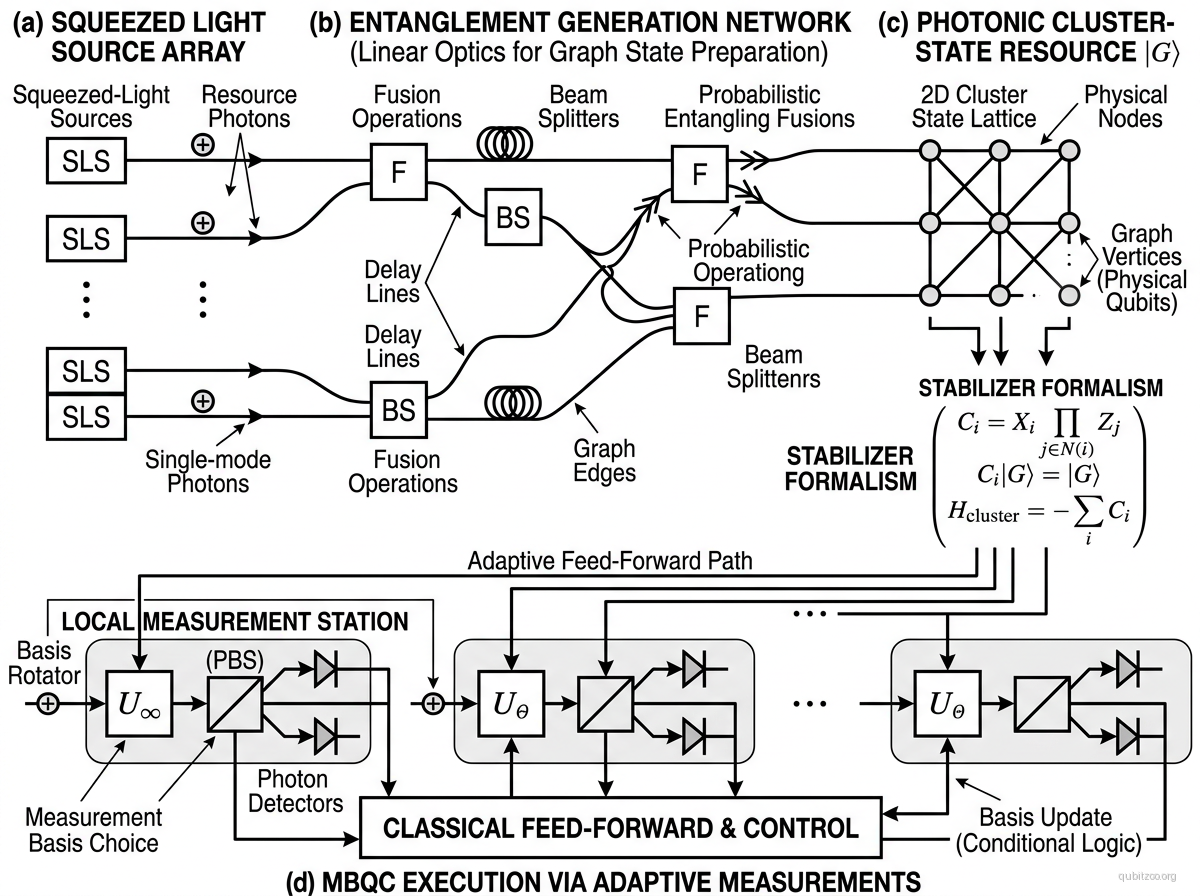
The photonic cluster-state MBQC qubit is a photonic qubit architecture designed for measurement-based quantum computing (MBQC, also called one-way quantum computing). In this model, computation does not proceed through a sequence of unitary gates applied to qubits. Instead, a large entangled resource state — a cluster state (or graph state) — is prepared first, and computation is then performed entirely through adaptive single-qubit measurements with classical feed-forward.
A cluster state is defined on a graph where each vertex hosts a qubit initialized in the state, and each edge represents a controlled- (CZ) entangling operation between neighboring qubits. The resulting state is the unique simultaneous eigenstate of all graph stabilizer generators. In a photonic implementation, the qubits are photonic modes (polarization, dual-rail, or time-bin encoded), and entanglement generation is realized using linear-optical circuits and probabilistic fusion operations — beam splitters, phase shifters, and single-photon detectors that project pairs of photons into entangled states with some probability of success.
Computation proceeds by measuring each qubit in a chosen basis (typically a rotated - plane basis). The measurement outcome is probabilistic, introducing random Pauli byproducts that are tracked classically (Pauli frame). Subsequent measurement bases are adaptively chosen based on prior outcomes to compensate for these byproducts, ensuring deterministic computation. A 2D cluster state is the minimal resource for universal quantum computation; 1D cluster states suffice only for single-qubit operations.
The key advantage of MBQC is the separation of resource preparation from algorithm execution: the cluster state can be generated offline using probabilistic operations, and the computational depth is determined by the measurement sequence, not by the entangling gate depth.
Hamiltonian
Cluster states are defined as simultaneous eigenstates of graph stabilizer generators:
where is the set of vertices adjacent to vertex in the graph . A parent Hamiltonian with as its unique ground state is:
This is a frustration-free, gapped Hamiltonian with energy gap . The cluster state is the unique ground state in the eigenspace of all stabilizers.
Computation via measurements: measuring qubit in the basis with effectively implements a rotation on the logical information propagating through the cluster, up to Pauli byproducts determined by the measurement outcome.
Motivation
- Separates resource preparation from computation: Cluster states can be generated using probabilistic linear-optical operations, while computation proceeds deterministically via adaptive measurements.
- Converts weak photonic interactions into a scalable model: Photons interact weakly, making deterministic two-qubit gates extremely difficult. MBQC circumvents this by using probabilistic fusion gates only during resource state preparation, not during computation.
- Distinct architectural path from gate-based photonic QC: Avoids the massive overhead of KLM-style teleportation-based gates.
- Naturally suited to photonic hardware: Photons propagate at the speed of light, enabling high-bandwidth measurement and feed-forward with optical delay lines.
- Scalability via multiplexing: Temporal and spatial multiplexing of photonic modes can generate large cluster states from modest hardware.
Experimental Status
One-way quantum computation concept — Raussendorf and Briegel (2001):
- Proposed MBQC using cluster states as universal computational resources.
- Showed that adaptive single-qubit measurements on a 2D cluster state are sufficient for universal quantum computation.
Optical MBQC proposal — Nielsen (2004):
- Showed how cluster states can be generated using linear optics and probabilistic operations.
- Connected the MBQC model to photonic implementations.
Resource-efficient construction — Browne and Rudolph (2005):
- Introduced fusion gates (Type-I and Type-II) as efficient primitives for building photonic cluster states.
- Demonstrated that linear-optical cluster state generation is more resource-efficient than KLM-style gate teleportation.
Small-scale demonstrations (2005–2015):
- Multiple groups demonstrated 4–6 photon cluster states and performed MBQC algorithms on them.
- Loss and detector inefficiency remained the dominant practical limitations.
Key Metrics
| Metric | Value | Notes | Fidelity reference |
|---|---|---|---|
| Computation model | One-way MBQC | Universal via adaptive measurements on 2D cluster | Raussendorf & Briegel 2001 |
| Resource generation | Probabilistic fusion gates | Success probability ≤50% (75% with boosting) | Browne & Rudolph 2005 |
| Dominant bottleneck | Photon loss + detector efficiency | Primary practical limitation | — |
| Cluster state dimension | 2D minimum for universality | 1D only for single-qubit operations | Raussendorf & Briegel 2001 |
| Feed-forward latency | ~ns scale | Optical delay lines | — |
References
Original proposals
- R. Raussendorf and H. J. Briegel, “A One-Way Quantum Computer,” Phys. Rev. Lett. 86, 5188 (2001)
- M. A. Nielsen, “Optical Quantum Computation Using Cluster States,” Phys. Rev. Lett. 93, 040503 (2004)
Resource-efficient linear optics
- D. E. Browne and T. Rudolph, “Resource-Efficient Linear Optical Quantum Computation,” Phys. Rev. Lett. 95, 010501 (2005)
Reviews
- P. Kok, W. J. Munro, K. Nemoto, T. C. Ralph, J. P. Dowling, and G. J. Milburn, “Linear optical quantum computing with photonic qubits,” Rev. Mod. Phys. 79, 135 (2007)
Linked Papers
- raussendorf-2000-quantum-computing-via-measurements-only
- nielsen-2004-optical-quantum-computation-using-cluster
- browne-2005-resource-efficient-linear-optical
- bombin-2021-interleaving
- raussendorf-2001-one-way-computer
- yarkoni-2026-the-pangaea-architecture-fault-tolerant
- feng-2026-on-chip-generation-of-multi-qubit
Evergreen context
- threshold-theorem — the main architectural question is how offline cluster-state preparation plus adaptive measurement still reaches a fault-tolerant regime despite probabilistic entangling operations
- erasure-error-vs-pauli-error — photon loss is often a flagged absence event, so loss-tolerant MBQC should be read through erasure structure rather than a purely Pauli-noise picture
- noise-bias-and-asymmetric-error-channels — cluster-state photonics only scales cleanly when loss and fusion failure remain structured, biased channels instead of washing out into generic depolarizing noise
Related Entries
- photonic-qubit — umbrella entry for the broader photonic-qubit family
- linear-optical-photonic-qubit — gate-based photonic QC (KLM approach)
- fusion-based-photonic-qubit — modern fusion-based photonic architecture
- gkp-codes — bosonic code applicable to photonic modes
- dual-rail-photonic-qubit — common photonic qubit encoding