 Qubit Zoo
Figure
Description
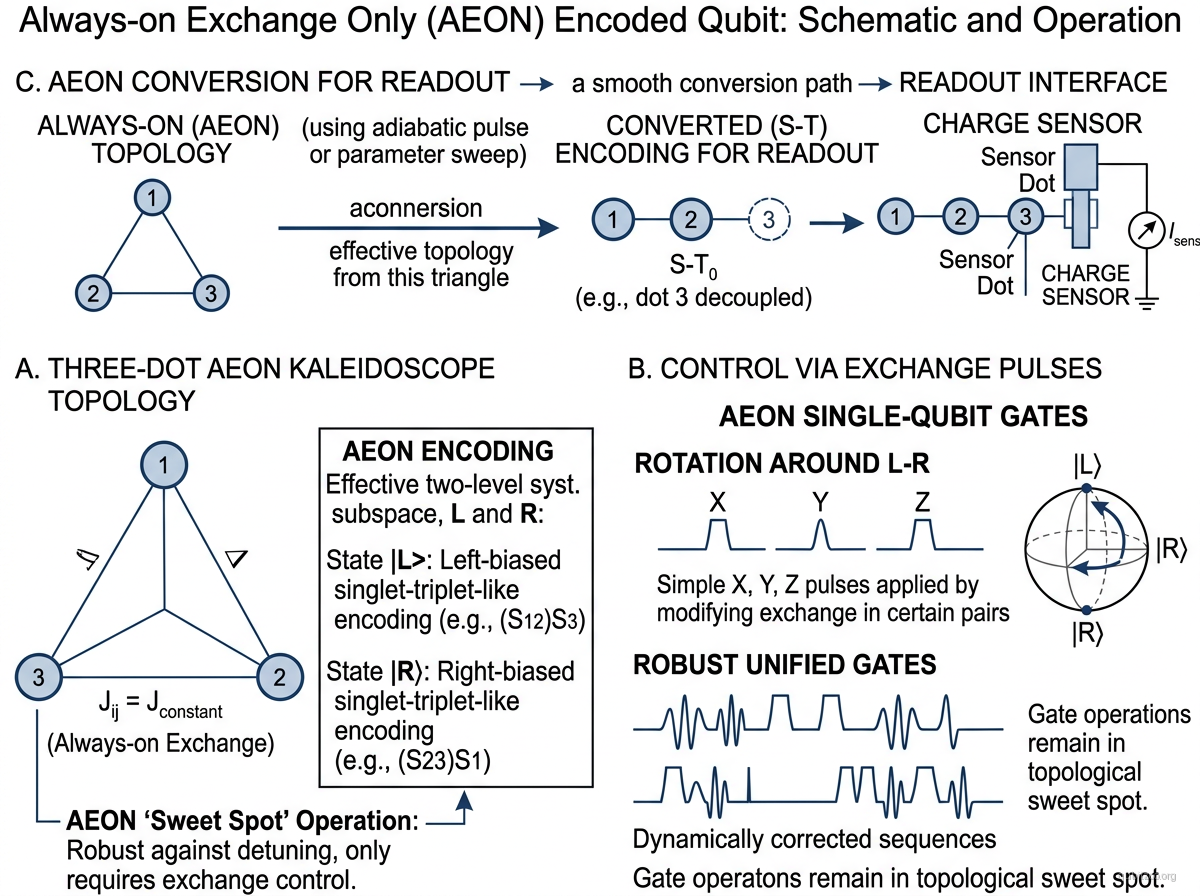
The Always-on Exchange-Only (AEON) qubit is a three-spin encoded qubit in a linear triple quantum dot (TQD) array where the nearest-neighbor exchange couplings (dots 1–2) and (dots 2–3) are kept permanently on. There is no direct tunnel coupling between the outer dots (). The qubit is encoded in the subspace of three singly-occupied quantum dots in the (1,1,1) charge configuration.
The defining feature of the AEON qubit is its double sweet spot: the qubit frequency is first-order insensitive to charge noise in both independent detuning parameters (dot 1 vs. dot 3) and (dot 2 vs. average of dots 1 and 3) simultaneously. Crucially, the sweet spot position depends only on the Coulomb energies — not on the tunnel couplings and — so gates can be performed by tuning barrier gates while remaining at the sweet spot throughout.
All single-qubit operations use baseband (DC) exchange pulses — no microwave drive is required. Two-qubit entangling gates between adjacent AEON qubits can be implemented with a single exchange pulse, a dramatic simplification over the 18+ sequential pairwise pulses needed for the original 3-DFS exchange-only encoding.
At the sweet spot, the AEON qubit has no transition dipole moment (), meaning it does not couple transversely to a superconducting resonator. Long-range coupling requires longitudinal (curvature) coupling to a cavity, or adiabatic conversion to the RX qubit regime where transverse coupling is available.
The qubit can be smoothly interconverted with other three-spin encodings: the RX qubit (for initialization, readout, and resonator coupling) and the 3-DFS exchange-only qubit (for a true off-state/memory with all exchange couplings turned off).
Hamiltonian
The AEON qubit is described by a Hubbard model for a linear TQD with only nearest-neighbor tunneling (). In the qubit subspace (, ), the effective Hamiltonian reduces to:
where and , with the Coulomb energy changes for double occupancy of dot . No term appears.
In the two-state qubit basis :
where and . The qubit energy gap is .
Double sweet spot
The sweet spot conditions and yield:
These depend only on Coulomb energies, not on or — enabling full gate control while remaining at the sweet spot.
Single-Qubit Gates
All single-qubit rotations are performed via baseband (DC) voltage pulses on the tunnel barrier gates, modulating and simultaneously while remaining at the double sweet spot:
- rotation: Symmetric exchange (, i.e., ) → precession around
- General rotations: Asymmetric exchange () → rotation around an axis in the -plane. Combined with , this gives universal single-qubit control
- Pauli : Can be decomposed as with , achieved with
No microwave pulses are needed — this is purely baseband, all-electrical control.
Two-Qubit Gates
Two AEON qubits in a linear array (dots 1–2–3–4–5–6) are coupled via the inter-qubit exchange between neighboring dots (e.g., dots 3 and 4). With intra-qubit couplings always on, the effective inter-qubit Hamiltonian in the weak coupling regime () is:
with all coefficients proportional to . For the linear geometry, and when .
A CPHASE/CZ gate can be implemented with a single exchange pulse — requiring . Estimated gate times range from ~20 ns (butterfly geometry with spin swaps) to a few hundred ns (linear geometry with conservative MHz). This is a dramatic improvement over the 18+ sequential pairwise pulses required for the original 3-DFS encoding.
The inter-qubit sweet spot condition () can also be satisfied by tuning average dot energies, keeping both qubits and the coupler charge-noise-insensitive.
Resonator Coupling
At the double sweet spot, the AEON qubit has zero transition dipole moment () — it does not couple transversely to a superconducting resonator. This is both a feature (suppressed decoherence from charge noise) and a constraint (no direct cavity QED).
Two strategies for long-range coupling:
-
Longitudinal (curvature) coupling — The second derivative of the qubit frequency with respect to detuning gives a non-zero longitudinal coupling to the cavity photon number. This enables dispersive readout and modulated longitudinal gates without leaving the sweet spot. (Theoretical — Ruskov & Tahan 2019, 2021)
-
Conversion to RX regime — Adiabatically sweeping converts the AEON qubit to an RX qubit, which has a large transverse dipole for cavity coupling. Readout and long-range entanglement proceed in the RX regime, then the qubit is swept back to the AEON sweet spot for computation. (The RX-cavity strong coupling regime has been demonstrated — Landig et al., Nature 2018)
Experimental Status
The AEON qubit was first experimentally demonstrated by Broz, Hoke, Acuna, and Petta (2025) in a Si/SiGe quantum dot device:
- Platform: Triangular QD array (note: the original proposal uses a linear TQD; the triangular geometry also supports AEON-like operation with simultaneous always-on exchange)
- Gate set: Full single-qubit Clifford set with simultaneous exchange pulses
- Fidelity: Average Clifford gate fidelity via blind randomized benchmarking
- Key advance: First demonstration of simultaneous (non-commuting) exchange pulses for an exchange-only qubit, versus conventional sequential pairwise pulsing
Two-qubit entangling gates and resonator coupling have not yet been experimentally demonstrated in the AEON regime.
Comparison with Related Encodings
| Property | 3-DFS Exchange-Only | RX Qubit | AEON |
|---|---|---|---|
| QD energy levels | General | ||
| Sweet spot | None (DFS only) | Partial (1 of 2 detunings) | Full (both detunings) |
| Single-qubit gates | 4 sequential exchange pulses | Microwave drive | 3 simultaneous baseband pulses |
| Two-qubit gates | 18+ sequential pulses | Dipole-dipole or single exchange pulse | Single exchange pulse |
| Resonator coupling | N/A | Transverse ( large) | Longitudinal only () |
| Idle/memory | All exchange off | Always-on, 0.5–2 GHz | Exchange off (converts to 3-DFS) or always-on |
(Table adapted from Shim & Tahan 2016, Table I)
References
Original proposal
- Y.-P. Shim and C. Tahan, “Charge-noise-insensitive gate operations for always-on, exchange-only qubits,” PRB 93, 121410(R) (2016) — arXiv:1602.00320
Two-qubit gates
- A. C. Doherty and M. P. Wardrop, “Two-qubit gates for resonant exchange qubits,” PRL 111, 050503 (2013) — showed that always-on exchange enables CZ gate in a single inter-qubit exchange pulse
Longitudinal resonator coupling (theoretical)
- R. Ruskov and C. Tahan, “Quantum-limited measurement of spin qubits via curvature couplings to a cavity,” PRB 99, 245306 (2019) — arXiv:1704.05876
- R. Ruskov and C. Tahan, “Modulated longitudinal gates on encoded spin qubits via curvature couplings to a superconducting cavity,” PRB 103, 035301 (2021) — arXiv:2010.01233
- R. Ruskov and C. Tahan, “Longitudinal (curvature) couplings of an N-level qudit to a superconducting resonator at the adiabatic limit and beyond,” PRB 109, 245303 (2024) — arXiv:2312.03118
RX qubit–resonator strong coupling (related experimental)
- A. J. Landig, J. V. Koski, P. Scarlino et al., “Coherent spin–photon coupling using a resonant exchange qubit,” Nature 560, 179 (2018) — demonstrated strong coupling of RX qubit to SC cavity (~31 MHz); AEON could convert to this regime
Experimental demonstration
- J. D. Broz, J. C. Hoke, E. Acuna, and J. R. Petta, “Demonstration of an always-on exchange-only spin qubit,” arXiv:2508.01033 (2025) — average Clifford fidelity, Si/SiGe triangular QD array, single-qubit gates only
Background: exchange-only qubits
- D. P. DiVincenzo, D. Bacon, J. Kempe, G. Burkard, and K. B. Whaley, “Universal quantum computation with the exchange interaction,” Nature 408, 339 (2000) — original exchange-only qubit proposal
- B. H. Fong and S. M. Wandzura, “Universal quantum computation and leakage reduction in the 3-qubit decoherence free subsystem code,” QIC 11, 1003 (2011) — optimized pulse sequences
Linked Papers
- shim-2016-aeon
- divincenzo-2000-exchange-only
- divincenzo-2000-universal-computation-exchange
- doherty-2013-qubit-gates-resonant
- knill-2000-theory-quantum-error-correction-general-noise
- landig-2018-coherent-spin-photon
- lidar-1998-decoherence-free-subspaces-quantum-computation
- martins-2016-symmetric-exchange-gates
- ruskov-2019-limited-measurement-spin
- ruskov-2021-modulated-longitudinal-gates
- ruskov-2024-longitudinal-curvature-couplings
- shulman-2012-demonstration-entanglement-electrostatically
- wang-2011-polarization-entanglement-purification
- zanardi-1997-noiseless-quantum-codes
Evergreen context
- exchange-interaction-in-quantum-dots — the tunable coupling resource AEON keeps always on
- heisenberg-exchange-in-quantum-dots — the pairwise-exchange Hamiltonian that AEON reshapes into an always-on encoded qubit
- decoherence-free-subspace — the encoded three-spin protection that AEON inherits
- charge-noise-sweet-spot — the double-sweet-spot idea that makes AEON special
Related Entries
Key Metrics
| Metric | Value | Notes | Fidelity reference |
|---|---|---|---|
| Qubit coherence | >1 s | Spin relaxation in Si | Shulman et al. 2012 |
| Qubit coherence | 10–100 μs | Enhanced by double sweet-spot operation | Shim & Tahan 2016 |
| Gate fidelity (1Q) | 99.86% | Average Clifford fidelity, blind RB (experimental) | Broz et al. 2025 |
| Gate fidelity (1Q, theory) | 99–99.5% | Baseband exchange at sweet spot (theoretical) | Shim & Tahan 2016 |
| Gate fidelity (2Q) | 95–99% | Single exchange pulse CZ (theoretical estimate) | Doherty & Wardrop 2013 |
| Gate time (1Q) | 1–50 ns | DC barrier gate pulses | Shim & Tahan 2016 |
| Gate time (2Q) | ~20–200 ns | Single exchange pulse (geometry-dependent) | Shim & Tahan 2016 |
| Operating temperature | 20–100 mK | Si/SiGe or GaAs | — |
| Qubit footprint | ~150–300 nm pitch | 3 dots per logical qubit | — |