 Qubit Zoo
Figure
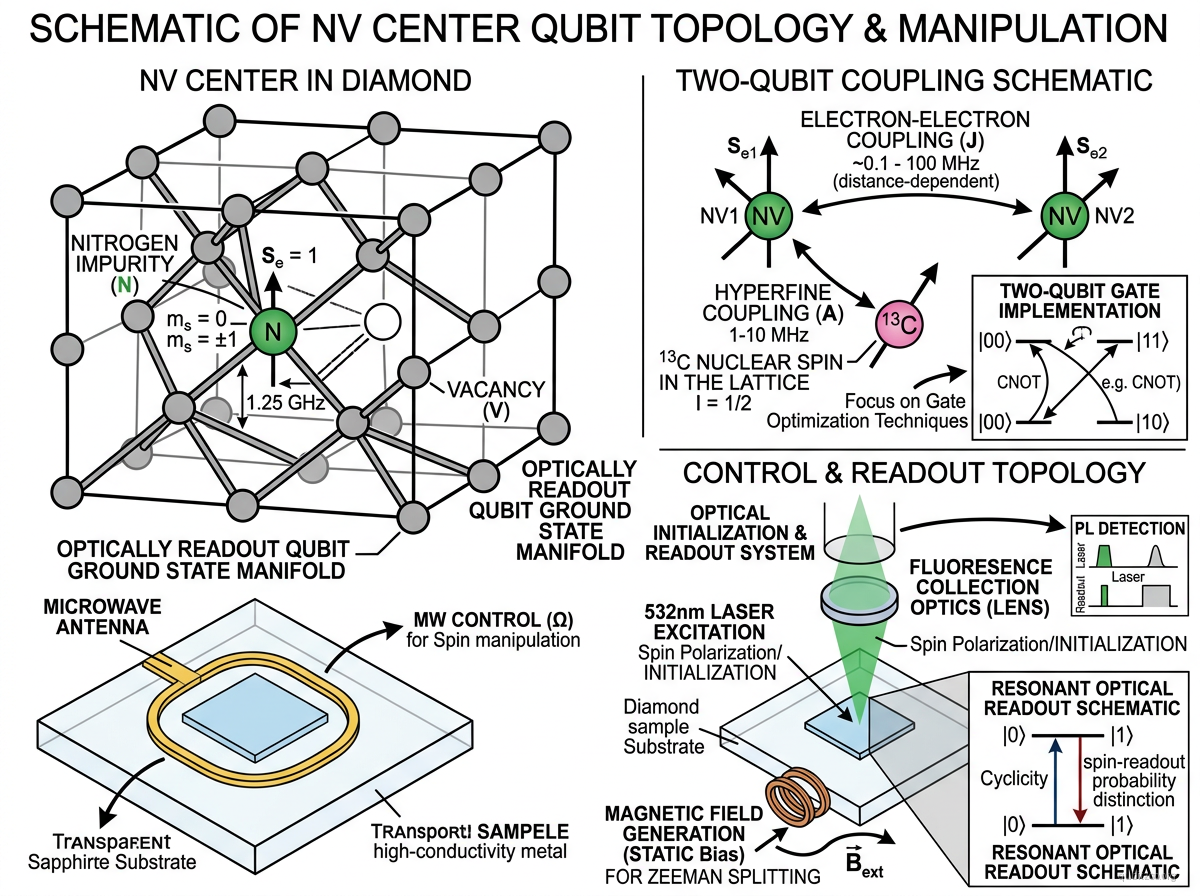
Figure note: Energy level diagram showing ground state ³A₂ with zero-field splitting D = 2.87 GHz, excited state ³E, singlet states ¹A₁/¹E for ISC, and optical transitions.
Description
The nitrogen-vacancy (NV) center in diamond is a point defect consisting of a substitutional nitrogen atom adjacent to a vacancy in the diamond carbon lattice. In its negatively charged state (NV), the center has a spin-1 ground state () that can be initialized, manipulated, and read out optically at room temperature — a unique property among solid-state qubit candidates.
The qubit is typically encoded in the and sublevels of the ground-state triplet, split by a zero-field splitting of . The state fluoresces more brightly than the states due to an intersystem crossing to a metastable singlet, enabling spin-state readout via optically detected magnetic resonance (ODMR). This same mechanism provides optical spin polarization (initialization into ) via repeated optical pumping.
Single-qubit gates are performed by resonant microwave pulses at the transition frequency. Two-qubit gates can use the magnetic dipole-dipole interaction between nearby NV centers (~10–25 nm spacing), coupling to nearby nuclear spins as quantum memory, or photonic entanglement between remote NV centers via spin-photon interfaces.
NV centers are the leading platform for quantum networking and long-distance entanglement distribution, having demonstrated deterministic entanglement delivery between nodes separated by .
Hamiltonian
Ground-state spin Hamiltonian (no external strain):
where is the zero-field splitting, is the transverse zero-field splitting (strain-dependent), is the electron -factor, is the hyperfine tensor for the nuclear spin (), and is the external magnetic field.
For the qubit subspace () with an axial field :
Motivation
NV centers operate at room temperature, can be optically initialized and read out with single-shot fidelity, and emit indistinguishable photons suitable for long-distance entanglement. These properties make them uniquely suited for quantum networks and distributed quantum computing, where other platforms (superconducting, trapped ion) require cryogenics and cannot easily produce flying qubits.
Experimental Status
First coherent control of a single electron spin — Jelezko et al. (2004):
- Demonstrated room-temperature coherent oscillations (Rabi, Ramsey) of a single NV center electron spin
- Established NV centers as viable solid-state qubits
Ultralong nuclear spin coherence — Maurer et al. (2012):
- Demonstrated for nuclear spins coupled to NV centers in isotopically pure diamond
- Room-temperature quantum memory exceeding one second
Loophole-free Bell test — Hensen et al. (2015):
- Deterministic entanglement between NV centers separated by 1.3 km
- First loophole-free Bell inequality violation using solid-state spins
Three-node quantum network — Pompili et al. (2021):
- Demonstrated a multinode quantum network of remote solid-state qubits
- Entanglement distribution and teleportation between three NV-center nodes
Ten-qubit register — Bradley et al. (2019):
- Quantum error correction on a 10-qubit register (1 electron + 9 nuclear spins)
- Quantum memory up to one minute
Key Metrics
| Metric | Value | Notes | Fidelity reference |
|---|---|---|---|
| (electron spin) | >1 hour (77 K); ~5 ms (RT) | Unique room-temperature operation possible | — |
| (electron, echo) | 1–2 ms (RT) | In isotopically pure diamond | Balasubramanian et al. 2009 |
| (nuclear ) | >1 s | Used as quantum memory | Maurer et al. 2012 |
| 1Q gate fidelity | 99.9–99.999% | SOTA 99.999% via GST | Bradley et al. 2019 |
| 2Q gate fidelity | 97–99.93% | NV-C hyperfine gate | Bradley et al. 2019 |
| Readout fidelity | 95% (RT), >99% (cryo) | ODMR; improved with SIL or cavity | Robledo et al. 2011 |
| Zero-field splitting | 2.87 GHz | Temperature-dependent (~77 kHz/K) | — |
| Photon emission wavelength | 637 nm (ZPL) | Debye-Waller factor ~3%; rest in phonon sideband | — |
| Operating temperature | 4 K – 300 K | Unique room-temperature operation | — |
References
Original proposal / early work
- F. Jelezko et al., “Observation of Coherent Oscillations in a Single Electron Spin,” Phys. Rev. Lett. 92, 076401 (2004)
Experimental demonstrations
- G. Balasubramanian et al., “Ultralong spin coherence time in isotopically engineered diamond,” Nat. Mater. 8, 383 (2009)
- L. Robledo et al., “High-fidelity projective read-out of a solid-state spin quantum register,” Nature 477, 574 (2011)
- P. C. Maurer et al., “Room-Temperature Quantum Bit Memory Exceeding One Second,” Science 336, 1283 (2012)
- B. Hensen et al., “Loophole-free Bell inequality violation using electron spins separated by 1.3 kilometres,” Nature 526, 682 (2015)
- C. E. Bradley et al., “A Ten-Qubit Solid-State Spin Register with Quantum Memory up to One Minute,” Phys. Rev. X 9, 031045 (2019)
- M. Pompili et al., “Realization of a multinode quantum network of remote solid-state qubits,” Science 372, 259 (2021)
Linked Papers
- jelezko-2004-nv-center
- balasubramanian-2009-ultralong-spin-coherence
- bradley-2019-ten-qubit-solid
- hensen-2015-loophole-free-bell
- knaut-2024-siv-entanglement
- maurer-2012-room-temperature-bit
- nguyen-2019-siv-network
- pompili-2021-realization-multinode-network
- robledo-2011-high-fidelity-projective
- rathi-2026-engineering-nanodiamonds-for-quantum
- kozodaev-2026-squeezing-for-dispersive-readout
- rana-2026-spin-bath-mediated-long-lived
Evergreen context
- divincenzo-criteria — NV centers are the cleanest defect-spin example of combining optical initialization/readout with the communication criteria for stationary-to-flying qubit conversion.
- coherence-time-hierarchy — the platform’s main advantage is layered memory: millisecond electron-spin control paired with much longer-lived nearby nuclear-spin storage.
- spin-photon-interfaces-separate-emission-collection-and-wavelength-matching — separates the mature local register from NV’s harder optical task: routing a weak zero-phonon channel into a useful network photon.
Related Entries
- t-center-qubit — another color center qubit platform (silicon)
- siv-color-center-qubit — SiV color center, alternative diamond defect
- loss-divincenzo-qubit — foundational spin qubit proposal