 Qubit Zoo
Figure
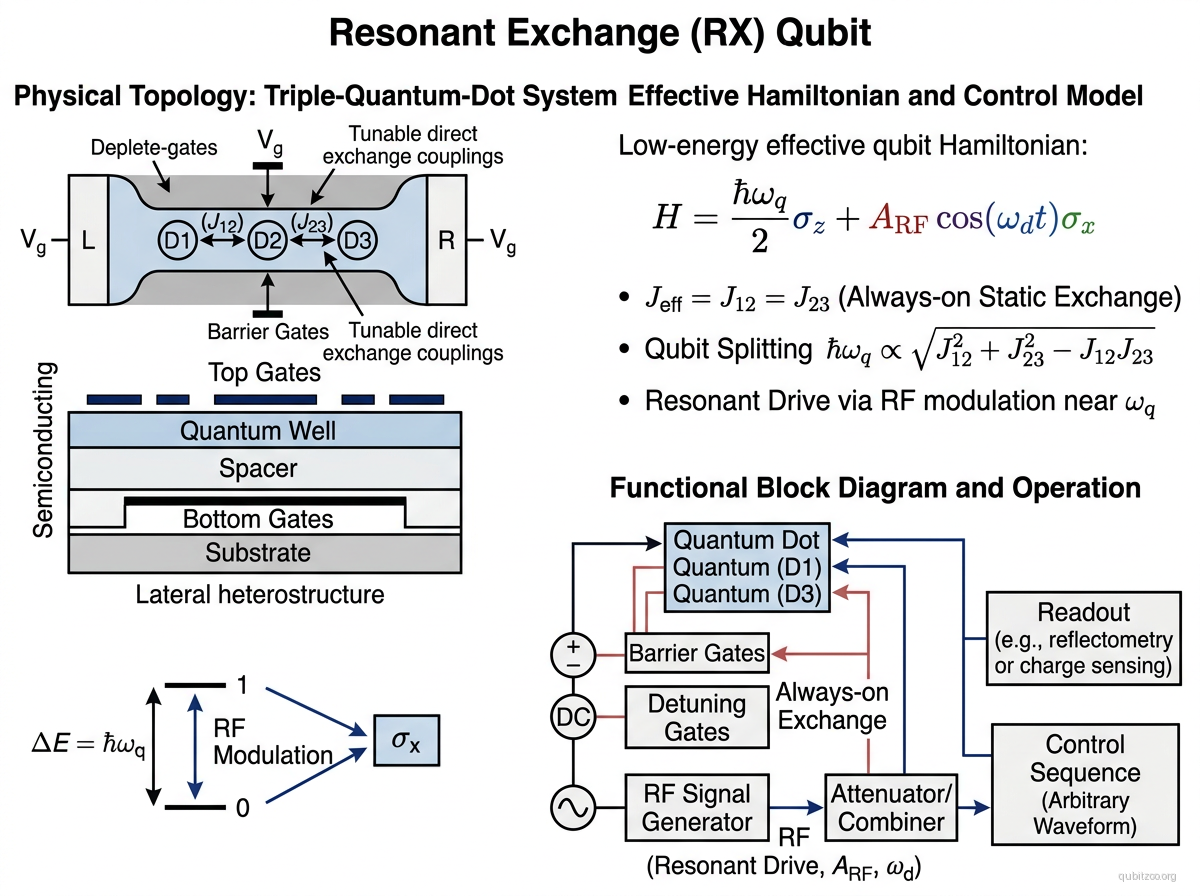
Description
The resonant-exchange (RX) qubit is a three-electron, triple-quantum-dot spin qubit operating with always-on exchange coupling and driven by resonant RF modulation near the qubit splitting. It encodes in the subspace of three electrons, using the two degenerate doublet states distinguished by their symmetry under exchange of the outer dots.
Unlike pulsed exchange-only qubits that require large, abrupt detuning pulses to switch couplings on and off, the RX qubit operates at a symmetric operating point () where the exchange-defined splitting creates a static energy gap . Single-qubit rotations are then performed by resonantly driving at frequency , analogous to electron spin resonance but using exchange modulation rather than magnetic fields.
This operating mode provides partial protection against low-frequency charge noise: at the symmetric point, the qubit frequency is first-order insensitive to detuning fluctuations (a sweet spot). The tradeoff is that the qubit is always precessing, requiring phase-locked resonant control rather than simpler DC pulsing.
Hamiltonian
Low-energy effective qubit model in the rotating frame:
where is set by the static exchange couplings among the three dots. The qubit splitting at the symmetric point is:
which at gives .
Motivation
- Preserves the all-electrical, exchange-only control advantage — no micromagnets or magnetic field gradients needed.
- Operates at a charge-noise sweet spot, improving coherence over non-resonant exchange-only pulse sequences.
- Provides a practical bridge between exchange-only and AEON-type operation for three-spin encodings.
- Compatible with resonator-mediated long-range coupling proposals for scaling beyond nearest-neighbor interactions.
Experimental Status
First demonstration — Medford et al. (2013):
- Demonstrated coherent resonant-exchange qubit operation in a GaAs triple quantum dot.
- Showed resonant driving at the exchange-defined splitting frequency.
- Observed Rabi oscillations and characterized the sweet-spot protection.
Continued development (2013–present):
- Demonstrated self-consistent measurement and state tomography of exchange-only qubits using resonant techniques (Medford et al., Nature Nanotechnology, 2013).
- Si/SiGe implementations of three-spin qubits have shown improved coherence over GaAs.
- Integration with resonator coupling for long-range interactions remains an active area.
Key Metrics
| Metric | Value | Notes | Fidelity reference |
|---|---|---|---|
| 1Q gate fidelity | 98–99.9% | Device and material dependent | Gyenis et al. 2021 |
| Qubit splitting | 1–10 GHz | Set by static exchange couplings | — |
| 2Q coupling path | Exchange / resonator-mediated | Architecture dependent | — |
| Operating temperature | 20–100 mK | Semiconductor dilution setups | — |
References
Original proposal
- J. Medford et al., “Quantum-Dot-Based Resonant Exchange Qubit,” Phys. Rev. Lett. 111, 050501 (2013)
Experimental demonstrations
- J. Medford et al., “Self-consistent measurement and state tomography of an exchange-only spin qubit,” Nature Nanotech. 8, 654 (2013)
Related review
- A. Gyenis et al., “Moving beyond the Transmon: Noise-Protected Superconducting Quantum Circuits,” PRX Quantum 2, 030101 (2021)
Linked Papers
- medford-2013-rx-qubit
- gyenis-2021-moving-beyond-transmon
- jiang-2025-sige-rx-resonator
- landig-2018-coherent-spin-photon
- medford-2013-self-consistent-measurement
Evergreen context
- exchange-interaction-in-quantum-dots — the RX splitting and control matrix elements both come from the always-on exchange landscape of a triple dot.
- heisenberg-exchange-in-quantum-dots — the Hamiltonian view makes clear that RX is still exchange-only physics, just operated in a resonantly driven regime.
- charge-noise-sweet-spot — the symmetric operating point is the whole architectural point of RX: keep exchange control while flattening detuning sensitivity.
- decoherence-free-subspace — RX inherits the exchange-only strategy of encoding and manipulating information inside a three-spin subspace that suppresses uniform magnetic-field noise.
Related Entries
- exchange-only-qubit — parent encoding; RX is the resonantly driven variant
- aeon-qubit — always-on exchange qubit with related operating principles
- singlet-triplet-qubit — two-electron spin qubit; simpler encoding, similar materials