 Qubit Zoo
Figure
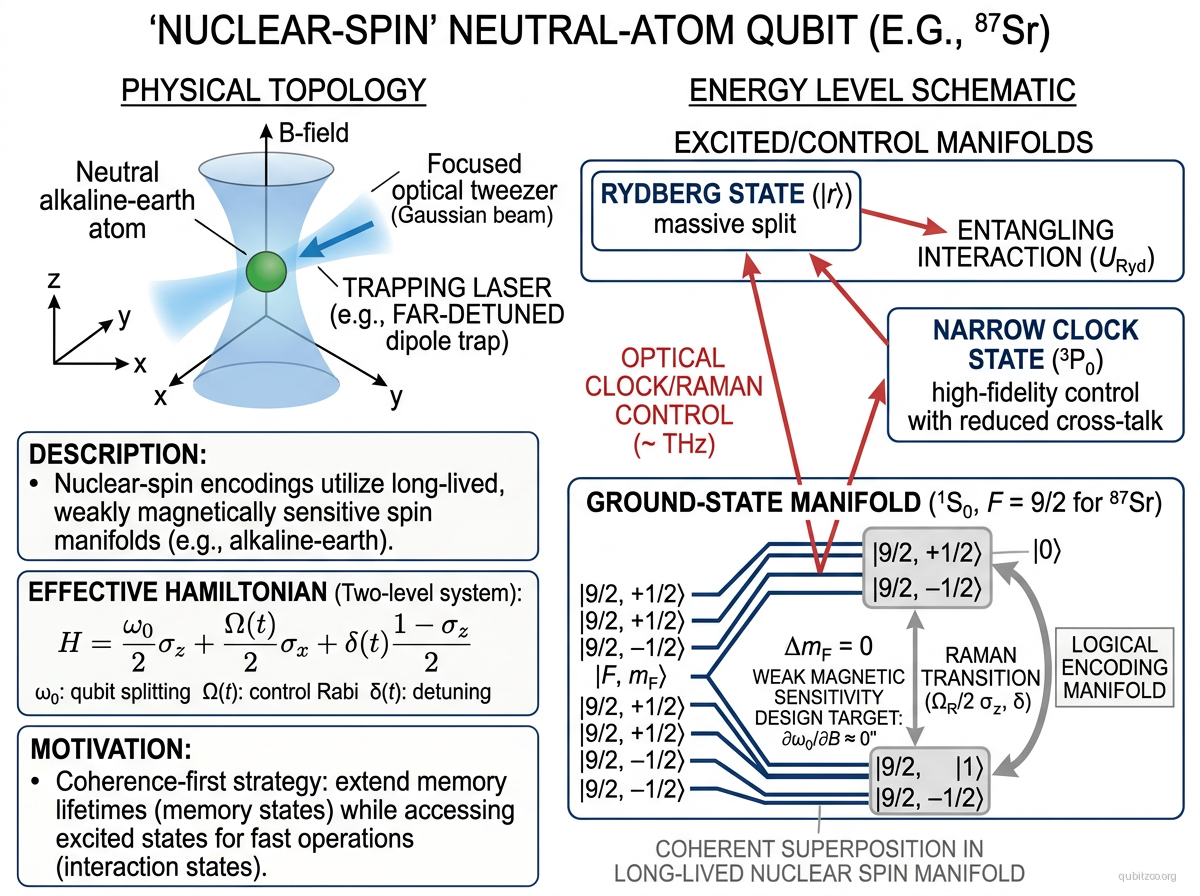
Description
Nuclear-spin neutral-atom qubits encode logical states in long-lived nuclear spin manifolds of alkaline-earth(-like) atoms such as Sr () or Yb (), exploiting reduced magnetic sensitivity and ultra-narrow optical transitions. The key idea is a coherence-first strategy: logical information is stored in weakly magnetically sensitive nuclear spin states within the ground-state manifold, while excited-state manifolds (Rydberg or optical-clock transitions) are accessed transiently for fast entanglement and control.
For Sr, the ground-state manifold provides 10 nuclear spin sublevels ( to ). Qubit states can be chosen as magnetically insensitive pairs (e.g., ), where the differential Zeeman shift vanishes to first order. This architecture cleanly separates “memory” and “interaction” roles to reduce crosstalk, and is compatible with both optical tweezer and lattice implementations.
Hamiltonian
Effective two-level encoding with weak magnetic sensitivity:
with design target at operating points, where is the qubit splitting, is the control field Rabi frequency, and is the detuning.
Motivation
Nuclear-spin encodings are a coherence-first strategy for neutral-atom computing. By pushing logical storage into weakly magnetically sensitive manifolds, these architectures can extend memory lifetimes while still using excited-state manifolds (Rydberg or optical-clock transitions) for fast entanglement and control. This provides:
- Long-lived storage with robust idle behavior
- Architecture-level separation of memory and interaction states to reduce crosstalk
- Compatibility with both tweezer and lattice implementations
- A promising route for modular networked neutral-atom processors
Experimental Status
Quantum computing proposal — Daley et al. (2008):
- Proposed quantum computing with alkaline-earth atoms using nuclear spin encoding
- Identified state-dependent lattice potentials as a key control primitive
High-fidelity entanglement — Madjarov et al. (2020):
- Demonstrated high-fidelity entanglement and detection of alkaline-earth Rydberg atoms (Sr)
- Validated the Rydberg entanglement pathway for alkaline-earth platforms
Nuclear spin coherence demonstrations:
- Nuclear spin manifolds in Sr and Yb confirmed to support long-lived storage
- Compatible architectures demonstrated in multiple groups (Kaufman, Thompson, Ye)
Key Metrics
| Metric | Value | Notes | Fidelity reference |
|---|---|---|---|
| Coherence potential | Very long (clock-state limited) | Primary motivation for encoding choice | Daley et al. 2008 |
| Gate strategy | Raman / optical-clock transitions | Platform dependent | — |
| Entangling mechanism | Rydberg or cavity-mediated | Architecture dependent | Madjarov et al. 2020 |
| Main challenge | Balancing coherence and gate speed | Open optimization frontier | — |
References
Original proposal
- A. J. Daley et al., “Quantum Computing with Alkaline-Earth-Metal Atoms,” Phys. Rev. Lett. 101, 170504 (2008)
Architecture development
- A. J. Daley, J. Ye, and P. Zoller, “State-dependent lattices for quantum computing with alkaline-earth-metal atoms,” Eur. Phys. J. D 65, 207 (2011)
Experimental demonstrations
- I. S. Madjarov et al., “High-fidelity entanglement and detection of alkaline-earth Rydberg atoms,” Nat. Phys. 16, 857 (2020)
Linked Papers
Evergreen context
- coherence-time-hierarchy — nuclear-spin storage only makes sense when the idle-coherence advantage stays far ahead of the gate-time cost
- rydberg-blockade-mechanism — even in memory-first encodings, fast entanglement still comes from temporary access to strongly interacting excited manifolds
- divincenzo-criteria — a useful lens for judging whether the memory/control separation actually translates into scalable initialization, gates, and readout
Related Entries
- alkaline-earth-neutral-atom-clock-qubit — closely related clock-state encoding
- rydberg-neutral-atom-qubit — alkali Rydberg platform with complementary trade-offs