 Qubit Zoo
Figure
Description
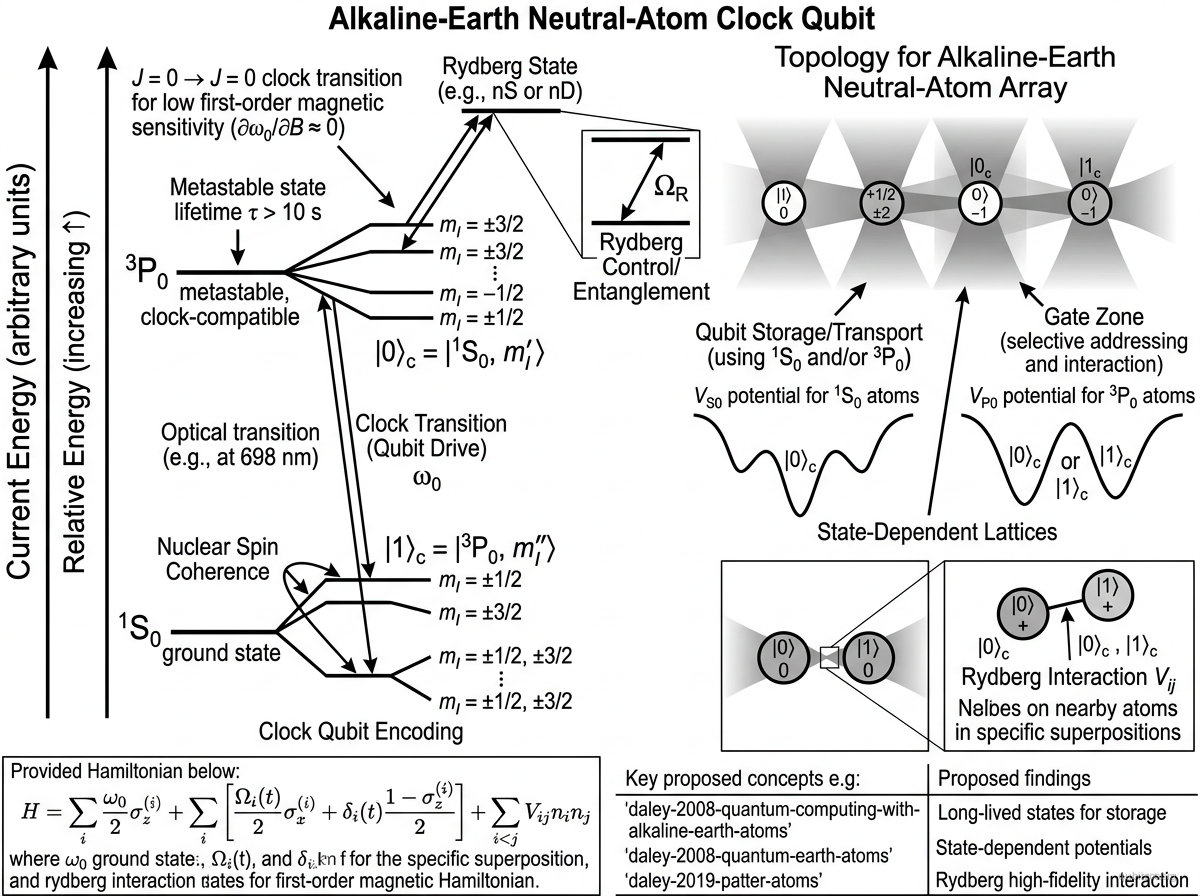
The alkaline-earth neutral-atom clock qubit encodes information in long-lived nuclear-spin or clock-compatible states of alkaline-earth(-like) atoms (e.g., Sr, Yb), with metastable electronic manifolds used for manipulation, addressing, or transport.
Unlike alkali Rydberg platforms centered on hyperfine ground states, this architecture exploits the multielectron structure of alkaline-earth atoms. The key encoding uses the ground state and metastable excited state — the same optical clock transition used in the world’s most precise atomic clocks. This transition has a naturally narrow linewidth (metastable lifetime for Sr, for Yb) and is first-order insensitive to magnetic field fluctuations:
which is the central coherence advantage over many hyperfine encodings.
Proposals use separate optical potentials (state-dependent lattices) for the and manifolds to decouple storage and control operations while preserving long coherence-compatible encoding states. Entanglement is achieved via Rydberg excitation from the state, providing access to strong interactions while maintaining the coherence benefits of clock-state storage. For Sr, the clock transition is at 698 nm; for Yb, at 578 nm.
Hamiltonian
A minimal clock-qubit + Rydberg-control model in tweezer/lattice arrays:
where is the clock transition splitting (encoding ), and are local control fields, and is a Rydberg-mediated interaction term for entangling operations.
For clock-state encoding specifically, first-order magnetic sensitivity can be engineered to vanish at operating points, providing the central coherence advantage.
Motivation
- Natural compatibility with optical-clock-grade internal states — leverages decades of atomic clock R&D
- Access to architecture-level control primitives (state-dependent lattices, narrow-line transitions) not available in simpler alkali-only manifolds
- Potential convergence path between neutral-atom quantum computing and quantum-metrology hardware stacks
- Nuclear spin encoding in states provides intrinsic protection from electronic decoherence channels
Experimental Status
Original proposal — Daley et al. (2008):
- Proposed quantum computing with alkaline-earth-metal atoms using nuclear spin encoding
- Identified the clock transition and state-dependent lattices as key resources
Architecture development — Daley, Ye, and Zoller (2011):
- Developed detailed proposals for state-dependent lattices for quantum computing with alkaline-earth atoms
- Showed how separate trapping potentials for and enable independent control of storage and gate operations
High-fidelity entanglement — Madjarov et al. (2020):
- Demonstrated high-fidelity entanglement and detection of alkaline-earth Rydberg atoms using Sr in optical tweezers
- Experimental validation of the Rydberg entanglement pathway for alkaline-earth platforms
Key Metrics
| Metric | Value | Notes | Fidelity reference |
|---|---|---|---|
| Clock transition coherence | Very long ( s for Sr) | Metastable lifetime | Daley et al. 2008 |
| Gate/control strategy | State-dependent lattices + Rydberg entanglement | Separates storage and interaction | Daley et al. 2011 |
| Entanglement fidelity | High (demonstrated in Sr Rydberg) | Two-atom entanglement demonstrated | Madjarov et al. 2020 |
| Magnetic sensitivity | First-order insensitive | clock transition | — |
References
Original proposal
- A. J. Daley et al., “Quantum Computing with Alkaline-Earth-Metal Atoms,” Phys. Rev. Lett. 101, 170504 (2008)
Architecture development
- A. J. Daley, J. Ye, and P. Zoller, “State-dependent lattices for quantum computing with alkaline-earth-metal atoms,” Eur. Phys. J. D 65, 207 (2011)
Experimental demonstrations
- I. S. Madjarov et al., “High-fidelity entanglement and detection of alkaline-earth Rydberg atoms,” Nat. Phys. 16, 857 (2020)
Linked Papers
- daley-2008-quantum-computing-with-alkaline-earth-atoms
- daley-2011-state-dependent-lattices-for-quantum-computing-with-alkaline-earth-metal-atoms
- madjarov-2020-high-fidelity-entanglement-and-detection-of-alkaline-earth-rydberg-atoms
- ma-2022-nuclear-spin-atom
Evergreen context
- coherence-time-hierarchy — the clock-state pitch is fundamentally a gate-time versus storage-time advantage story
- rydberg-blockade-mechanism — these platforms still cash out their entangling power by temporarily promoting clock-state atoms into interacting Rydberg manifolds
- erasure-error-vs-pauli-error — alkaline-earth neutral atoms are one of the clearest routes to deliberate erasure-dominant QEC rather than plain Pauli-noise suppression
- divincenzo-criteria — the memory/control separation enabled by clock states and state-dependent lattices is exactly the lens for testing whether a coherence-first encoding still satisfies scalable initialization, gate, and readout requirements
Related Entries
- rydberg-neutral-atom-qubit — alkali Rydberg platform with complementary trade-offs
- nuclear-spin-neutral-atom-qubit — closely related nuclear spin encoding approach
- trapped-ion-qubit — alternative platform with similar clock-state philosophy