 Qubit Zoo
Note: This is a category entry covering the photonic-qubit paradigm. Specific encodings and architectures have their own detailed entries: dual-rail-photonic-qubit, time-bin-photonic-qubit, linear-optical-photonic-qubit, photonic-cluster-state-mbqc-qubit, and fusion-based-photonic-qubit.
Figure
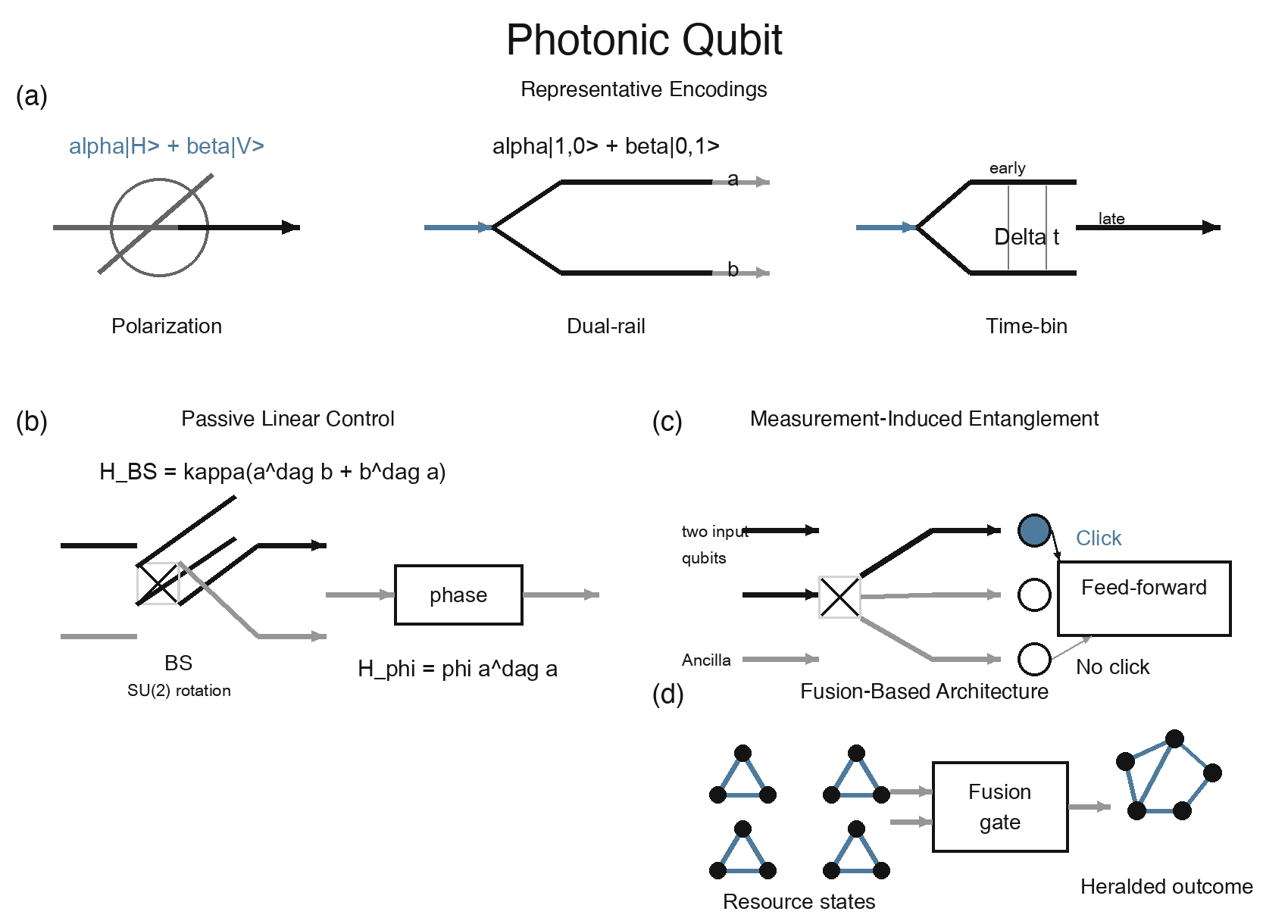
Description
A photonic qubit stores quantum information in optical modes rather than stationary matter degrees of freedom. The central advantage is that photons already behave like the communication layer quantum hardware wants: they propagate with very low decoherence, interface naturally with fiber and integrated photonics, and can connect distant modules without an explicit transducer.
That same advantage creates the platform’s core constraint. Photons are excellent carriers but weakly interacting processors. In practice, photonic quantum computing therefore splits into two separate design questions that should not be conflated:
- Encoding question: which optical degree of freedom holds the qubit, for example spatial modes in dual-rail-photonic-qubit or temporal modes in time-bin-photonic-qubit?
- Architecture question: how do we manufacture entangling power and fault tolerance despite weak native interactions, for example with linear-optical-photonic-qubit, photonic-cluster-state-mbqc-qubit, or fusion-based-photonic-qubit?
This umbrella note is the entry point when the question is simply why photons are attractive at all, before choosing a specific encoding or computation model.
Formalism and control
A discrete-variable photonic qubit occupies a two-dimensional subspace of optical modes. For two orthogonal modes with creation operators and ,
so an arbitrary qubit is . The modes may be polarization, path, time, or frequency bins; the logical algebra is the same even though the hardware used to stabilize and measure the modes differs.
Lossless linear optics is generated by a number-preserving bilinear Hamiltonian,
which implements a unitary mode transformation . Beam splitters, phase shifters, waveplates, and electro-optic modulators therefore provide deterministic single-qubit rotations. Passive linear optics does not supply a deterministic photon-photon interaction; entangling operations require measurement, ancilla photons and feed-forward, pre-built resource states, or a physical optical nonlinearity.
Photon loss maps the one-photon codespace into vacuum. When the absence is detected, the error is naturally an erasure; finite detector efficiency, multiphoton contamination, mode mismatch, and unheralded loss determine how cleanly that favorable model holds in practice.
Motivation
- Best native flying qubit: photons are the cleanest hardware for long-distance transport and chip-to-chip interconnects.
- Low transport decoherence: room-temperature optics and fiber compatibility make distributed architectures natural.
- Manufacturing leverage: integrated photonics, detectors, and multiplexing infrastructure can be borrowed from mature optical engineering stacks.
- Architectural flexibility: the same family supports communication-first nodes, gate-based LOQC, cluster-state MBQC, and fusion-based scaling strategies.
Experimental status
Single-photon polarization states were already used as a two-dimensional information carrier in the 1984 BB84 protocol. Reck et al. showed in 1994 how arbitrary finite-dimensional optical unitaries can be decomposed into beam-splitter transformations, and Knill, Laflamme, and Milburn showed in 2001 that scalable computation is possible in principle using single photons, linear optics, measurement, ancillas, and feed-forward.
Photonic qubits are mature for quantum communication and have supported integrated single- and two-qubit gate demonstrations. This does not make a fault-tolerant photonic computer mature: system performance depends on the joint efficiency and indistinguishability of sources, switches, interferometers, detectors, multiplexing, feed-forward, and loss-tolerant error correction.
Representative metrics
These rows establish demonstrated capabilities; they are not universal platform records. Values from one encoding or device should not be transferred to another photonic architecture without checking the protocol and loss budget.
| Metric | Representative value | Context | Fidelity reference |
|---|---|---|---|
| Encoding overhead | 1 photon in 2 orthogonal modes | Polarization, path, time-bin, or frequency-bin basis | Bennett and Brassard 1984 |
| Integrated CNOT logical-basis fidelity | Polarization-encoded, post-selected glass-chip gate at 806 nm | Crespi et al. 2011 | |
| Integrated CNOT process fidelity | Same device; quantum process tomography | Crespi et al. 2011 |
Scaling bottlenecks
- End-to-end optical efficiency multiplies source, coupling, switching, propagation, and detector efficiencies; individually strong components can still produce a poor system yield.
- Two-photon interference requires photons to be indistinguishable in spectrum, time, polarization, and spatial mode.
- Linear-optical entangling operations are measurement-induced and therefore consume ancillas, resource states, multiplexing, and fast feed-forward.
- Loss is advantageous only when it is reliably flagged; missed photons and multiphoton source events create unheralded logical errors.
Key questions
- Which encoding best matches the hardware path: dual-rail-photonic-qubit or time-bin-photonic-qubit?
- Is the architecture fundamentally gate-based (linear-optical-photonic-qubit) or resource-state-based (photonic-cluster-state-mbqc-qubit, fusion-based-photonic-qubit)?
- Does the dominant noise stay structured enough to be treated as erasure-like loss rather than generic hidden Pauli error?
Linked Papers
- bennett-brassard-1984-bb84-polarization
- reck-1994-experimental-realization-any
- knill-2001-klm
- crespi-2011-polarization-photonic-gates
- li-2026-experimental-tabletop-petz-recovery
- ferrari-2026-robust-ion-photon-entanglement-via
- kolar-2026-integrated-dual-resonator-architecture-for
- cohen-2026-a-heterogeneously-integrated-coupled-cavity
- cameron-2026-entanglement-swapping-across-a
- wu-2026-experimental-certification-of-the
References
- C. H. Bennett and G. Brassard, “Quantum cryptography: Public key distribution and coin tossing,” Proceedings of the International Conference on Computers, Systems & Signal Processing (1984). Original-paper scan; archival reprint.
- M. Reck, A. Zeilinger, H. J. Bernstein, and P. Bertani, “Experimental realization of any discrete unitary operator,” Physical Review Letters 73, 58 (1994).
- E. Knill, R. Laflamme, and G. J. Milburn, “A scheme for efficient quantum computation with linear optics,” Nature 409, 46–52 (2001).
- A. Crespi et al., “Integrated photonic quantum gates for polarization qubits,” Nature Communications 2, 566 (2011).
Evergreen context
- quantum-hardware — the systems-level reason photonics keeps reappearing is that it solves transport and networking problems more naturally than most stationary qubit platforms.
- erasure-error-vs-pauli-error — photonic platforms are most legible when photon loss is treated as a flagged absence event rather than forced into a generic qubit-noise picture.
- noise-bias-and-asymmetric-error-channels — practical photonic architectures live or die on whether loss, fusion failure, and detector inefficiency remain structured enough for specialized decoding.
- threshold-theorem — every serious photonic architecture is ultimately an argument that weak interactions plus enough optical redundancy can still cross a scalable fault-tolerance threshold.